Monday, September 18, 2006

Cape of Good Hope


Not sure why but arrived in Cape Town and rapidly felt better. Somehow, unintentionally retraced the Argus (that was what I was doing in Cape Town the last time I was here). Made several spontaneous stops, including Kalk Bay (spotted a whale and shared fish and chips with gulls and Nel), then waddled with penguins and Koreans (seriously, a pack of Asians descended on the Penguin festival) and then saw some beautiful sights along Miller's Point, Misty Cliffs and Chapman's Peak. Also bumped into my aunt in Hout Bay, had a longish sometimes ridiculous conversation before shooting off to the Waterfront to meet Ilze and Johan.

I felt so much better by then that I even managed to shove down 3 quarters of a an incredibly greasy pizza, and touched alcohol again. We almost watched Nacho Libre after that, but my conscience compelled me to keep an appointment with Helga, so we drove to the mountain and our old abode. Still looks, smells and sounds the same.

Honey, a replacement replacement housemate, wanted to watch TV (and snorted slightly when I incorrectly guessed that she was British), so I slunk into the kitchen to watch Helga make tea.
In the meantime she's transformed herself into a ROXY surfer.

Next morning we took in Afrikaans Celebrity life at Blouberg (or is it Blaauberg), and then worshipped briefly at the altar of shopping (at Canal Walk - continuing to expand at a scary pace).
Got F a delicious pink top (inspired by the Helga-Roxy thing) and when I finally arrived at the airport, guess whose head was first in line to poppet out at me. Dressed in red and blue and was just nice to an get all hands on HUG again.

People treated me damn well while I was away, especially in PE and CT. More good news is that all my exam marking has been given to some paid slave (who must be insane). I shouuld be done with term papers by Wednesday or Thursday and can then start focussing on the fun stuff.

Oh, and my brother has a girlfriend. Also 24. Seems to be the best age for ripe pickings.

Meanwhile I have to reschedule interviews and fetch the Cannon and Heart Rate monitor. Both were serviced while I was away. I fortunately had a service as soon as I got back.

Friday, September 15, 2006

Thank you for vomitting

How to vomit (without really trying)
by Nick van der Leek

I met Glory, a journalist from Zambia, last night. If I was a smoker I would have tentatively sucked on a ciggie while listening to her talk about Life in Lusaka. Instead, I kept popping one more morsel of food into my mouth. An olive, then a piece of salami, then a wobbly white egg, then a green onion ball (soaked in vinegar), then some cheese, then - OK, you get the picture.

I got to the pictures proper half an hour after they started, but it didn't seem to matter. Movie (Thank you for smoking) was just a diversion, and then I headed back to New House. I passed Mushy Peas in the street (outside The Rat) and, since she had her back to me, gently prodded her midriff to say 'Hi/Bye'. I happened to be on the phone too.

Then something truly awful happened. I went to bed before 11pm on the Rhodes University campus, and I couldn't sleep. Just felt *&%#ing queasy. Now imagine this: you've had one whiskey all day (so it's not about brain numbing alcholism), and you're lying in bed, and you suddenly find yourself on an express elevator - falling down. Think Virgin Mobile, but going in the opposite direction.

I wobbled, egglike, to the bathroom, and - forgive me for being descriptive here - urinated poo. Yes, urgh! (It's at times like these that the intentions of the writer making these public disclosures do become unclear - I admit it's a pertinent question: are you supposed to know this stuff?)*
What followed were massive waves of nausea, as an eggy, olivetti, pastry and onionised soup created a new brand of beer (Vomit Lager)in my gut.

Back in bed, the world began to spin, and I am not exagerrating: I thought I was going to die. I thought of crawling to reception and croaking: 'call an ambulance'.
The fugue continued, and then I got that taste on my tongue. The salty liqurice snake, coiling, and poisonous, on the back of my tongue. I flew out of bed, like Pinochio on strings, and crouched over a bin with its white plastic liner. And then my throat and stomach contracted. A small cough of air slipped out of my mouth, with the smallest croak, of pain. Then it happened again - a convulsion but no liquid voiding. It's extremely painful. If you've seen The Hole, then you know, a dehydrated person can die from basically tearing their stomach to pieces as the body attempts to pump out a poisonous swarm of bacteria infested beer.

Finally I went from crouching position to almost upright (a quick nod to the evolution of ape to man - theoretically apes spent a lot of time hungover, hence their posture). I sipped some water (conscious that some evil Stephen King bacterium might be swimming like a thin green snake, once again, into my fragile system.

This time the wave of nausea sent me scrambling to the white toilet, and my throat stretched into a moist conduit. Along this membrane, about 6 full cups of noxious beer, with clumps of you don't want to know what, poured into a new, and if my say, fairly pristine, reservoir.

I flushed the brew into the sea, and skin, prickled by cold licks of air, hobbled back to bed.

Somehow I managed to get 4 and a half minutes of sleep. I emerged this morning, only able to walk quite slowly, and all processes functioning at a decelarated rate. It still feels like a number of small cactusses are bursting internally, making me feel cold and prickly and sore headed.

Going to head back to PE tonight instead of early Saturday morning. I can only imagine how amplified the above experience would have been if I had added a few more whiskies, and The Rat and Parrot to it. The RAP is a near death experience even when the beer that is served is brewed by Heineken, and consumed - naturally enough - by Rhodents.

*My guess is I am still suffering from juvenile male teenage syndrome (JMTS), a condition characterised by boasting about grotesque achievements associated with the lower body functions.

Lighting up the dark continent

By Nick van der Leek

Day 1 at the Digital Citizen Indaba

I find myself glancing away from the keynote speaker, my gaze drifting to the delegates and speakers-in-waiting that fill the small amphitheatre-lectorium. Lots of squares of light fill the room, but not quite one for each delegate.

I have my own microsquare - a new Samsung phone capable of sending content from my hand direct to the internet. We’re armed, and our armoury consists of all this stuff: electronic gadgets capable of utilising the massive software tools and the world wide reach of the Web.

Blogging is about having your own space on the internet. It’s about individuals expressing themselves, and in the end, it;s fair to suggest that the unarticulated dream of blogging is for the world - for each person in the world - to have a voice.

Some voices, obviously, may not be as interesting as others, and that will be reflected in how much people visit their sites. But others really need to be heard: and they will be.

The great thing about blogging (and a new blog comes into existence every second - the world now has over 50 million blogs)is that the crowd no longer just reads - they can write as well. The spaces on the internet are just like real world spaces (like living rooms, or bars). The vast majority of bloggers are talking about ’what they had for lunch’ or ’what they thought of a fottball game’.

Just as on reporter.co.za (a citizen blog essentially), quality is an issue. I have to admit, if I know that some of my fairly uninformed articles are getting exposure, then just how valuable is the material on the internet (particularly on blogs). And especially, how relevant are blogs when compared to top notch stuff like the New York Times.

The power of the blog is that we can tap (and assess) the wisdom of the crowd. And contributors - especially to citizen sights - can also call out errors on articles, as frequently happens. Reporter.co.za encourages accuracy and I think most contributors are fairly rigorous about at least not having textual errors. Fact checking is less simple.

Interestingly, a lot of citizen media has come about because of blogging (not the other way round). I have found, for example, that all much of the time I spent blogging is now being diverted to reporter.co.za. In some ways I think this is good and encouraging (I get more exposure), but in other ways, it’s also not exactly what blogging is about. Blogging is sometimes being brutally honest and personal about issues personal to ourselves, and sometimes we have a specific (rather than mainstream) Joe Public in mind. The other issue is that blogging for money is different to blogging for the love of it (or out of brutal necessity, or even activism).

What we are seeing is radical changes going on in the internet. And that’s exciting.
Now we all have the ability - as Dan Gilmore wrote - to ’commit acts of journalism’. We can all be contributors on a level playing field, and that’s something new and radical in world that has become increasingly flat.

All of this is good news for Africa.

Thursday, September 14, 2006

I Have This


This handset it 12.9mm wide, and has a 3megapixel camera. It's really like a little magic box, because you touch something and yellow circles flame on the screen. After using the most basic Nokia model, this handset feels like I've been beamed up into the Enterprise. The LCD flowers with beautiful color, and instead of irritating beeps, a trickling piano melody woke me up this morning.
Some nice touches, like the camera - Thanks, but I think I stick to my Sony 7Meg camera for the photos.

I've taken some nice shots of the conference so far. So far I have this sort of buzzing headache from information overload. I want to take a picture of Mushy Peas - who is quite a hottie incidently. I think a cigarette between her lips (freshly painted in shiny red lipstick) ought to work, without giving away exactly what she looks like.

Some very interesting information and also I've also jotted down some interesting websites and blogs that I would not have known about otherwise.

I think I am going to watch THANK YOU FOR SMOKING tonight. Not sure if I can handle another night of second hand smoke and alchohol fumes. It's the noise - it reminds me too much of the mayhem of teaching.

"We all have the ability to commit acts of journalism" - Don Gillmor

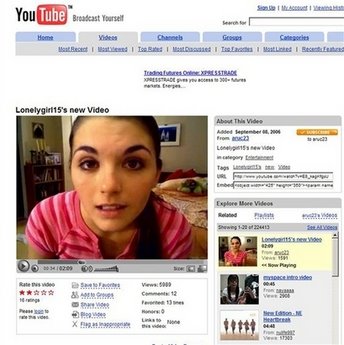
The Lonelygirl15 Mystery


By GARY GENTILE, AP Business Writer
Wed Sep 13, 12:49 AM ET

LOS ANGELES - The creators behind the Internet video mystery teen Lonelygirl15 have revealed themselves and want their fans to know they are not a front for a big Hollywood studio marketing some upcoming film.

Instead, the three friends launched the adventures of the doe-eyed, 16-year-old homeschooled "Bree" as an experiment in storytelling that they intend to continue on their own Web site that was launched Tuesday.

Bree's inventors went public after fans of the two- to three-minute videos began questioning her existence and expressing disappointment that the seemingly genuine video diaries were a hoax.

The creators identified themselves to The Associated Press as Miles Beckett, 28, of Woodland Hills, Calif.; Mesh Flinders, 26, of Petaluma, Calif., and Greg Goodfried, 27, of Los Angeles.

Beckett, a self-confessed Internet geek, said he came up with the idea of using short videos as a storytelling technique while a surgical resident. Earlier this year, he met Flinders, a fledgling filmmaker, at a party.

Flinders said he had been developing the character of a teenage girl who was more at home relating to adults than with her peers. The character never quite fit into any of his screenplays, but seemed a perfect fit for Beckett's idea of telling stories using video blogging.

The two joined with Goodfried, an attorney, recruited the actors to play Bree and her dorky boyfriend, Daniel, and began writing the broad outlines of an open-ended plot filled with the kind of mysteries and clues TV watchers know from the hit ABC show "Lost."

The short videos began appearing on the Web sites YouTube and MySpace in June. The creators said Tuesday that they never intended to stage a hoax or trick people into believing their characters were real.

Rather, they intended to begin posting elements of the story online and then incorporate reactions and suggestions from fans into the plot.

The result was part video game, where viewers exercise some measure of control over the characters, and part mystery novel, complete with hidden clues and cliffhanger chapters that left viewers wanting more.

Flinders writes scripts for each "episode" and the actress playing Bree delivers her lines with a persuasive power that still has some online viewers believing she is genuine, even after "The Creators" posted their online confession several days ago.

The three creators declined to identify the name of the actress Tuesday. But amateur Internet sleuths discovered she is Jessica Rose, a 19-year-old actress from New Zealand who recently moved to Los Angeles.

The revelation that Bree was fake initially angered fans on YouTube, who suspected Lonelygirl15 was a slick Hollywood attempt to advertise some upcoming movie or TV show.

But since the creators revealed the fictitious nature of the show last week, the number of people subscribing to the Lonelygirl15 channel on YouTube has skyrocketed.

"Just because I know a movie isn't real isn't going to stop me from watching it," Alexandra Inman, a 17-year-old fan from St. Louis, said Tuesday. "I'm there for the entertainment."

Bree's adventures will continue on a new Web site created in conjunction with the online syndication network Revver. The company helps video-makers profit from their efforts by attaching ads to each video, then burying a "tag" in the computer code that tracks where the video is posted. Revver then shares the ad revenue with the authors.

As far as what happens to Bree next or just how long "Season One" will last, the creators themselves are unsure. Stay tuned.

from: www.yahoo.com

Digital Citizen Indaba

It's cold in Grahamstown, and I am still recovering from smoke inhalation and one whiskey too many.

Last night I met delegates and speakers in the legedary watering holes (like The Rat) dotted around Rhodes University campus. I also met a Dutch woman (I'll remember her name in a minute) who represents one of the sponsors of the conference.

Many of the delegates are bloggers - people who actively write and update their web logs on a daily basis.

We're here to talk about New Media, and blogging is just one of the topics under discussion. It's been interesting listening to the articulate opinions going round. I also heard a new term last night: Splog. It's a Spam Blog (filled with pieces of everyone elses blogs!)

Another interesting person I've met is the writer of a blog called Mushy Peas on Toast (http://mushypeasontoast.blogspot.com/), an award winning blog by its mysteriously invisible writer.
If you visit her in bloggerspace, be sure to wish her a happy birthday.

I hadn't even heard of Mushy Peas until arriving in Grahamstown, and there has been an almost celebrity vibe surrounding her. She's asked us not to reveal too many personal details - she's given her name - but I'm not sure if I can repeat it here. Have a look at her blog to see what all the fuss is about.

Meanwhile, I am attending the first of two days at the Media Africa Matrix, and will report on what is interesting.

I've also asked Mushy Peas, over breakfast, for an interview, so watch this space.

Wednesday, September 13, 2006

Memory Loss and Near Death


On Monday night I was about to pedal towards a green traffic light when a truck barrelled in front of me - missing me by the width of the wind slipstreaming alongside it.

Also discovered in PE, that the R350 memory I bought at Kloppers had picked up pouch climbing, because it found a way out of my camera pouch. Will be in Grahamstown from now on and might be quiet for a bit.

Mixed messages

go!

Hi Nick

Could you please send me an invoice for your story? We'll pay R2500 (for words and pictures all in). Please send us your banking details as well as ID No. and address.

Many thanks,
Andrea


Andrea Weiss
Deputy Editor: Weg/go!
Tel (021) 4171155
Cell No 0829205993

YOUR JOURNEY STARTS HERE

SHAPE

Thanks, I managed to open it. Please let me know if you have a positive response regarding any “snapshots” taken.
I have e-mailed the website and am awaiting response from them. We are going to print early next week, so we are pressed for time, unfortunately if we don’t have pictures for this article by next Monday we wont be able to use it. Please let me know how things progress.
warm regards

STEPHEN WOLF . DESIGNER & PICTURE EDITOR. SHAPE MAGAZINE . SOUTH AFRICA .(021) 4083914

Hi Nick,
No, I've just received pictures. Plse can you send the text.
Thnks
SONYA NAUDE

EDITOR, LONGEVITY MAGAZINE

Tel: 011 280 5418/35
Fax: 011 280 3860
Mobile: 082 377 1219
Email: naudes@johncom.co.za

LONGEVITY - THE POWER OF HEALTHY LIVING!


Quintiles:

Howzit Melda
Caroline called me this morning at about 9am asking me to come for a secondassessment. Unfortunately I had to catch a flight to PE (departing10:50am) so was unable to make it.I will be here until the weekend, so would appreciate an opportunity to dothe assessment next week. It's important for me to pursue this opportunityso I hope you can make an exception for me.

Thanks
Nick

No problem, we'll slot you in when you come back.

Regards
Melda

DCI

Dear Delegates,
As the countdown to the DCI begins, we have a couple of important announcements to share with you.

Firstly, Rhodes University abides by The Regulation of Interception of Communications and Provision of Communications-Related Information Act (RICA) which in our case means that they won̢۪t issue any anonymous Internet logins. The agreement we have come to is that each delegate will receive a temporary account to access the University WiFi network and computer labs on the condition that an End-User License Agreement is signed and a copy of your ID book or Passport is presented at the registration desk. It would therefore be greatly appreciated if you would come prepared with the later in order to speed up the registration process.

A map and details of where and when registration will take place have been placed on the DCI homepage (http://dci.ru.ac.za). In addition to receiving your conference badge and Internet login, you will also be able to sign-up for Friday’s workshops and participate in one of the exciting ‘Speed Speaking’ sessions taking place after lunch.

We have setup a conference Wiki (http://dci.ru.ac.za/wiki) where speakers will post their notes and resources and a summary of each panel for anybody who wanted to attend but couldn̢۪t make it. There is also a conference Blog (http://dci.ru.ac.za/blog) which will hopefully capture the DCI in true blogger fashion.

I wish those of you who will be travelling in the next couple of days a safe trip and we look forward to meeting you in Grahamstown later in the week.

Sincerely, Colin Daniels

DCI Coordinator

Image courtesy topleftpixel.com

"I experience a period of frightening clarity in those moments when nature is so beautiful. I am no longer sure of myself, and the paintings appear as in a dream "

- Vincent van Gogh

Feeling Switchy


Number portability kicks in next Monday

Tired of your cellular network operator? On September 18, all subscribers will have the option of changing networks, whilst maintaining the use of their original cell phone numbers. The UK have enjoyed this privilege since 1999.

Studies have indicated that about 20% of subscribers would like to switch networks, but only about half that number will go through the rigmarole. It is likely to be a one-off fee of R75, but it’s not necessarily going to be cheaper to change networks.
Here’s why:

It’s important to remember that if you change networks, and your number remains the same, other callers thinking they are calling network to network (intranetwork) actually are not.

The real value of number portability is by consolidating groups onto the same networks. This means that a family (or business) who was originally on a number of different networks can agree to join the same network. There will be real cost savings involved here if most calls are done between the members of this group.

Number portability is likely to benefit the smaller networks (such as Virgin Mobile/Cell C, and MTN). Vodacom, with the largest subscriber base, is likely to lose relatively more subscribers than other networks.

One Crazy Canadian


About a year ago I was on my bike and my companion (also on a bike) casually suggested cycling across Canada. Having done 3 1000km cycle tours in South Africa, I thought my friend (who hadn't cycled more than 100km at a time) was naive, to say the least. Today, after 3 months of virtual silence, I heard from him again:

I* have safely completed a coast-to-coast bicycle ride from Victoria B.C. to St-John's N.L. The complete distance was 8929km, and that included the Gaspe Peninsula the (very hilly) Cabot Trail in Nova Scotia,and the complete island of Newfoundland.

I lost 17lbs, with some of that gut going down to my legs ;-)
It took me about 79 days(including 20-25 days off) to complete.
I wore through 3 tires, 1 rim, 1 seat post, 5 flat tires, 2 pair of gloves, a pair of shorts, 3 chains, and many layers of skin from my butt!!

I feel great with no serious side effects from the ride, sore knees being the worst thing. I met some fantastic people along the way, giving me a new and rejuvenated feeling about Canada and Canadians.

I cannot thank my family and friends who helped me and friends who showed interest before, during and after the trip.

*David Glashan - I met David in South Korea and did a couple of wintry cycles along the cement paths that snake along the massive Han River through Seoul.

Tuesday, September 12, 2006

Excerpt out of Sons and Lovers


Lawrence begins by sketching his own description of the universe that surrounds us all. He describes our human will as great horizontals; unfolding fields of land and sky, while the soul is depicted as arches, repeating as life after life leaps across the horizontal space. And then the divine: a vertical, perpendicular space governing the space below. It is in these broad dimensions that he places Paul and Miriam.

Paul had compared himself to a Norman church and Miriam to a Gothic cathedral. By doing this he communicates how convoluted (sometimes even ugly) Miriam is to him, but also flatters her that she might find ecstasy (with her fingertips reaching into the heavens like a steeple). Paul meanwhile identifies with the dogged, struggling, repetitive attempts of the Norman arches to reach something, to persist in his desire-filled fumbling even without a clear strategy or direction. It is perhaps a strange pair of ideas to suggest, but given Miriam’s religious mindset, perhaps Paul has made a desperate effort to reach her in terms that he feels she will best understand.

Lawrence creates his intended effects by adding details to the ‘sweeping shore of sand’. It was warm and sandy, and soon, dark and still. The sea is also a soothing presence: foam hisses softly and water whispers. Now Lawrence uses light and shadow to create perspective and depth: the moon rises over land and sea (once again a trinity is expressed). This moon is orange, and enormous. The moon represents Paul’s passionate soul: when his blood bursts into flame the moon’s appearance does too.

Juxtaposed beside this theorizing is the reality of two young people walking on a balmy evening on the sand beside a beach. He feels a flame inside of him, but her face is dark and brooding. Despite the fire inside of him, he cannot make a light in her. He feels impotent when facing her impenetrable piety. He feels humiliated and ashamed, and finds feelings of hatred and dislike rising inside himself for her. His feelings of love and lust transform quickly into shame and fear. Her fear resonates in him making him feel hesitant and unnatural. It is interesting to see how powerful emotions can be so easily colored into their opposites.

Now, contrasted against this pleasant and sensual environment, is Paul’s humiliation, like death. Paul is natural and free, and sensitive, but also filled with the passionate lust of a young man. It is not necessarily immoral – it is a natural need to engage one’s desires, and Miriam’s thinking and analysis are the killers of his romantic impulses. He wants a practical physical experience with Miriam, but her religious dogmatism makes this impossible. For her intimacy is in the abstract understanding and communication of it, which, understandably, constantly frustrates and interrupts Paul’s desire and physical momentum.


The moon, suspended over this picture, first waxes, then wanes. It appears enormous and orange initially, but one imagines by the end it has become silver and small. The moon that draws the tides, demonstrates the immense forces at work in Paul, and first making his waters roar and then crawl quietly ashore in shame.

Paul, who is natural, free and impassioned, finds himself stuck in Miriam’s fear and hesitation. The darkness Paul sees in her embodies his confusion. She wants a theoretical knowledge of the world – she wants to look at the world, not touch it. Paul wants the full experience. This conflict, this stalemate, is a source of profound pain for Paul.

There is the sight of the land, dark and still, and the sound of the sea, whispering. While they walk on their path, the shape shifting moon hovers over them. Their path takes them on their road through the universe towards a yellow light in a cottage. It a place where Paul hopes to find comfort, a home for his heart. But in a moment the light of the moon has changed, and the house on the hillside is no longer a home.

Kunstler: Glandular Energies

Sept 11, 2006 This was the day five years ago that war began between the US and Jihad, an unincorporated combine of Islamic nations, gangs, sects and tribes united in a campaign to harm, disable, defeat, and exterminate "infidel" Christians and Jews. There are various explanations for why this started. I have my own.

It's essentially an ecological crisis, conveniently pegged on an old religious beef. The population of many Islamic nations, fed by oil wealth, has reached critical overshoot. In particular, there are too many young men with no positions, no incomes, no prospects, and no hopes. Their glandular energies have been enlisted to act out the righting of real and imagined grievances against their"infidel" enemies. Their actions range from the sheer sadistic thuggery of small gangs to the strategic geopolitical maneuvers of major nation states.

We will be fighting with them for as far ahead as anyone can see, because our society can't function without their leading (in some cases only) resource, oil, and we are used to getting regular supplies from them. To aggravate things, the world is in a peculiar situation with this resource. The shorthand phrase for it is "peak oil."

Peak oil means that the oil-producing nations have reached their all-time maximum output and now face a certain relentless decrease in this resource and the wealth derived from it. This is especially problematical in a global economy based on steady incremental growth. Peak oil promises only incremental contraction in everything from industrial activity to available food. The people of the world will fight over what's left and they will divide into teams to do this. Right now, two teams facing off in the arena are the US and Jihad. Perhaps a few years from now Team China, Team Russia, Team Europe, and Team Japan will jump into the contest. Anything can happen now. Peak oil has the capacity to drive the world crazy. It is certainly driving the US crazy. Last week, Chevron announced the discovery of a major oil "play" in the Gulf of Mexico, a collection of deep-water fields code-named "Jack." The announcement was uniformly greeted by the news media with headlines that said, in effect, ENERGY PROBLEM SOLVED.

There are reasons to be unpersuaded. Chevron's "Jack" has been estimated to contain as little as 300 million barrels and as much as 15 billion barrels of oil. Nobody really knows yet. It will be years before we find out. During those years, production from the other oil fields of the world will decline by an amount that will cancel out any purported gain from even the best estimates of "Jack." The world uses about 30 billion barrels of oil a year. The US alone uses about 7 billion.

The oil from "Jack" will be expensive and difficult to produce. It is more than a mile underwater and another four miles under the rock under the water. It will require a lot of pipe and a lot of pressure to move that oil up, and the seabed in these deep-water operations is too far down for pipelines, so the oil will have to go directly into tankers. If oil's future is in deep-water, then its future is expensive and precarious.

It was interesting to see the price of oil on the futures market plummet down into the mid $60 range last week. I take two conclusions from that. One is that the psychological stress of peak oil has increased the emotional dimension of the trade to a dangerous degree, i.e. driven the traders crazy. The intense wish to solve the energy problem has momentarily overcome the reality of it not being solved. The second is that the US economy may be in greater trouble than the news media realizes, especially the economic "engines" of "home" building, real estate sales, and the associated mortgage rackets, with their spin-offs in the financial markets. There may be a hell of a lot fewer 18-wheelers shlepping chipboard and sheetrock around the nation this fall, fewer family trips to the WalMart, fewer Di-tech Mortgage customers dredged out of the sub-prime muck, and fewer bundles of interest-only ARMS passed through to the hedge funds.

Thus we would have a profile of exactly what oil geologist Colin Campbell and other peak oil opinion leaders have predicted: roller-coaster-style economic activity pegged to up-ratcheting oil prices, with increasingly deep economic troughs and ever higher oil price peaks. In short, massive economic instability.

Meanwhile, in the deep background of all this looms Jihad. We will have to be resolute in the face of Jihad and much more adaptable at home. So far, on the home front we have done nothing but defend and rationalize a stupid mode of existence -- suburbia -- and an insane economy based on building more of it -- the housing bubble. We have no leadership in politics, business, science, news media, or education informing the public that we have to make other arrangements for daily life -- not ten years from now, but right away.

Five years after 9/11/2001, the "progressives" want to wish away Jihad and the "conservatives" want to wish away the need to change daily life in America. Real political leadership, if it emerges at all, will have to come from some place off the normal political scale.

Monday, September 11, 2006

5 Year Plan


This looks like JM Marie exiting the Water Matrix, and entering our world.

While invigilating I came up with this:

2006 (October):

Write: Philippines story, paper on Mrs Dalloway (Virginia Woolf)
Coaching (assistant to Simon Gray)
Proathlete - spending most time training to win local cycle races, and gradual preparation for Ironman next year
Also work for local student paper (Irawa) and continue to submit material to the bigger publications.
More focus on newspapers like The Star

November/December - Mozambique/Swaziland/learning to surf JBay

2007: Argus, Ironman (serious attempt to qualify for World Champs), Comrades, World Champs in Hawaii
From Hawaii to Alaska/Amazon
Study Masters in English
Teaching English at university/some coaching

End of 2007-2008: Japan/Taiwan - teaching (to recoup dollars spent in Hawaii)
Olympics

2009: Work on non fiction Energy book: HIGH AND DRY and begin work on fictional version: THE CASTLE (Study Honors in English - Journalism)

2010: Soccer world cup - work as tour guide? Surfing?

2011 and beyond: marriage, start an energy farm (something like in Star Wars), sell bike to pay for trip-into-outer-space. Hang on, what will I really do in 2011?

Coup


I managed to survive 3 days in prison. I managed this partially by breaking out twice, both times for a cycle - oh, and I also went to Euro Cafe to soak my brain in a small cold glass of J&B.

My relationship with the students seems to be improving. Possibly because - with the end in sight - I've become a lot more lighthearted and jokey.

Today I heard that I won't have to mark BE exam papers. Consideration because I am going to a conference for a week, or lack of trust? Who knows? I do know the computer course which was touted as ADVANCED was just a roadtrip through the internet and MSWord, so it would probably have been pretty dull. Glad I unintentionally missed that.

As I said I got two excellent training rides in over the weekend. Just like last term, in exam time, I find myself fighting off some kind of infection. Just need a good night's sleep tonight, and I think a week at the sea and being observant (in new surrounds) should stave off the bug attack. I think I am in dire need of a bunch of fruits and vegetables. (Over the weekend I ate a pile of chips and downed a few litres of soda pop - not good. My boep now weighs about as much as a bowling ball.

Cycled 63km on Friday and 82km yesterday. Since I had to squeeze both workouts in I'm quite happy I went as far as I did. I trained a total of just under 8 hours last week, which averages to just over an hour a day. Want to build - from here - on these totals.

Shape has been calling and emailing for pictures (which I don't have) of Eco Primal Quest. The actual competitors doesn't know what high rez means, and the website photos are apparently unusable. Wonder whether this will be sorted out by the end of the week.

I'm looking forward to being airborne again, and even more, being covered in the hiss of seawater.

Image above is Jean Marie Neethling

Friday, September 08, 2006


Above: These are the guys I cycle with on Sundays. Jacques Greef, in front, is one of the Free State's top riders. He sometimes also cycles with a Spinergy in front (as I do), but didn't today. I took this photo on my way back from Clocolan early Sunday, then raced home to change and joined them on the climb up Lucas Steyn Road, through Heuwilsig.

The Lore of Swimming


Get into the swim of things

Summer’s coming, and by the time you’ve finished reading this article, you’re going to want to swim in a pool. There, I’ve warned you.

I know what you’re thinking. Swimming is a bit of a misnomer, right? In fact, swimming is as natural for us as it is for otters. We start life as sparks swimming in a see-through soup. And in this amniotic soup we grow and multiply until we burst into the world covered in bloody slime. Then we slurp up some white liquid. Meanwhile our bodies are 70% water and waitaminute, the body of our planet is 70% water too. What’s with that?

If you’re still not convinced, let’s go into the folklore. Let’s look at the terms we use: Sink or swim. ‘Swim’ is an epithet for living.
Going against the flow. ‘Flow’ is the flow of life, the forces of nature.
The Ocean of truth. The ocean symbolizes the immensity of subconscious, and that we can swim in it, and that it can swim through us.
Born again. This implies, well, when you think about it literally at any rate, that we are re-liquidised into amniotic fluid and birthed back into the world, simple and fresh, shining and new.
Fishers of men. This implies that men must be ‘fished out’ the ocean of their truth.
Drowning in work. This is a negative epithet, but we’re only drowning if we haven’t mastered the skills to stay afloat, to surf the waves.
Surfing the internet. It implies an effortless motion along the leading edge of information (and technology), driven by the rising tides and truths of the ocean-universe.
Walking on water. The implication that one has achieved mastery over all things.
People are also capable of the following:
Making waves. Gushing. Storming off. Wet kisses.

We notice that something is:
A drop in the ocean.
Or someone is:
Wet behind the ears
Or something has:
A ripple effect.

This is because life is fluid. DH Lawrence captures the essence of this by writing about the fluid relationships that we see in life. Some of it washes and mixes, and some of it spreads over dry sand and dries.

The psychology in swimming training is powerful for our era. There is plenty of monotony in the sterile bathroom environment. We can easily be dazzled death by the bouncing arrays swining and swooping around us. There is the crash of arms in the water. If our motion is unconscious, and for every single wingbeat, every kick done in ignorance, we catch our wingtips and our toes on a sharp triangular edge of water. It slows us down, it wears us down. But if we’re conscious of our technique, aware of the angle of our elbows, the entry of our fingers, the pull of the wrist, and feel of the water, we begin to move effortlessly and powerfully. We can feel the pressure of the water over skin – a signal that we are moving fast through the water.

In the process of doing endless sets, the body yearns to be dry and warm. And yet the dedicated swimmer completes each session, endures each session with all its discomforts, and emerges, through grit and discipline and determination, when the job is done. The swimmer doesn’t react to each impulse to escape his discomfort, his loneliness, his cold environment. And herein lies the secret: the swimmer has an incredible workethic, and tends to outlast all those around him because he knows how to do the work, and knows he can simply work harder and longer and those around him. Outwork, outlast.

And after all this time in the water, the subtleties emerge. The flow through the water is perfected. The body grows lighter and the skin tighter. The body is able to whip quickly through the silver. Sometimes there are flashes of flying, or bright skies filling the eyes, crashing childhood recollections suddenly into place. In the end, the water carves the body: Softly making it hard, quietly making it tough, and brown and strong.

The breathing is primeval. The movements might be from a dream, or inklings from time in utero. The light and arms and waves and water come together to produce a music of motion. Practise makes the crashing cacophony into music and much later, after hundreds of hours, after the hundred cold shower, the body moves as a symphony of light through a silver sea.

The Lore of Swimming, in the end then, is about having the resilience and temperance of steel. To swim means to thrive in the clear sparkling waters that crawl and dance under the sun.

Thursday, September 07, 2006


Rush hour in Clocolan.

de TERMINATION


There is magic in the water, and that's where I need to be. I've been kicking through the dusty desert for far too long. Well never mind, on the 4th I received a beige brown envelope and in it a short message on the Brebner letterhead. Just an officious statement to say that work (pay really) won't continue beyond this month. Reaction? Ambivalence.

That has turned to relief and even flights of happiness.
Today I was thinking about flying to the Amazon and staying in a camp with Natalie Seddon (a doctor of Zoology who studied at Cambridge). What better place to experience the fullness of life. Do I dare to provide the other half of that sentence. In our TUT today, on Waiting for the Barbarians we discussed the real possibility of the ending of the Empire. It's imminent, and it;s likely to be associated with a holocaust. Each day that it does not happen is a day to be treasured. And I wonder whether it is not the best place to be spending these days in forests teeming with soon to be extinguished life. To see the sky filled with parrots, the soil thick with leaves and worms and monkeys and snakes.

I'll be moving out of my slot in the Circus that is Brebner hostel by the end of this month. My training will go up a gear, and I will be able to dedicate myself to my studies and more particularly to my writing. I have 2 immediate job offers, one from a Chinese school and one from Quintiles. I would really prefer to be a free agent for all of October, but then I suspect that might be the beginning of a long jobless summer.

Learn to surf in Bali, or Jeffrey's Bay and write about it.? Go on a tour of Swaziland (somewhere I have never been), or Mozambique, or Kozi Bay, or some desert backwater.

I have piles of tests and projects to mark, and the deadline is much earlier this term. I've also been told today that my name was not copied from a handwritten list to a typed shortlist for advanced users (I am probably the most advanced person at the school in terms of computer literacy). But never mind.

After this weekend I will be flying from one coast of the country to another and it will all be behind me. Now to embrace what is right here, before me.

A braai on Saturday night and delirium in between.

Wednesday, September 06, 2006

A trip down 7de Laan

Why is this soapie so popular?
by Nick van der Leek

Soapies, as part of modern media culture, are very popular. So what are the ingredients of the more popular soapies? The answer lies in the ideology behind these soapies, and the degree to which they reflect or cathect with the modern (and often beleaguered) television audience.

7de Laan is the most popular soapie in South Africa. Interestingly it is nothing like the dozen or so soapies out there that explore contemporary themes such as good versus evil (Generations), or tackling relevant social issues (Backstage). These soapies are about conflict and drama. 7de Laan presents a utopian community, a coffe shop scenario that unfolds with a fairy tale quality which appears to meet a very specific need in audiences: the need to escape, but it is beyond mere escapism. It is a pleasant mixture of feel-good entertainment and light-fantasy. 7de Laan works because TV audiences want a break from bad news and heavy melodrama. The modern audience it seems (certainly in South Africa) want positive and lighthearted escapism.

In 7de Laan the assumption is that people drink a lot of coffee, and seem to spend most of their lives in coffee shops! 7de Laan presents a utopian South African scenario, where all races seem to seamlessly merge with one another, and the more pertinent questions are not race based, but centre around the forces of attraction and family relationships between the characters.

Another assumption is that someone who is blind can easily regain their sight. A blind blonde girl and a sensitive sweet man with a scarred face form a distinct dyad in 7de Laan. The people who seem most likely to win a contest do, although a little intrigue is thrown in to keep things interesting. There is also an assumption that internet dating is okay, a perfectly reasonably way to meet people. Finally, the maid in a household of some particularly old and peculiar people seems perfectly happy working where she does, and they have a relationship that seems like ‘couple and familiar guest’, not ‘employers and employee’.

The assumption that blindness can easily be cured brings about a ‘wish fulfillment scenario’ which may capture the interest of people who might be unhappy with their reality. This obscures the obvious reality that a) the person she can’t see has a terrible scar across his face and b) this person finds her (the blind girl) attractive even though she is married. There is also the distortion that racism in South Africa does not exist.

The power relations are quite subtle in 7de Laan (unlike many other soapies). The owner of the coffee shop has more power than most, and to an extent, the husband of the blind blonde woman (Dezi) also has power (over her, preventing her from doing what she, perhaps, wishes to do), but this appears to be a limiting, frustrating kind of power, almost an oppressive power. Negative aspects that are excluded have been referred to above: the atmosphere in each episode presents an absolute absence of racism. All races seem to get along perfectly, and other issues (jealousy, love, insecurity, desire to win something, desperation) take centre stage.

The blind Dezi and her guitar playing friend (played by Chris Chameleon) puts the blind girl in a privileged position (based on her beauty) and the guitarist lurks around in the shadows (as a sort of beast).

The poor (as a group) are ignored, and there is very little serious stuff to disturb the utopian mindset. Aids is not mentioned (as it is in Backstage), and racism is virtually non-existent. Also, serious infidelity (adultery) is hinted at but rarely plays out. This is possibly because the audience of 7de Laan is a conservative Afrikaans one with fairly high moral values.

Interestingly, it is not only the Afrikaans segment that appears to enjoy 7de Laan. African High School students (ages 14-16) when quizzed demonstrated high levels of interest and enthusiasm, predictably for Generations (63 votes) and Isidingo (46 votes), but a large proportion were very enthusiastic about 7de Laan (41 votes). The Lab and American soapies reported far lower levels of interest, which goes to show the power and impact of socially relevant (or essentially cathartic) TV content.

It’s also interesting to note that while 7de Laan is a sort of melting pot of coffee slurpers, the Asians are completely left out of this mixed race utopia.

The Dezi-Guitarist binary is a fairy-tale like depiction that elicits mythical themes out of Phantom of the Opera and Beauty and the Beast. Oubaas and Hilda also present an almost idealized pair of ‘grandparents’. Their precious epithets (especially from Oubaas) are a type of sentimental crooning that is somehow sweet and disarming (rather than cheesy or saccharine).The coffee shop is also a very mythical place. Everything seems to happen there, people arrange to meet there and there seems to be only one restaurant and 1 coffee shop in 7de Laan land. There are also no real interlopers – strangers passing through as we encounter in real life.

The style of 7de Laan is very homey and safe. The context of a coffee shop also presents a harmless environment for a utopian scenario to be set out. Much of what happens is not earth shattering. Dezi recovering her sight is not a significant or socially relevant moral challenge. Much of the style supports this feel-good formula, and the content often focuses on food, and indulgence, and wish fulfillment (there always seem to be competitions). The folksy gatherings and performances by musicians also enhance the theme styled around safety and community.

The kernel at the heart of 7de Laan appears to be this: that somewhere in South Africa there is a street where everyone, no matter what their disability or skin color or station in life, has their place in the sun, everyone gets along most of the time, and everyone gets to live happily ever after – well, happily until the next hiccup emerges in the next soapie which again, is resolved without unsettling utopia.

7de Laan’s value lies in the safe place it provides (in TV land) for audiences to go to get away from the patently unsafe and frankly hostile place that urban and rural South Africa is. So we see that 7de Laan’s simple and hopeful optimism presents an ideal to which South Africans can aspire towards. This is a subtle influence, but a powerful and invaluable stimulus to a population that evidently needs it.


Her arm flashed, her shoulders in a pool of liquid silver - DH Lawrence, Sons and Lovers

World Oil Woes Over?


Chevron hits the jackpot in the Gulf of Mexico
by Nick van der Leek

At record depths and pressures, a consortium led by Chevron successfully struck oil in the Gulf of Mexico. The well exploded with 6000 barrels of crude a day.

That's a hit which is on par with what the guys are hitting off the Angolan coast.

Meanwhile it has recently been announced that vehicle sales in South Africa hit a new record of 60 000 per month. I wrote a magazine article about a year ago indicating that South Africa's monthly volumes were then at 30 000 (and said that this national figure matched the car production for one Chinese city.*)

This means that in South Africa alone, we're seeing the number of cars flooding our roadways and city arteries doubling year on year. Countries like India and China are experiencing similar growth. Is one 6000 barrel per day well going to save us, when the world consumes more than 84 million bpd and accelerating fast?

Meanwhile Tropical Storm Florence has flowered in the warm waters of the Atlantic, thankfully hundreds of kilometres from land.Investors and citizens all over the planet have congratulated themselves over the news in the Gulf, and forecaster have also confidently predicted a 'calmer' storm season** for this year.

Like my friend Jim Kunstler, I predict we'll see rough weather in the financial markets stirring up trouble as South Africa enters the height of their summer driving season, and America advances beyond the Labor Day weekend*** into unknown weather, and further turbulence.


*Beijing - China's biggest city.
** "Slighty below average, with just 6 hurricanes."
*** See www.kunstler.com for James H. Kunstler's daily observations pertaining to all things oil (and geopolitically relevant).

World oil woes over: Chevron hits the jackpot

September 5

From The New York Times What could be a major discovery of domestic oil in the Gulf of Mexico was announced today by a trio of companies led by the Chevron Corporation....The news pushed the price of crude oil to a five-month low of $68.38 a barrel in midday trading....

Kunstler Komment: The Times is playing this up to be a big thing. However, these extremely deep discoveries ( over 28,000 feet down, offshore) amount to several separate fields with a total reserve estimate of between 3 and 15 billion barrels. The US consumes over 7 billion barrels a year. Do the math. This is not going to save Easy Motoring and Wal Mart.

Chevron hits oil in major Gulf of Mexico well
By Mark McSherry Tue Sep 5, 10:19 AM ET
NEW YORK (Reuters) - Three oil companies, led by Chevron Corp. (NYSE:CVX - news), have successfully drilled for oil in the Gulf of Mexico's deep waters, suggesting there may be more oil in the region that already provides a quarter of U.S. output, the companies said on Tuesday.


During the test, at record depths and pressure, the Jack No. 2 well flowed at a rate of more than 6,000 barrels of crude per day, Chevron said. That puts it on a par with discoveries in exploration hot spots such as the waters off Angola.
With U.S. oil output in decline, big new fields are increasingly rare and oil companies are widening their search to more difficult places. Chevron, the No. 2 U.S. oil company, did not give an estimate of the field's reserves.
Chevron is the operator of the Jack prospect with a 50 percent working interest. Devon Energy and Norway's Statoil (STL.OL) each own a 25 percent working interest.

"This is very important for Chevron, but it is more important for its other partners -- pound-for-pound, Devon gains a lot more than Chevron," said Oppenheimer & Co. analyst Fadel Gheit.
"Chevron has double the interest, but it is five times the size of Devon. So if I were betting, I'd put my money on Devon, not on Chevron."

Devon said its holdings in the lower-tertiary region of the Gulf of Mexico -- a bed of ancient rock deep under water -- could more than double its current reserve base of about two billion equivalent barrels in the coming years.

Chevron shares rose 2.7 percent and Devon shares rose 2.3 percent before the opening bell.
Chevron officials estimate the lower-tertiary region could hold 3 billion to 15 billion barrels of oil and gas reserves, according to The Wall Street Journal. The high end of that range would boost U.S. current reserves by 50 percent.

"This region is proving quite prospective. Certainly, the test well results are on the top end of most analysts' ranges," said Jason Kenney, an analyst at ING in London.
Mike Wittner of investment bank Calyon cautioned that until the size of the field is known, it will be difficult to draw conclusions.

He added, "It seems to be a significant find and there is still life left in the deepwater Gulf of Mexico, particularly as you move into ultra-deep water."
"The results of the Jack test allow Chevron and its co-owners to better understand the deliverability of the emerging lower-tertiary trend, a trend where Chevron is the largest leaseholder," said Gary Luquette, Chevron's president, North America Exploration and Production.

Chevron was not immediately available for further comment.
Chevron first announced the discovery of the Jack prospect in September 2004. It is 270 miles southwest of New Orleans and 175 miles offshore.
Chevron said the Jack well was completed and tested in 7,000 feet of water, and more than 20,000 feet under the sea floor, breaking Chevron's 2004 Tahiti well test record as the deepest successful well test in the Gulf of Mexico.

The Jack No. 2 well was drilled to a total depth of 28,175 feet.
More than half a dozen world records for test equipment pressure, depth, and duration in deepwater were set during the Jack well test, Chevron said.

Chevron and its co-owners plan to drill an additional appraisal well next year.
Chevron said it is the largest lease holder in the deepwater Gulf of Mexico and is currently developing the $3.5 billion Tahiti project, scheduled to commence production in 2008.

Tuesday, September 05, 2006


Ran 10km today. Best 1000km was 3:41.

Kunstler on: New Zealand
(btw SA beat NZ 21-20 over the weekend)

We often forget, I think, how magical the blandishments of the high-energy life really are. The Digital Earth Conference organizers, led by former NASA and UN scientist Tim Foresman, were extremely kind to me, starting with business-class travel to Auckland. It is magical enough to be able to get to the South Pacific in one day. The last time I went down there, to Australia in the 90s, I sat in economy with the rest of the livestock, where, in a fugue of insomnia, I watched at least five Sandra Bullock movies end-to-end and got off the plane feeling like my brains were pulled out through my nose. But I did get there virtually overnight.

This time, flying NZ Air business class out of the odious LAX, I had my own little slumber pod, kind of a tricked up Pullman berth with a built-in mini home entertainment center. We boarded late in the evening. The crew plied us with every conceivable luxury from steaming towels to roast lamb, fine sauvignon blanc, and mango ice cream. After that, I scrolled through a video library of classic films and settled in with Robert Altman's original 1970 M*A*S*H movie (Donald Southerland, Elliot Gould) on my personal LED screen while snuggled under a duvet in my little trundle bunk. Somewhere over the Pacific, perhaps between the Clipperton Fracture Zone and Pitcairn Island (and with the help of Ambien 10mg) I zonked out. I woke up hours later, feeling pretty alert, with dawn breaking as the crew hosed us down with caffeinated beverages and excellent croissant. An hour later we touched down in Auckland tra-la.

The geography of New Zealand is stunning to an extreme, but Auckland is not a handsome city. What little architectural history it might have possessed had been mostly destroyed in a Post-WWII rampage of modernism and automobile retrofit. The few extant pre-war bungalow nighborhoods are cute (and supernaturally overpriced), but the newer districts of post-war ranch houses show almost as much genius for horrifying banality of design as their American counterparts. That said, the city center was far more active than any comparably-sized US city, full of shops, bistros, and bustling pedestrians, even at night. Imagine a place about the size of Nashville, only with some human life in it.

There was quite a bit of recent waterfront gentrification in the form of condominium blocks, with bistro-lined promenades along the yachting slips, and much of it was admirable in scale and quality. However, like most cities in the "advanced" nations, Auckland seems to overlook the possibility that waterfront property might some day, not far off, have to be used again for maritime trade operations -- with all the gritty infrastructure of wharves, warehouses, and sailors' flophouses implied. Isolated as it is on the map, NZ in particular had better make some provision for this, as global energy scarcities develop, and air freight becomes less and less viable, and they have to get serious about shipping again.

NZ's car dependency is right up there with the champs of the world (US, Canada, and Australia). In fact, the week before I arrived, the government announced that passenger rail service between Auckland and Wellington, the capital city, was about to be discontinued. I will refrain from remarking further how unbelievably dumb that is. Rush hour traffic in and out of Auckland is utter gridlock. After being in the city about a week, and chatting up some of its leading denizens, I would say that their awareness of the global energy situation was close to nil, and this could not be attributed to their geographical isolation. I could only infer that the psychology of previous investment was as entrenched there as it is here in the US, meaning, like us, they cannot face the fact that they have squandered their postwar wealth on the futureless furnishings of easy motoring and it has therefore become impossible for them to entertain the possibility of living otherwise.

But in the spirit of enjoying the twilight of cheap oil, we rented a car to explore the countryside north of Auckland. Motor tourism is pretty much what the place is set up for. Like America, you cannot see the land any other way. What we found in this "Northland" was a spectacular rugged landscape lightly populated by US and European standards, with a climate like Northern California, gorgeous forests studded with giant tree ferns and other weird flora in the Jurrasic Park style, and countless miles of fantastically beautiful seacoast with utterly empty beaches.

More to the point, perhaps, in those places suited for it, we found much more intensive agriculture than, say, the Eastern US. NZ has three million human beings in a land the size of Great Britain (which has about 60 million). Meanwhile, NZ has as many sheep as Britain has people, and quite a few cattle, too. Where sheep and cattle weren't grazing happily, you saw vineyards and sweet potato fields. The small towns of the region were uniformly hideous -- composed solely of industrial sheds at their centers plus the usual surrounding ranch houses. But, there was next to zero highway sprawl as we know it spilling outside of the towns and we are probably too close to a permanent global energy crisis for much to happen there now.

For those of you wondering, I did not go to New Zealand to scope out a bolt-hole for the tough times ahead. I'm determined to stick around the US and watch the show. But NZ has obvious appeal. Imagine California, un-fucked-up.

During the week we were away, almost nothing newsworthy emanated out of the US. I maintain that we're going to see interesting events unfold in the housing and financial markets this fall, and once the Labor Day holiday is behind us, the fun ought to begin.

Images above are Jean Marie Neethling.

Monday, September 04, 2006

Survivor South Africa (Panama)

It’s watchable, but not the real thing
by Nick van der Leek

Have you ever bought yourself a Vanilla Coke? Why not? Because the original is always best. The first thing you’ll notice about Survivor SA is the music. It’s weak and unrecognizable. And it’s like comparing the SABC news jingle to CNN’s. They don’t really compare, but you find yourself making one comparison after another to the American show, and in almost every department, the South Africans come off a lot weaker.

It would be fine if it was just a lack of style that was missing, since Survival is more about substance, than style, right? Right? Well, that’s arguable in this game, but the problem is that the substance, so far, of Survivor South Africa also appears inadequate. I was also surprised to see South Africans running through a Panamayan village, and stealing axes from a building (they were supposed to only get fuel). It gets ridiculous when someone nearly drowns during the first swim to the island. Hello Mr. Casting Agent, didn’t you check that your contestants can actually swim? COO KOOO!

On the other hand, it’s interesting to see South Africans running amuck, if only to compare them to the Americans. On the very first day Danielle says, “I don’t like this game.” Ummm, can we not immediately substitute her for someone more determined, and someone who wants to be there?

I don’t know if it’s a matter of too close for comfort, but I felt myself cringing at how amateurish some of our contestants were. Don, the oldest guy of the lot, immediately lay around and didn’t do anything except snip his toenails; he sulked right off the bat, and appeared to squint into a closed water bottle nozzle and then pour some of it over his arm. Um…COO KOOO! How on earth were these people selected? On the basis of stupidity?

When Don was voted off he declared indifferently: “I saw it coming.” There are probably several thousand people (like me!) who would have shown far, far more interest and passion and determination, and would have cared about being voted off the show. Has this guy even watched a single episode? To have someone immediately sitting around and sulking from day one makes one wonder who the casting agent is for this show. Well, here is a message for you too: COO KOOO again!

And it’s kind’ve eerie having Bayly using the very same lines Probst made famous: “The tribe has spoken.” More annoying is you often can’t hear what Bayly is saying.

On the positive side, the islands are beautiful and full of life, and Mzi has already demonstrated excellent fishing skills.
We’re also going to see some interesting antagonism in the next episode, where Mzi (the good fishermen) faces off with The White Loudmouth Guy With Big Muscles.
So far I like the restauranteer. He’s cool. Mzi also has my vote. The chicks are pretty dull and colorless, even in their blue bikinis, but perhaps it is too soon to tell.

Jeff Probst is the character I miss the most. Chris Bayly may take some getting used to, but he is always going to be compared to Probst, and Probst is after all, the voice and the face of Survivor. Bayly is like being asked to drink Vanilla Coke. Not bad, but wouldn’t you rather have the real thing?

So the jury’s out: Will this show grow on us, or just get on our nerves?


Survivor South Africa is on MNET Open Time (that means everyone with a TV can watch it or choose not to) on Sundays from 6-7pm.

Ad Awards

Sometimes ‘fun’ is the vital ingredient advertisers use in their commercials. But when is ‘fun’ fun, and when is ‘fun’, well, dumb?

Rocks

Pronutro has a few ads based on the theme: suspiciously good for you. I like that premise alone. The latest one with Ryk Neethling – who stops in midrace to sort out his googles (and is still able to stay ahead of the pack) – is excellent.
Dodge Caliber also has a couple of ads on the theme: anything but cute. It’s not as good as Pronutro’s, but it’s promising. In one rendering, a number of cute dolls and furry thingamajigs pass judgment on the Dodge. The ad I really like is the one with the fairy, shooting a train (turning it into a cute toy train) and so on. Its fairy sprinkles bounce off the Dodge though, but the fairy is persistent, and finally one fairy bolt ricochets back against the fairy, knocking her against the wall. Excellent rendering, excellent effects. A passerby walking his dog sniggers at the fallen fairy and the fairy lets him have it. Brilliant twist.

Huh?

I don’t get the Sissy Boy ‘love yourself’ ad. It’s not so much fun as it is sexy, but a girl kissing herself in the mirror doesn’t tell me a lot about jeans, but then I’d probably have to be a girl to appreciate it. And do Sissy Boy make jeans for guys?
Bacardi’s ad is a lot of fun. It shows two marathon runners dressed as fish, swimming upstream. It’s fun but again the link to Bacardi is kind’ve vague.

Rubbish

Jeep Grand Cherokee is the quickest SUV on earth. I think it can go from 0-100km in 5 seconds. There are some funny (as in weird) touches. Yellow doves landing on a desiccated tree, and then a set of green doves. Sorry but you can’t marry Formula 1 with the Ecosystem. Also, who in an SUV (and let’s face it, Jeep is supposed to be about going off-road isn’t it?) needs to go that fast? I find the whole SUV thing (especially when it’s a 4x4) laughable when these cars are used to demonstrate wealth and power, and are not really bought on the basis of functionality. People who drive these things to drop the kids off at school, or to commute to work are like…hmmm…like having a picture of your girlfriend instead of the real thing – quite a big difference.

Another strange attempt is Southern Comfort’s kaleidoscope-music video thing. Okay so Southern Comfort is colorful and confusing and there’s music. Thanks. Can I have a J&B (or something that actually makes sense please).

On the other hand, one person’s idea of fun is another’s idea of dumb. Like the idea of skinny dipping in Llandudno? Okay well, have you ever done it? Now then, if you were with a group of people, some would have called it fun, while others would have said you’re dumb. I thought it was fun. Millions, I’m sure, would disagree.

Nerves of Neethling


Nerves of Neethling

Many of us, when we think of swimming, have sunny memories, touched with globs of icecream, smears of sunblock and watermelon smiles. Swimming and childhood is mixed together, like silver bubbles in chlorine clear water. But for professional swimmers, a swimming pool is quite different. It’s cold and hard. There are lines on the bottom of the pool that they see in their dreams. It’s living and breathing in the sterile light of a bathroom (especially in winter). The body crushes through the water time-carving a spinal understanding about hydrodynamics. Each session ends with a coarse towel on skin. Above all swimming is about endurance: enduring the cold and coming out smiling and strong. What, I wonder, are the rewards? Jean Marie Neethling provides some insight into what it takes to become a fish.

By Nick van der Leek

Jean Marie ushers me into a sunny room. She has the lithe frame of a swimmer, slim but strong. I’ve seen her on TV, and swimming at the Virgin Active pool, and a few times I found myself swimming while a pink and white swordfish (that I took to be her) went flashing by in the lane beside me.
“Is that Jean Marie Neethling?” I asked a few times.
I’ve heard that she is already training 6 hours a day (in the holidays especially). She is just 16, but she is building up the necessary momentum now to be a world champion.

I suppose I already admire what she has achieved, and what she is doing. Her mom peeks in the door, greets me, and then closes the door to give us some privacy.

There’s a lot of blue in the room, and Jean Marie herself is wearing blue jeans and a blue Billabong jersey. These colors bring out the blue in her eyes, but when I look closer, her eyes aren’t blue. They have a cool grey steeliness that is in parts attractive and perhaps a little intimidating. I used to train with Ryk when he swam in Bloemfontein, and I’m surprised to see Ryk’s face flash at me through hers. I sit in a sunbeam and fumble in my bag for a tape recorder while a green parrot starts climbing up the white sleeve of my tracksuit.
I press RECORD and the red light illuminates.

JM: I learned to swim when I was a baby. My mom taught me, [she pokes a thumb over her shoulder towards the pool,] and my brother always took me in the water.”
NV: Did you enjoy it when you were little?
JM: I never liked swimming. The best part of swimming for me now is, like, the galas. Your hard work pays off. I didn’t really like going to training that much. But I learnt you can only swim well at a gala if you’ve trained hard. I came first in my first gala when I was 10 years old.

NV: How is it now, because now you’re training hard? Now you’re aware of the reality of swimming.
JM: Very much. My brother is a big help. He wants to keep me from making the same mistakes he made. I appreciate that, but it’s hard to listen to him – him not wanting me to make the same mistakes as him – but I think the only way to learn is from my own mistakes.
NV: I must say – because I swam – those mistakes can kill your spirit. Even if you’re willing to allow that. Do you often get sick?
JM: Yes. I do. Very often. I’m in hospital at least 3 times a year. This year I was lucky, I was in hospital only once.
NV: How come?
JM: It starts off as a cold, which turns into bronchitis, and then a lung infection.
NV: So how do you counter that?
JM: It’s very hard. I get mediglobin injections. It doesn’t really help. I drink so many vitamins, minerals…I can’t even count them all. I just have to keep myself from overtraining.
NV: I think – and it’s like that with the Ironman as well – in the end you’re training against yourself. You’re training against your limits.
JM: You want to get fit but then the harder you train, the weaker you seem to get [after a certain point].
NV: So the trick is-
JM: Knowing your limits.
NV: I think Ryk can help you a lot with that. In terms of knowing how to not make that mistake more often than you absolutely need to.
JM: Well, he’s made a lot of mistakes in overtraining [Ryk and Roland both took part in Melbourne with colds], and he just thinks, ‘the harder you work the better’. One of his biggest mistakes is overtraining. He pushes himself until he almost dies [laughs].
At Commonwealth he was very, very weak, and over trained, and he admitted that. And two weeks later he swam in the World Champs in Shanghai and he won three gold medals, and swam his best times.

NV: So, can you say you enjoy it?
JM: I shouldn’t hesitate answering that, but the part I enjoy is the galas. The training, at the moment, isn’t as fun at the moment as it could be, or should be. I don’t have anyone to race against.
NV: What about those guys I’ve seen you training with?
JM: No, they don’t do the same strokes I do. They don’t want to train as hard as I train, or according to my programme.
NV: So what’s your routine?
JM: In a perfect situation I’m allowed to go train in the mornings. In the holidays I swim 5 hours a day, and gym for an hour.
NV: And yesterday? [she cancelled the interview yesterday]
JM: Yesterday wasn’t a good day for me.

NV: Why do so many asthma sufferers swim?
JM: Swimming forces you to control your breathing, and asthma sufferers especially need to strengthen that aspect of their physiology.
NV: There seem to be a large amount of asthma suffers who are some of the world’s top swimmers…
JM: Some of them started swimming at a young age because of the asthma.
NV: Could there be a physiological benefit to having asthma and swimming?
JM: No, you have a handicap because you can’t stay underwater as long [as other swimmers] and you have to use a[n asthma] pump.
NV: [I smile] Maybe that’s what makes you swim faster!

NV: So tell me about this year.
JM: In January I was at a training camp in Germany, training for the Commonwealth Games. We had a gala in Berlin. And then in March I was in Melbourne.
NV: Do you feel you were…uh [I see something tugging the curtains] is that a monkey?
JM: [Giggles] Oh ja. We have a whole zoo here. It’s actually a marmoset.
NV: Oh. [Pause] Okay so the traveling: do you enjoy that aspect? Going overseas-
JM: [Emphatically] Yes! That’s the best part. Seeing the world, seeing people from different countries. The athletes village, the passion of the people…I loved the Commonwealth and the whole setup with the [athlete’s]village [at the Commonwealth Games]. It was amazing.
NV: Did you feel happy with how you did in Melbourne?
JM: Very happy. Especially with my medley [a race where all 4 strokes are employed]. I came sixth, and I broke the open SA record.
NV: So obviously a personal best and a South African women’s medley record.
JM: My breaststroke was a bit disappointing [in another separate race]. It wasn’t my best time. I came in 7th. I’m not as good in the shorter distances like the 100[m] Breastroke. I don’t have the speed and the strength yet.

NV: How old were you compared to the other swimmers?
JM: I was the youngest swimmer there. I was fifteen at the time, I’m sixteen now.
NV: How old are most of the swimmers.
JM: Most of the girls are 15-21. The guys are much older. There are no 15 year old guys at big meets [like the Commonwealth Games]. The youngest guys are 17 but then they’re not at their best.
NV: I remember when I swam there was a stage when the girls were-
JM: Better, yeah. [she says with a grin]

NV: Did you feel overwhelmed in Melbourne?
JM: Overwhelmed?
NV: I seem to remember reading that there was concern that you might be overwhelmed [being a 15 year old at the Commonwealth Games] by the size of everything there.
JM: My brother was worried that the moment would be too big for me, but it was great walking out there with the Australian crowd screaming.
NV: So when you were standing in front of the blocks. I know this can be very nerve-racking – were you OK?
JM: The medley was my first race. I was very nervous in the morning. I was 14th on their rankings, so I wasn’t even ranked to make the final. But I went into the final ranked 6. I was nervous before they told us to go out. When I stood in front of the blocks everything [the nervousness] just went. I focused on the swimming pool, my lane in front of me. I thought of nothing except my race. I remember when they announced me: ‘Lane 6, Jean Marie Neethling.’ I looked over at my brother and he just nodded and I remembered what he’d said to me: ‘Relax. It’s just another race.’ I just went out there and gave my best. I wasn’t nervous at all.

NV: I remember seeing you on TV and you looked really focused. You didn’t wave at the camera.
JM: Well, the waving at the camera thing…I didn’t want to lose focus. I knew I wasn’t going to do much; I wasn’t one of the big shots there. I was just there to do my time.
NV: Well someone who doesn’t wave at the camera is either very nervous or very focussed.
JM: I was focused.
NV: Do you find it easy to focus?
JM: No it’s easy for me to focus.

Her mom opens the door and offers us coffee. Jean Marie says, “Asseblief” and I also nod.

JM: What was I saying? I focus easily when I just go out and train. But my mom’s [Mrs Neethling coaches swimming in Bloemfontein] swimmer’s, they’re also my friends, they’re afraid of me when I go swimming. They don’t talk to me while I swim. I’m not myself when I swim because I focus. I don’t like being interrupted when I’m training.
NV: I knew from your cap, and that you were swimming pretty fast that this is probably Jean Marie Neethling swimming next to me.
JM: [Laughs]
NV: And I thought of saying: ‘Howz Ryk’ or ‘Howzit’ or something, but I got that feeling: don’t!
JM: Oh no! [Laughs] It’s not that bad! It’s when my teammates – because they want to talk and play around – I never play around when I train.

There’s a bit of silence as this sinks in.

**NV: Are you a perfectionist?
JM: I’m a big perfectionist. I’d rather not do something if I can’t do it perfectly, or as close to perfect as possible. That’s actually one of my downfalls. I don’t want to do anything if I can’t do it perfectly. That’s why I didn’t do athletics. I’m not going to do something just to do it. It must be done right.
NV: I think that [being a perfectionist] is key to being successful, probably in anything, whether sport or business. Lance Armstrong is the ultimate perfectionist.
JM: Ja.
NV: But the other side of it is: are you a perfectionist in everyday life, and what’s that like? Because that’s sometimes difficult for other people [dealing with a perfectionist].
JM: Sure. [Laughs]
NV: Because my girlfriend is a perfectionist and she sometimes drives me crazy. So the question is, can you be a perfectionist in one area of your life, and not in another area?
JM: I am. I used to be a big perfectionist in everything. My room, my cupboard, my clothes – everything had to be in a specific place. Now I’ve sort’ve moved all my focus to just swimming, and the smaller details on what will get me better and faster.
NV: Is that a family thing?
JM: My dad is a very big perfectionist. In everything but especially in his work.
NV: He’s a lawyer.
JM: Yes. And lawyer’s have to be.

NV: So what are your ambitions?
JM: At the moment I’m on the way to the world junior champs in Brazil. I hope to swim well there. I don’t like to set any specific time for myself, and I don’t expect to win. I take it as it goes. I just give my best, and I hope it goes well because I’ve trained hard for it.
Then slightly longer term: when I come back from Brazil I start training for world senior champs in Melbourne next year. And then 2008 is Beijing, with my brother. I have to qualify for that and I really hope I make it.
NV: I’m sure you will. So Jean Marie, at this point, what are you most proud of?
JM: I still really can’t believe I went to the Commonwealth Games. It’s one of the three biggest events in swimming [the Olympics and World Championships are the other two].
So I’ve achieved one, and I did well. I’m the best IM [individual medley] swimmer in South Africa.
NV: Nice feeling…
JM: Yes [smiles]. I can’t really believe it when I say that. So that’s…I’m really proud of that.
NV: And otherwise, other non-swimming achievements you’re happy about?
JM: I suppose getting an average of over 80% in the last exams. I’m barely in school so I’m happy with that.
NV: And after school?
JM: I plan to go to college in Tucson Arizona; the same place my brother went.

NV: What do you do in your free time?
JM: I don’t have much free time, but I like drawing. I’ve won a few prizes for my drawings.
NV: Such as?
JM: A R25 000 bursary to study art.

She shows me some of her paintings. They’ve vivid, bright and bursting with color.

NV: I spoke to someone who said she’s done drama with you.
JM: Who?
NV: I can’t remember her name.
JM: I actually love drama. That was actually one of my favourite things to do. The ideal job for me would be being an actress.
NV: Well, when you were on TV when you were in Melbourne. Maybe you should use those opportunities to showcase your acting talent.
JM: [Laughs] But my parents won’t really support me going for that sort of thing, unless I was sure of what I was doing, and I’d already made some money for myself [out of swimming].
NV: But that’s a whole different setup. Swimming is about discipline, whereas acting – not that it’s not about discipline, because you need discipline with everything – but there’s more of the vanity aspect involved, and that can make one disorientated. Doesn’t Ryk find that he’s very busy now with other things, I mean I’ve just heard him in a radio ad-
JM: He still has the focus on swimming. He does that very well; keeping a balance. But it does get a bit too much.

NV: Ryk said: to win you have to be the best in the history of your body. What’your mantra?
JM: Something he said to me recently: Nothing is impossible. It just takes a little longer. And: Nothing is hard if you love it.
NV: You were saying it was lonely. Don’t you find it quite wonderful that you’re like a baanbreker. When you’re in the pool, training, day to day, you’re the best person in the pool, and you’re on top of your game.
JM: I’m a bit unsure of myself. I don’t think: ‘Wow I’m great.’ Or: ‘Wow I’m on top of my game.’ Most of the time I’m thinking: ‘I can do better.’ And: ‘How can I do better?’
NV: Well to me you’re confident. You come across very determined.
JM: Yes, well inwardly I think I am.
NV: I noticed you had a funny tan. You even had it in Melbourne.
JM: Oh that’s a bikini tan. I love swimming in my bikini when I swim outside.

A few weeks later I see Jean Marie again. She’s healthy (she was sick during the interview) and recently back from Brazil. She tells me her races went ‘Okay. Under the circumstances, quite well.’ She placed seventh and improved her world ranking by one.

The sun is throwing white arrows into the water but the air still has that sharp bite of early spring. She jumps into water – cold as stone – and I see, this is her domain. I can see that she’s obviously cold, but as soon as she moves she’s comfortable. She has long fingers, and long limbs. Like everything about her, there’s a lot of talent imbedded in from fingers to toes and behind the sweep of her forehead. You can see it in the way she moves.

She floats in the water at one point, her fingers twirling a few dancing stars. There is something beautiful about her here, in her watery domain. I feel inklings of the simple power of youth when Jean Marie swords through the water. She leaves a billowing wake filled with stars.

Friday, September 01, 2006

Ragged

Got a call today from Prof Greyling saying my letter (about the unhelpful Professor Factory) has gone all the way to the Dean and the student body and there are some legal implications too. I actually spoke to her on Wednesday, asking her when the tests were marked, and if they were marked. She immediately flushed, and kept saying, "Possibly." When I asked if she could guess when my tests would be available she said they'd been given to someone else, and she didn't know who. She didn't seem to know anything. Very unhelpful again.

Meanwhile I seem to have lost my touch with reporter.co.za - very few articles published this week, and those that were were pretty much in the fineprint text at the bottom.
I can't say that I've been providing news for them though. There were riots at the university yesterday (after an all white student body was chosen - but what can you expect if no blacks vote or stand for election) and I didn't cover that - but then I didn't notice anything out of the ordinary when I atteded my class (except that the lecturer had forgotten the code to exit the building, so we had lectures in his office).

There is apparently no 10km race up Naval Hill tomorrow. Maybe I'll go for an early morning swim at Virgin Active or something. Or maybe quickly go to Kloppers to fetch a camera casing.

Have a party and prefect awards at the hostel tonight. I think they're going to be braaiing. Thought I'd miss that by going with Ina somewhere this weekend but have somehow suckered myself into being tied down, even on Saturday morning.

Spoke to some Taiwanese students in the hall. About Taiwan and Asian culture. Quite interesting. Outside a bunch of kids and a few teachers were planting trees for Arbor Day.
Some of the lady teacher's have dressed really attractively today. Especially the brunette who teaches next to my class, and Lynn's daughter (who is still skipping the EAL classes at Varsity).

Glad the week is wrapping up, but have a pile of things to do:

The bad:
Marking assignments, informal tests and test.

Not so bad:
Doing three assignments for literature and Idealogy

Good:
Photosession with Jean Marie tomorrow. That should be fun.

Image courtesy topleftpixel.com

The Empire and the Barbarians


Which side are you on?

The Empire is powerful, and the Barbarians pose some threat to the Empire. This is the premise behind JM Coetzee's brilliant book, 'Waiting for the Barbarians'.

Behind the story is an abstract debate, a moral debate really, about the motives of the Empire.
In my view, the Empire of our time is the USA. This all-Powerful entity nevertheless feels threatened and fearful of agents operating far beyond their borders. And here we begin to see the brutality and torture, the surveillance that all Empire's are capable of. Empire represents civilisation, does it not? It's stability, it's culture, it's increasing trends towards urbanity.

The Barbarian hordes are apparently uncivilised and dirty, they lie around (especially when dislocated), they're troubled and seeking escape (back to their own territories). This might be a Barbarian in Guantanomo Bay or once, at Robben Island.

The Empire of our time continues to cite Weapons of Mass Destruction as a motive for protecting themselves. Attack a perceived threat. So far, America has suffered at least one direct hit by a weapon of mass destruction. Her name was Katrina. 2 hurricanes right now are trawling the oceans that straddle America. It's likely that hits 2, 3 ,4 and more will also fall of of the sky, and sweep up the waters against the shallow shores of the Empire.

In South Africa, we have a trinity of crises. We have a crisis of unemployment (40% unemployed, plus 5% discouraged, which is really half the population - a phenomenal figure). We have a crisis of crime and massive prison populations, second in the world olnly to the USA (with a population many times larger than hours.) We also have a crisis of disease, not only AIDS, but mostly AIDS. Each crisis on its own is a terrible, horrific state of affairs. We have three, and those are just the easiest to tick off a shortlist.

So in this country, South Africa, where is the Empire? I think the white man, here, is the new Barbarian. One reporter, writing about his experiences in China and Japan (as a part time citizen) clearly demonstrates how disconnected the white man has become with what should be his own country. Trevor Manuel, whose big hand I have shaken, has also pointed a finger at the white man - no longer belonging in the offices of finance.

I watched Pariliament TV and was shaken by some people shouting their feelings about how necessary it is to change the name of an airport. Shouting, despite the Deputy Madam Speaker appealing for calm, appealing for a civilised way of expressing oneself.
I see the same sense of disrespect in the classroom. It was said, today, in the staffroom where I work that this year's population of learners is the worst ever. And they are practically unteachable - except for a small handful.

The Empire: is it good? We know it is strong, but is it good? We also know that the badness in an Empire causes it to collapse from within. It perceives a threat on the outside, it moves to subjugate, but then its soldiers and corrupters turn on each other in a kind of bloody internecine conflict.

In the end, it seems, the Barbarians triumph over the hypocrisy of Empire. And since the rise and fall of Empires seems hardwired into human civilisation, the question begs itself: how to avoid the catastrophe? How to prevent what Coetzee calls 'the jagged rise and fall' of civilisation.
The answer lies perhaps in making genuine attempts to accept the aliens among us, the misunderstood 'Other'. It is in making genuine attempts to respect those we share our space with. Failure to do so invites paranoid (self) destruction, or simply a collapse, with the meek overrunning what's left, and starting the process all over again.

In our country those genuine attempts would be serious measures to combat unemployment, crime and the scourge of AIDS. I don't see evidence of that happening from the Empire, but I do see some individuals rising, raising their voices and balling their fists under the fierce sun; the sun that shines and rains arrows down on all, even as far as the outskirts of the empire.

SA Fuel infrastructure stressed

Johannesburg - The infrastructure for the refining and transporting of petroleum products has to be expanded in order to ensure that the demand can be satisfied, the South African Petroleum Industry Association (Sapia) says in its latest annual report.
It says that the demand for petroleum products in South Africa has grown by some 12% in the past four years and it is likely to grow more as the government's plans to accelerate economic growth bear fruit.

Demand in the inland areas has grown even faster than the coastal areas.
"This means that the infrastructure for the refining and transporting of these products has to be expanded in order to ensure that demand for petroleum products can be satisfieded.
Recent events have demonstrated that the supply infrastructure is currently stressed," Sapia chairperson Advocate Rams Ramashia said.

In addition, the production of cleaner fuels had effectively reduced refining capacity, he said.
"The industry has sought an incentive to assist in the financing of the investments required to produce the cleaner fuels, but has so far been unsuccessful in this endeavour," he added.
While it was desirable, given the worldwide growth in the demand for petroleum products and the resultant tight global refining capacity situation, that South Africa should have adequate domestic refining capacity, this was not as critical as adequate capacity to transport the products to the markets in South Africa.

"This is because it possible - at a price - to buy refined products on world markets, but if the infrastructure to move the products from the coast to the industrial heartland is inadequate, then demand simply cannot be met," Ramashia continued.

"Clearly any shortfall in supply of petroleum products will have an inhibiting effect on the country's economic growth rate. It is vital that everything possible is done to encourage the necessary investment in infrastructure.

"Sapia calls on all the stakeholders to work together in ensuring that the necessary planning takes place," he added.
Close cooperation between the industry and rail utility Transnet - which operates the country's vital pipeline and rail networks as well as its ports - would be a key feature of a plan to ensure that growing demand was met.

"Sapia therefore welcomes the plans to increase the capacity of the pipeline network and the plans to restore the efficiency of Spoornet.
"Keeping pace with, and proactively promoting, the dynamic growth that South Africa is enjoying is a challenge that must be met," Ramashia said.