Showing posts with label Jean Marie Neethling. Show all posts

Saturday, January 12, 2008

Roxanne: Olympic Ambitions (PART 1)


Something is wrong. The swimmer in the lane next to me is kicking my butt badly. I am swimming freestyle and she – yes, a sweet doll of a girl - is keeping pace with me, and she’s just kicking. I check under water for fins. No fins. I catch my breath. A naughty smile betrays that a lot is happening inside the pretty head of Roxanne Meyer. By Nick van der Leek

I find out post workout that this 2 hour, 6km swim turns out to be a par for the course workout, and the second of the day. She trains like this every day, Sundays too, and she is not only one of the best swimmers in the country, but has made a World Cup final. Anything else? Yes, didn’t you know it’s the year 2008, which means the Beijing Olympics are in August, and training for all the Olympic hopefuls is about to get even harder. Alrighty then.

Okay, so the girl can swim a bit, she’s a lot attractive. That’s the whole story, right? Well, not quite…

NVDL: Have you heard the song ‘Roxanne’.
Rox: [Smiles] Yes.
NVDL: And? Do you like it?
Rox: Well I heard it in Moulon Rouge and I loved that movie, so yes.
NVDL: [Forming a pun] Is Roxanne in Moulon Rouge?
Rox: Yes.
NVDL: [Smiles] Really?
Rox: Yes, and it was definitely in one of the best scenes in Moulon Rouge.

NVDL: Ok. Obvious question: Do you know Ryk and Roeland well?
Rox: I know Roeland better, because he comes to swim all the galas in South Africa, and at the after parties we chat.
NVDL: How are they different?
Rox: I think Ryk is very focused, he’s more serious; Roeland’s more relaxed.
NVDL: What about Ryk’s sister Jean Marie?
Rox: I don’t really know her at all. I haven’t spoken to her. I’ve seen her swim and she’s very talented.
NVDL: Do you think she’ll make this year’s Olympics?
Rox: I really have no idea. She didn’t race in many of the galas this year because she wrote matric, and now she’s gone to America to swim. So I don’t know what kind of shape she’s in.

NVDL: Okay so we’re talking about the likes of Ryk and Roeland, people probably want to know: ‘What have you achieved’?
Rox: Well should I start at the beginning?
NVDL: Is it such a long story?
Rox: [Laughs] Yes.
NVDL: Ok well, how old are you now? 19?
Rox: Yes
NVDL: And it’s a long story?
Rox: 9 years.
NVDL: Jeepers. Is it that long? So you started achieving when you were 10?
Rox: 11.
NVDL: And when did you start swimming?
Rox: When I was 8.
NVDL: So how did you start?
Rox: I started when my dad was transferred to Kimberely. It was very hot there and we didn’t have a pool, so we went to the public pool. A lady there – Amanda Greenan – encouraged me to swim. And then I saw people training and then I started. There was an old guy there who said I was quite talented.
NVDL: So you saw people training in a pool and you just started training with them?
Rox: Yes. I started swimming because there was a club there.
NVDL: Fair enough.
Rox: And then I made Griqualand West at the age of 8 or whatever.
NVDL: In your first year?
Rox: Yes.
NVDL: So you’re 8 years old, you’ve made Griqualand West, then what?
Rox: I moved to Joburg when I was 10 or 11 and started swimming with Vivienne Kukard in Krugersdorp. At that stage we trained very hard. We did so much mileage. I think what also helped me is we did lots of sprint work. Everything was very hard, and sets were on specific times. I was very young and I got very thin very quickly. And so when I was 11 I broke the South African records in the 100m backstroke, 200m backstroke by a couple of seconds. I broke CGA records in other things like 200m IM and whatever…
NVDL: K.
Rox: But from the beginning it was backstroke, and I qualified for senior nationals in the backstroke at the age of 11. I’m still the youngest ever swimmer to have done that in South Africa.

Doesn't this picture below look a lot like Natalie Portman?

Nerves of Neethling

Many of us, when we think of swimming, have sunny memories, touched with globs of icecream, smears of sunblock and watermelon smiles. Swimming and childhood are mixed together, like silver bubbles in chlorine clear water. But for professional swimmers, a swimming pool is quite different. It’s cold and hard. There are lines on the bottom of the pool that they see in their dreams. It’s living and breathing in the sterile light of a bathroom (especially in winter), silver surfaces everywhere, for hours on end. Above all it is about endurance. Enduring the cold and coming out smiling and strong. What are the rewards? Jean Marie Neethling provides some insight into what it takes to become a fish.

By Nick van der Leek

Jean Marie ushers me into a sunny room. There’s a lot of blue in the room, and Jean Marie herself is wearing blue jeans and a blue Billabong jersey. I’m surprised to see Ryk’s face flash at me through hers. I sit in a sunbeam and fumble in my bag for a tape recorder while a green parrot starts climbing up the white sleeve of my tracksuit.
I press RECORD and the red light illuminates.

“What was your idea of swimming, before Ryk came back?”
“I got used to swimming while I was younger. He (Ryk) would be at the pool (at a gala) every Saturday. I just watched him swim, and it seemed like a big deal because he was very serious. If he didn’t swim well he’d be in a bad mood, and he was tired most of the time. There was a lot of dedication. He didn’t really go out that much. But I was very young so I could understand that he was in America for swimming. That was my idea of swimming.”
“Was your perception of swimming negative then?”
“Well, I was six when he went to the states. And I realized he was taken away from us because of the swimming. But it was my brother that made me swim.”
“Was that before he’d had a breakthrough with his swimming? I mean, did he achieve some success and then say, ‘C’mon, you also need to start swimming.’”
“No, he just loves swimming. I can’t think that anyone loves swimming more than him. He loves everything about swimming. I think he just wanted me to love it as well.”
“Because I know he went through a–”
“A dip. In 2000. That was actually the time he told me. I was 9 or 10 years old. It was just after Sydney [Olympics]. He thought that was going to be his breakthrough but then he came 8th. So he stopped swimming for 9 months, and gave his gear away. But he always said, ‘I don’t want to grow old and say ‘what if? What if I could have made it to the next Olympics?’”
“So when did he speak to you about swimming. Was it after he made the internal shift?”
“No, before.”
“That’s quite significant. At that point he didn’t know what he was still going to achieve, and yet he was still motivating you to start.”
“He wasn’t even really known in South Africa at that time. No one really knew about him.”
“So, without all the glory – if I can put it that way – he said to you, ‘You should start swimming.”
“Yes.”
“So in those first few days did you go swimming together or did he write a programme for you or–”
“He just took me swimming, and said I should get active. I went to Lizelle Markgraaf first, and then Lynette Wessels, and then I went to Simon [Gray]. And now I’m with [chuckles]no one actually. My brother writes programmes for me. My mom [who coaches swimming] also checks up on me.”

“How is it now, because now you’re training hard. Now you’re aware of the reality of swimming?”
“Very much. My brother is a big help. He wants to keep me from making the same mistakes he made. I appreciate that, but it’s hard to listen to him – him not wanting me to make mistakes as him – but I think the only way to learn is from my own mistakes.”
“I must say – because I swam – those mistakes can kill your spirit. Even if you’re willing to allow that-.”
“So, can you say you enjoy it?”
“ I shouldn’t hesitate answering that, but the part I enjoy is the galas. The training, at the moment, isn’t as fun at the moment as it could be, or should be. I don’t have anyone to race against.”
“What about those guys I’ve seen you training with?”
“No, they don’t do the same strokes I do. They don’t want to train as hard as I train, or according to my programme.”
“So what’s your routine?”
“In a perfect situation I’m allowed to go train in the mornings. In the holidays I swim 5 hours a day, and gym for an hour.”
“And yesterday? [she cancelled the interview yesterday]”
“Yesterday wasn’t a good day for me.

“When did you learn to swim?”
“I learned to swim when I was a baby. My mom taught me,” she pokes a thumb over her shoulder towards the pool, “and my brother always took me in the water.”
“Did you enjoy it when you were little?”
“I never liked swimming. The best part of swimming for me is, like, the galas. Your hard work pays off. I didn’t really like going to training that much. But I learnt you can only swim well at a gala if you’ve trained hard. I came first in my first gala when I was 10 years old.”

For more, go here.

Thursday, January 10, 2008

Source


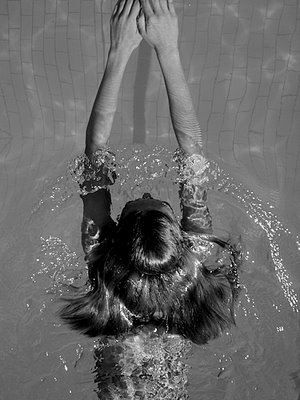
FYI: The image used to source the background for the title text. The girl is 15 year old Jean Marie Neethling. The light in this image is quite magical, and I think, beautiful, especially on her hand.

Monday, January 07, 2008

Voices of Summer (PHOTOGRAPHY)


Image below (which I think is the pic of the bunch) wasn't taken by me. Unfortunately I haven't made it to the beach thus far this summer. Also not sure how many girls in bikinis would put their hands in the air and shout: "me, me, me!" were I to appear on the beach with a camera. More likely they'd go: "Who is this weirdo...?"

Awash (PHOTOGRAPHY)


Thursday, November 15, 2007

Breach: An Anecdote on Logic and Life


In the cool vaults of water I floated the day before yesterday night, gliding slowly forward, water moving against skin with a soft murmur, a distant whoosh…
Oxygen starvation was an urgent but far-off pull.
And it was with perhaps a few metres to go, having advanced most of the way across the rectangular body of water, that I watched my shadow and a lighter double of my shadow, tailing me. What is this?
What is this body of mine that glows under the florescent lights, that flies through soft water?
What is this shadow that I cast? Is it part of me, and will it ever be?

I try to see beyond the shadow, a reflection of color in the cold blue tiles, in the narrow white line. I tried to see myself reflected back at me; floating in the water, but all I see is the shadow. The tiles are not dark enough, the light on them too bright, too cold, to reflect any more than a shadow.

It was then that my lungs constricted painfully, began to scream. Panic had set in. despite the poer ofmy will, there are limits to life. Holding one’s breath for long enough can kill you. Life is not eternal, or invulnerable, or invincible.

I have swam much further underwater, endured entire minutes without oxygen, but the truth – right then – suddenly sucked the life out of my lungs. I tore through the revolving silver foil, and surfacing at the other end, I realized that truly, logically, despite our desires, despite every effort, we will come to death. I will come to death, and despite the poems and books and sermons, once asleep, I will not wake again. No one will.

And there where we sleep, we will not gather, or sing, or walk. We will not be reunited with long lost loved ones. We will not be alone. Because, we simply will have ceased to Be. Is it possible to be unemotional about the end of one’s existence? When we sleep, when we are too tired for dreams, is there an emotional thread that matters? There is a simple, natural, non-existence period. It seems that even life, even in life, there must be outages for rest, for recovery, for the tremendous engine of energy to be restored, for another session, until the finite store is finished.

If our waking sessions are countable, this makes – this means – our every act is a vital act. A smile, a glance, a call, a gesture, a turn, a garment, a gift, an insult, a reaction, an offer, an opinion, a hope, a movement – every single act. We ought to, in each and every day, give the gift of life, enhancing life for others, finding ways to thrive while we are still here. Because being here, now, is all we have and all we ever will have.

Is there life after death? Yes, but not for us. If we have had children, from a particular point of view, something similar to ourselves, continues to imprint itself on the world, is the world, beyond our very selves. Do we continue to exist? No. A part of us, nevertheless an automated independent entity borne of ourselves, can continue to operate in the world without us. We can share with them our consciousness, the vital essence of ourselves, our memories. This lives on. But let us not con ourselves; when it comes down to it we know the answer. In death, we die.

Our children, our brothers and sisters, our parents - it is all part of who you are, and yet it is not you. In the same way, God exists (everything that is exists) yet everything that is does not know itself to exist (everything that is, is not). There is death. There is life. Both are part of Is, both comprise the reality of Existence. Being able to read this and consider this, means we are alive. In time, that duty will fall to others as they ask the same questions, seeking their answers. Being dead, we are not elsewhere, we arenot listening or dreaming or watching. We will no longer exist apart from the universe, the fragments of energy will be re-assimilated in air, and soil, and subsumed by various other living things. To be clear: we will be dreams and dust.

The shadow and the light, and the being that floats in between. Water, air and drowning. We must find our way throughout the circle, across the extremes. But getting to where we must go may not be conscious the entire way. It may simply be destiny, like a cube of ice gradually surrendering its grip, and transitioning into something it is, but also, something it is not. When it is in a liquid state, other laws will quickly move it, losing itself in the stream.

The vital, logic constant in this, the identity, the integrity, the personality of life, simply cannot be sustained during the transition. The energy given to our bodies may be eternal, but it does not belong to us forever. It only arranges itself in the pattern, the arrangement that describes our being, and then, that arrangement is relinquished.

In this sense it is natural to fear death. In another sense, when we fear life, we cannot also fear death, and the the balancing context is restored. All we can do, is Be. Not Being is a certainty that we can DO nothing about. So yes, fear death, embrace life; fearing life, embrace death, but the answer to the question is obvious (to all who live), isn’t it: to be or not to be?

NVDL: This came about trying to see something where there was nothing to see, and being simultaneously forced to breach, being underwater, I was rapidly approaching the limits to living. As such it was something of a stark revelation. Do you think it was accurate?

For more on swimming and the soul, go here or here.

Monday, November 12, 2007

Inspired, Motivated - Did I Say Inspired?


I've been on a good wicket this weekend, around 9 hours training in total. So I was pretty whacked by the end of this week, but I think I'm getting used to it. I went to gym on Friday evening after work, planning on doing just a 30 minute swim, going about 1km. Then I stood on the scale and had a heart attack: 87.2km. After searching the Virgin Active locker room for a pistol (in order to shoot myself), I did what any other ex-fit, ex-demigod would do, I through my unfit butt into the water and started training.
I ended up doing almost 3km, and was in the water for more than 2 hours? The reason?

Well, first of all, the water was warm. Okay, I'm skirting around the subject. Someone I knew from way back when, the days of training with Simon Gray, came to train. She also brought her 19 year old daughter Roxy, who is in fine form - she was like this fish spearing through the dark water in the lane beside mine - probably going to the US next year.
So that's what it is. Excellence. The last time I had a good swim was with the captain of the SA Polo team. She wopped my butt too. See, it's seeing people out there that are working their butts off that remind you of what you are capable of. Roxy swam 5-6km in the time we were messing about. That's always going to be impressive. She reminded me of Jean Marie Neethling, and said there was a chance she and Ryk would be in some sort of upcoming photo for a swim sponsored by Emarald Casino.

So when I weigh myself after the swim, I'm at 86.4km. Not great, but I was able to leave the gym without singing that song about being suicidal because someone else is so beautiful.
Although I'm into a reasonably cycling habit now, I'd like to resuscitate my swimming. 3-4 times a week, 3km each time. Because I'm feeling inspired, motivated - did I say inspired?

Thursday, October 11, 2007

Interview: Ryk's Sister Jean Marie


Nerves of Neethling

Many of us, when we think of swimming, have sunny memories, touched with globs of icecream, smears of sunblock and watermelon smiles. Swimming and childhood is mixed together, like silver bubbles in chlorine clear water. But for professional swimmers, a swimming pool is quite different. It’s cold and hard. There are lines on the bottom of the pool that they see in their dreams. It’s living and breathing in the sterile light of a bathroom (especially in winter). The body crushes through the water time-carving a spinal understanding about hydrodynamics. Each session ends with a coarse towel on skin. Above all swimming is about endurance: enduring the cold and coming out smiling and strong. What, I wonder, are the rewards? Jean Marie Neethling provides some insight into what it takes to become a fish.

By Nick van der Leek

Jean Marie ushers me into a sunny room. She has the lithe frame of a swimmer, slim but strong. I’ve seen her on TV, and swimming at the Virgin Active pool, and a few times I found myself swimming while a pink and white swordfish (that I took to be her) went flashing by in the lane beside me.
“Is that Jean Marie Neethling?” I asked a few times.
I’ve heard that she is already training 6 hours a day (in the holidays especially). She is just 16, but she is building up the necessary momentum now to be a world champion.

I suppose I already admire what she has achieved, and what she is doing. Her mom peeks in the door, greets me, and then closes the door to give us some privacy.

There’s a lot of blue in the room, and Jean Marie herself is wearing blue jeans and a blue Billabong jersey. These colors bring out the blue in her eyes, but when I look closer, her eyes aren’t blue. They have a cool grey steeliness that is in parts attractive and perhaps a little intimidating. I used to train with Ryk when he swam in Bloemfontein, and I’m surprised to see Ryk’s face flash at me through hers. I sit in a sunbeam and fumble in my bag for a tape recorder while a green parrot starts climbing up the white sleeve of my tracksuit.
I press RECORD and the red light illuminates.

JM: I learned to swim when I was a baby. My mom taught me, [she pokes a thumb over her shoulder towards the pool,] and my brother always took me in the water.”
NV: Did you enjoy it when you were little?
JM: I never liked swimming. The best part of swimming for me now is, like, the galas. Your hard work pays off. I didn’t really like going to training that much. But I learnt you can only swim well at a gala if you’ve trained hard. I came first in my first gala when I was 10 years old.

NV: How is it now, because now you’re training hard? Now you’re aware of the reality of swimming.
JM: Very much. My brother is a big help. He wants to keep me from making the same mistakes he made. I appreciate that, but it’s hard to listen to him – him not wanting me to make the same mistakes as him – but I think the only way to learn is from my own mistakes.
NV: I must say – because I swam – those mistakes can kill your spirit. Even if you’re willing to allow that. Do you often get sick?
JM: Yes. I do. Very often. I’m in hospital at least 3 times a year. This year I was lucky, I was in hospital only once.
NV: How come?
JM: It starts off as a cold, which turns into bronchitis, and then a lung infection.
NV: So how do you counter that?
JM: It’s very hard. I get mediglobin injections. It doesn’t really help. I drink so many vitamins, minerals…I can’t even count them all. I just have to keep myself from overtraining.
NV: I think – and it’s like that with the Ironman as well – in the end you’re training against yourself. You’re training against your limits.
JM: You want to get fit but then the harder you train, the weaker you seem to get [after a certain point].
NV: So the trick is-
JM: Knowing your limits.
NV: I think Ryk can help you a lot with that. In terms of knowing how to not make that mistake more often than you absolutely need to.
JM: Well, he’s made a lot of mistakes in overtraining [Ryk and Roland both took part in Melbourne with colds], and he just thinks, ‘the harder you work the better’. One of his biggest mistakes is overtraining. He pushes himself until he almost dies [laughs].
At Commonwealth he was very, very weak, and over trained, and he admitted that. And two weeks later he swam in the World Champs in Shanghai and he won three gold medals, and swam his best times.

NV: So, can you say you enjoy it?
JM: I shouldn’t hesitate answering that, but the part I enjoy is the galas. The training, at the moment, isn’t as fun at the moment as it could be, or should be. I don’t have anyone to race against.
NV: What about those guys I’ve seen you training with?
JM: No, they don’t do the same strokes I do. They don’t want to train as hard as I train, or according to my programme.
NV: So what’s your routine?
JM: In a perfect situation I’m allowed to go train in the mornings. In the holidays I swim 5 hours a day, and gym for an hour.
NV: And yesterday? [she cancelled the interview yesterday]
JM: Yesterday wasn’t a good day for me.

NV: Why do so many asthma sufferers swim?
JM: Swimming forces you to control your breathing, and asthma sufferers especially need to strengthen that aspect of their physiology.
NV: There seem to be a large amount of asthma suffers who are some of the world’s top swimmers…
JM: Some of them started swimming at a young age because of the asthma.
NV: Could there be a physiological benefit to having asthma and swimming?
JM: No, you have a handicap because you can’t stay underwater as long [as other swimmers] and you have to use a[n asthma] pump.
NV: [I smile] Maybe that’s what makes you swim faster!

NV: So tell me about this year.
JM: In January I was at a training camp in Germany, training for the Commonwealth Games. We had a gala in Berlin. And then in March I was in Melbourne.
NV: Do you feel you were…uh [I see something tugging the curtains] is that a monkey?
JM: [Giggles] Oh ja. We have a whole zoo here. It’s actually a marmoset.
NV: Oh. [Pause] Okay so the traveling: do you enjoy that aspect? Going overseas-
JM: [Emphatically] Yes! That’s the best part. Seeing the world, seeing people from different countries. The athletes village, the passion of the people…I loved the Commonwealth and the whole setup with the [athlete’s]village [at the Commonwealth Games]. It was amazing.
NV: Did you feel happy with how you did in Melbourne?
JM: Very happy. Especially with my medley [a race where all 4 strokes are employed]. I came sixth, and I broke the open SA record.
NV: So obviously a personal best and a South African women’s medley record.
JM: My breaststroke was a bit disappointing [in another separate race]. It wasn’t my best time. I came in 7th. I’m not as good in the shorter distances like the 100[m] Breastroke. I don’t have the speed and the strength yet.

NV: How old were you compared to the other swimmers?
JM: I was the youngest swimmer there. I was fifteen at the time, I’m sixteen now.
NV: How old are most of the swimmers.
JM: Most of the girls are 15-21. The guys are much older. There are no 15 year old guys at big meets [like the Commonwealth Games]. The youngest guys are 17 but then they’re not at their best.
NV: I remember when I swam there was a stage when the girls were-
JM: Better, yeah. [she says with a grin]

NV: Did you feel overwhelmed in Melbourne?
JM: Overwhelmed?
NV: I seem to remember reading that there was concern that you might be overwhelmed [being a 15 year old at the Commonwealth Games] by the size of everything there.
JM: My brother was worried that the moment would be too big for me, but it was great walking out there with the Australian crowd screaming.
NV: So when you were standing in front of the blocks. I know this can be very nerve-racking – were you OK?
JM: The medley was my first race. I was very nervous in the morning. I was 14th on their rankings, so I wasn’t even ranked to make the final. But I went into the final ranked 6. I was nervous before they told us to go out. When I stood in front of the blocks everything [the nervousness] just went. I focused on the swimming pool, my lane in front of me. I thought of nothing except my race. I remember when they announced me: ‘Lane 6, Jean Marie Neethling.’ I looked over at my brother and he just nodded and I remembered what he’d said to me: ‘Relax. It’s just another race.’ I just went out there and gave my best. I wasn’t nervous at all.

NV: I remember seeing you on TV and you looked really focused. You didn’t wave at the camera.
JM: Well, the waving at the camera thing…I didn’t want to lose focus. I knew I wasn’t going to do much; I wasn’t one of the big shots there. I was just there to do my time.
NV: Well someone who doesn’t wave at the camera is either very nervous or very focussed.
JM: I was focused.
NV: Do you find it easy to focus?
JM: No it’s easy for me to focus.

Her mom opens the door and offers us coffee. Jean Marie says, “Asseblief” and I also nod.

JM: What was I saying? I focus easily when I just go out and train. But my mom’s [Mrs Neethling coaches swimming in Bloemfontein] swimmer’s, they’re also my friends, they’re afraid of me when I go swimming. They don’t talk to me while I swim. I’m not myself when I swim because I focus. I don’t like being interrupted when I’m training.
NV: I knew from your cap, and that you were swimming pretty fast that this is probably Jean Marie Neethling swimming next to me.
JM: [Laughs]
NV: And I thought of saying: ‘Howz Ryk’ or ‘Howzit’ or something, but I got that feeling: don’t!
JM: Oh no! [Laughs] It’s not that bad! It’s when my teammates – because they want to talk and play around – I never play around when I train.

There’s a bit of silence as this sinks in.

**NV: Are you a perfectionist?
JM: I’m a big perfectionist. I’d rather not do something if I can’t do it perfectly, or as close to perfect as possible. That’s actually one of my downfalls. I don’t want to do anything if I can’t do it perfectly. That’s why I didn’t do athletics. I’m not going to do something just to do it. It must be done right.
NV: I think that [being a perfectionist] is key to being successful, probably in anything, whether sport or business. Lance Armstrong is the ultimate perfectionist.
JM: Ja.
NV: But the other side of it is: are you a perfectionist in everyday life, and what’s that like? Because that’s sometimes difficult for other people [dealing with a perfectionist].
JM: Sure. [Laughs]
NV: Because my girlfriend is a perfectionist and she sometimes drives me crazy. So the question is, can you be a perfectionist in one area of your life, and not in another area?
JM: I am. I used to be a big perfectionist in everything. My room, my cupboard, my clothes – everything had to be in a specific place. Now I’ve sort’ve moved all my focus to just swimming, and the smaller details on what will get me better and faster.
NV: Is that a family thing?
JM: My dad is a very big perfectionist. In everything but especially in his work.
NV: He’s a lawyer.
JM: Yes. And lawyer’s have to be.

NV: So what are your ambitions?
JM: At the moment I’m on the way to the world junior champs in Brazil. I hope to swim well there. I don’t like to set any specific time for myself, and I don’t expect to win. I take it as it goes. I just give my best, and I hope it goes well because I’ve trained hard for it.
Then slightly longer term: when I come back from Brazil I start training for world senior champs in Melbourne next year. And then 2008 is Beijing, with my brother. I have to qualify for that and I really hope I make it.
NV: I’m sure you will. So Jean Marie, at this point, what are you most proud of?
JM: I still really can’t believe I went to the Commonwealth Games. It’s one of the three biggest events in swimming [the Olympics and World Championships are the other two].
So I’ve achieved one, and I did well. I’m the best IM [individual medley] swimmer in South Africa.
NV: Nice feeling…
JM: Yes [smiles]. I can’t really believe it when I say that. So that’s…I’m really proud of that.
NV: And otherwise, other non-swimming achievements you’re happy about?
JM: I suppose getting an average of over 80% in the last exams. I’m barely in school so I’m happy with that.
NV: And after school?
JM: I plan to go to college in Tucson Arizona; the same place my brother went.

NV: What do you do in your free time?
JM: I don’t have much free time, but I like drawing. I’ve won a few prizes for my drawings.
NV: Such as?
JM: A R25 000 bursary to study art.

She shows me some of her paintings. They’ve vivid, bright and bursting with color.

NV: I spoke to someone who said she’s done drama with you.
JM: Who?
NV: I can’t remember her name.
JM: I actually love drama. That was actually one of my favourite things to do. The ideal job for me would be being an actress.
NV: Well, when you were on TV when you were in Melbourne. Maybe you should use those opportunities to showcase your acting talent.
JM: [Laughs] But my parents won’t really support me going for that sort of thing, unless I was sure of what I was doing, and I’d already made some money for myself [out of swimming].
NV: But that’s a whole different setup. Swimming is about discipline, whereas acting – not that it’s not about discipline, because you need discipline with everything – but there’s more of the vanity aspect involved, and that can make one disorientated. Doesn’t Ryk find that he’s very busy now with other things, I mean I’ve just heard him in a radio ad-
JM: He still has the focus on swimming. He does that very well; keeping a balance. But it does get a bit too much.

NV: Ryk said: to win you have to be the best in the history of your body. What’your mantra?
JM: Something he said to me recently: Nothing is impossible. It just takes a little longer. And: Nothing is hard if you love it.
NV: You were saying it was lonely. Don’t you find it quite wonderful that you’re like a baanbreker. When you’re in the pool, training, day to day, you’re the best person in the pool, and you’re on top of your game.
JM: I’m a bit unsure of myself. I don’t think: ‘Wow I’m great.’ Or: ‘Wow I’m on top of my game.’ Most of the time I’m thinking: ‘I can do better.’ And: ‘How can I do better?’
NV: Well to me you’re confident. You come across very determined.
JM: Yes, well inwardly I think I am.
NV: I noticed you had a funny tan. You even had it in Melbourne.
JM: Oh that’s a bikini tan. I love swimming in my bikini when I swim outside.

A few weeks later I see Jean Marie again. She’s healthy (she was sick during the interview) and recently back from Brazil. She tells me her races went ‘Okay. Under the circumstances, quite well.’ She placed seventh and improved her world ranking by one.

The sun is throwing white arrows into the water but the air still has that sharp bite of early spring. She jumps into water – cold as stone – and I see, this is her domain. I can see that she’s obviously cold, but as soon as she moves she’s comfortable. She has long fingers, and long limbs. Like everything about her, there’s a lot of talent imbedded in from fingers to toes and behind the sweep of her forehead. You can see it in the way she moves.

She floats in the water at one point, her fingers twirling a few dancing stars. There is something beautiful about her here, in her watery domain. I feel inklings of the simple power of youth when Jean Marie swords through the water. She leaves a billowing wake filled with stars.

For more on Jean-Marie Neethling, click here.

Monday, October 01, 2007

Ryk and Sister on Cover of New Magazine


What is wrong with this picture?
The photogrpher deserves to be shot for this cover shot, and I don't mean with a camera. What were they thinking? Why is Ryk AND his sister on the cover? What's wrong with Jean Marie on the cover by herself? Ryk looks like he is suffering from a bad hangover, and Jean Marie has been plastered with so much makeup because, GASP, she's just 16 years old! Jeepers, what is wrong with featuring a hot 16 year old on the cover of a magazine? Here's my suggestion for a cover photo of Jean Marie, one I shot earlier this year:

The color one's are even better.
Click here to read my interview with Jean Marie.

Wednesday, April 18, 2007

D


Above image: Jean Marie Neethling, one of the prints on display at 'Magic of Color and Light', a Photo Exhibition on May 4.

Apparently that's the vitamin more vital to health (well, holding off the flu in particular) than Vitamin C. It's efficacy has been proved in clinicial trials. So try to get 20 minutes of face-time with the sun each day.


Meanwhile, my legs feel like they have a marathon in them, rather than yesterday's easy 4km run and 40km cycle. The 9km run though is probably still sitting in them, but still.


Heart rate was high on yesterday's cycle, which makes me think it was for the best that I didn't ride Saturday. Just think how sick I'd be feeling today.


Went to the unit at Waverley and I am really in awe of what my Dad did there. He said he could have squashed in 5 more units if he had built them in the conventional assembly line style you see at most townhouse developments. You know, each one a carbon copy of the next. So sacrificing money for style/beauty/environmental concerns (eg sparing large trees), all the units are different. Different angles, different tiles. Such is the work (and the sacrifice, and the pain) of the perfectionist. Driving through there feels like entering a little Island Paradise beyond Bloemfontein. In itself that's a pleasure.


Since I'll be living near Jean, think we'll be doing a few training rides together. Should be good.


South Africa eclipsed England's cricket aspirations last night. Brilliant. Was an interesting night. Watched Smallville, had a serious conversation at Marco's. Then had another night of strange dreams.

Monday, September 04, 2006

Nerves of Neethling


Nerves of Neethling

Many of us, when we think of swimming, have sunny memories, touched with globs of icecream, smears of sunblock and watermelon smiles. Swimming and childhood is mixed together, like silver bubbles in chlorine clear water. But for professional swimmers, a swimming pool is quite different. It’s cold and hard. There are lines on the bottom of the pool that they see in their dreams. It’s living and breathing in the sterile light of a bathroom (especially in winter). The body crushes through the water time-carving a spinal understanding about hydrodynamics. Each session ends with a coarse towel on skin. Above all swimming is about endurance: enduring the cold and coming out smiling and strong. What, I wonder, are the rewards? Jean Marie Neethling provides some insight into what it takes to become a fish.

By Nick van der Leek

Jean Marie ushers me into a sunny room. She has the lithe frame of a swimmer, slim but strong. I’ve seen her on TV, and swimming at the Virgin Active pool, and a few times I found myself swimming while a pink and white swordfish (that I took to be her) went flashing by in the lane beside me.
“Is that Jean Marie Neethling?” I asked a few times.
I’ve heard that she is already training 6 hours a day (in the holidays especially). She is just 16, but she is building up the necessary momentum now to be a world champion.

I suppose I already admire what she has achieved, and what she is doing. Her mom peeks in the door, greets me, and then closes the door to give us some privacy.

There’s a lot of blue in the room, and Jean Marie herself is wearing blue jeans and a blue Billabong jersey. These colors bring out the blue in her eyes, but when I look closer, her eyes aren’t blue. They have a cool grey steeliness that is in parts attractive and perhaps a little intimidating. I used to train with Ryk when he swam in Bloemfontein, and I’m surprised to see Ryk’s face flash at me through hers. I sit in a sunbeam and fumble in my bag for a tape recorder while a green parrot starts climbing up the white sleeve of my tracksuit.
I press RECORD and the red light illuminates.

JM: I learned to swim when I was a baby. My mom taught me, [she pokes a thumb over her shoulder towards the pool,] and my brother always took me in the water.”
NV: Did you enjoy it when you were little?
JM: I never liked swimming. The best part of swimming for me now is, like, the galas. Your hard work pays off. I didn’t really like going to training that much. But I learnt you can only swim well at a gala if you’ve trained hard. I came first in my first gala when I was 10 years old.

NV: How is it now, because now you’re training hard? Now you’re aware of the reality of swimming.
JM: Very much. My brother is a big help. He wants to keep me from making the same mistakes he made. I appreciate that, but it’s hard to listen to him – him not wanting me to make the same mistakes as him – but I think the only way to learn is from my own mistakes.
NV: I must say – because I swam – those mistakes can kill your spirit. Even if you’re willing to allow that. Do you often get sick?
JM: Yes. I do. Very often. I’m in hospital at least 3 times a year. This year I was lucky, I was in hospital only once.
NV: How come?
JM: It starts off as a cold, which turns into bronchitis, and then a lung infection.
NV: So how do you counter that?
JM: It’s very hard. I get mediglobin injections. It doesn’t really help. I drink so many vitamins, minerals…I can’t even count them all. I just have to keep myself from overtraining.
NV: I think – and it’s like that with the Ironman as well – in the end you’re training against yourself. You’re training against your limits.
JM: You want to get fit but then the harder you train, the weaker you seem to get [after a certain point].
NV: So the trick is-
JM: Knowing your limits.
NV: I think Ryk can help you a lot with that. In terms of knowing how to not make that mistake more often than you absolutely need to.
JM: Well, he’s made a lot of mistakes in overtraining [Ryk and Roland both took part in Melbourne with colds], and he just thinks, ‘the harder you work the better’. One of his biggest mistakes is overtraining. He pushes himself until he almost dies [laughs].
At Commonwealth he was very, very weak, and over trained, and he admitted that. And two weeks later he swam in the World Champs in Shanghai and he won three gold medals, and swam his best times.

NV: So, can you say you enjoy it?
JM: I shouldn’t hesitate answering that, but the part I enjoy is the galas. The training, at the moment, isn’t as fun at the moment as it could be, or should be. I don’t have anyone to race against.
NV: What about those guys I’ve seen you training with?
JM: No, they don’t do the same strokes I do. They don’t want to train as hard as I train, or according to my programme.
NV: So what’s your routine?
JM: In a perfect situation I’m allowed to go train in the mornings. In the holidays I swim 5 hours a day, and gym for an hour.
NV: And yesterday? [she cancelled the interview yesterday]
JM: Yesterday wasn’t a good day for me.

NV: Why do so many asthma sufferers swim?
JM: Swimming forces you to control your breathing, and asthma sufferers especially need to strengthen that aspect of their physiology.
NV: There seem to be a large amount of asthma suffers who are some of the world’s top swimmers…
JM: Some of them started swimming at a young age because of the asthma.
NV: Could there be a physiological benefit to having asthma and swimming?
JM: No, you have a handicap because you can’t stay underwater as long [as other swimmers] and you have to use a[n asthma] pump.
NV: [I smile] Maybe that’s what makes you swim faster!

NV: So tell me about this year.
JM: In January I was at a training camp in Germany, training for the Commonwealth Games. We had a gala in Berlin. And then in March I was in Melbourne.
NV: Do you feel you were…uh [I see something tugging the curtains] is that a monkey?
JM: [Giggles] Oh ja. We have a whole zoo here. It’s actually a marmoset.
NV: Oh. [Pause] Okay so the traveling: do you enjoy that aspect? Going overseas-
JM: [Emphatically] Yes! That’s the best part. Seeing the world, seeing people from different countries. The athletes village, the passion of the people…I loved the Commonwealth and the whole setup with the [athlete’s]village [at the Commonwealth Games]. It was amazing.
NV: Did you feel happy with how you did in Melbourne?
JM: Very happy. Especially with my medley [a race where all 4 strokes are employed]. I came sixth, and I broke the open SA record.
NV: So obviously a personal best and a South African women’s medley record.
JM: My breaststroke was a bit disappointing [in another separate race]. It wasn’t my best time. I came in 7th. I’m not as good in the shorter distances like the 100[m] Breastroke. I don’t have the speed and the strength yet.

NV: How old were you compared to the other swimmers?
JM: I was the youngest swimmer there. I was fifteen at the time, I’m sixteen now.
NV: How old are most of the swimmers.
JM: Most of the girls are 15-21. The guys are much older. There are no 15 year old guys at big meets [like the Commonwealth Games]. The youngest guys are 17 but then they’re not at their best.
NV: I remember when I swam there was a stage when the girls were-
JM: Better, yeah. [she says with a grin]

NV: Did you feel overwhelmed in Melbourne?
JM: Overwhelmed?
NV: I seem to remember reading that there was concern that you might be overwhelmed [being a 15 year old at the Commonwealth Games] by the size of everything there.
JM: My brother was worried that the moment would be too big for me, but it was great walking out there with the Australian crowd screaming.
NV: So when you were standing in front of the blocks. I know this can be very nerve-racking – were you OK?
JM: The medley was my first race. I was very nervous in the morning. I was 14th on their rankings, so I wasn’t even ranked to make the final. But I went into the final ranked 6. I was nervous before they told us to go out. When I stood in front of the blocks everything [the nervousness] just went. I focused on the swimming pool, my lane in front of me. I thought of nothing except my race. I remember when they announced me: ‘Lane 6, Jean Marie Neethling.’ I looked over at my brother and he just nodded and I remembered what he’d said to me: ‘Relax. It’s just another race.’ I just went out there and gave my best. I wasn’t nervous at all.

NV: I remember seeing you on TV and you looked really focused. You didn’t wave at the camera.
JM: Well, the waving at the camera thing…I didn’t want to lose focus. I knew I wasn’t going to do much; I wasn’t one of the big shots there. I was just there to do my time.
NV: Well someone who doesn’t wave at the camera is either very nervous or very focussed.
JM: I was focused.
NV: Do you find it easy to focus?
JM: No it’s easy for me to focus.

Her mom opens the door and offers us coffee. Jean Marie says, “Asseblief” and I also nod.

JM: What was I saying? I focus easily when I just go out and train. But my mom’s [Mrs Neethling coaches swimming in Bloemfontein] swimmer’s, they’re also my friends, they’re afraid of me when I go swimming. They don’t talk to me while I swim. I’m not myself when I swim because I focus. I don’t like being interrupted when I’m training.
NV: I knew from your cap, and that you were swimming pretty fast that this is probably Jean Marie Neethling swimming next to me.
JM: [Laughs]
NV: And I thought of saying: ‘Howz Ryk’ or ‘Howzit’ or something, but I got that feeling: don’t!
JM: Oh no! [Laughs] It’s not that bad! It’s when my teammates – because they want to talk and play around – I never play around when I train.

There’s a bit of silence as this sinks in.

**NV: Are you a perfectionist?
JM: I’m a big perfectionist. I’d rather not do something if I can’t do it perfectly, or as close to perfect as possible. That’s actually one of my downfalls. I don’t want to do anything if I can’t do it perfectly. That’s why I didn’t do athletics. I’m not going to do something just to do it. It must be done right.
NV: I think that [being a perfectionist] is key to being successful, probably in anything, whether sport or business. Lance Armstrong is the ultimate perfectionist.
JM: Ja.
NV: But the other side of it is: are you a perfectionist in everyday life, and what’s that like? Because that’s sometimes difficult for other people [dealing with a perfectionist].
JM: Sure. [Laughs]
NV: Because my girlfriend is a perfectionist and she sometimes drives me crazy. So the question is, can you be a perfectionist in one area of your life, and not in another area?
JM: I am. I used to be a big perfectionist in everything. My room, my cupboard, my clothes – everything had to be in a specific place. Now I’ve sort’ve moved all my focus to just swimming, and the smaller details on what will get me better and faster.
NV: Is that a family thing?
JM: My dad is a very big perfectionist. In everything but especially in his work.
NV: He’s a lawyer.
JM: Yes. And lawyer’s have to be.

NV: So what are your ambitions?
JM: At the moment I’m on the way to the world junior champs in Brazil. I hope to swim well there. I don’t like to set any specific time for myself, and I don’t expect to win. I take it as it goes. I just give my best, and I hope it goes well because I’ve trained hard for it.
Then slightly longer term: when I come back from Brazil I start training for world senior champs in Melbourne next year. And then 2008 is Beijing, with my brother. I have to qualify for that and I really hope I make it.
NV: I’m sure you will. So Jean Marie, at this point, what are you most proud of?
JM: I still really can’t believe I went to the Commonwealth Games. It’s one of the three biggest events in swimming [the Olympics and World Championships are the other two].
So I’ve achieved one, and I did well. I’m the best IM [individual medley] swimmer in South Africa.
NV: Nice feeling…
JM: Yes [smiles]. I can’t really believe it when I say that. So that’s…I’m really proud of that.
NV: And otherwise, other non-swimming achievements you’re happy about?
JM: I suppose getting an average of over 80% in the last exams. I’m barely in school so I’m happy with that.
NV: And after school?
JM: I plan to go to college in Tucson Arizona; the same place my brother went.

NV: What do you do in your free time?
JM: I don’t have much free time, but I like drawing. I’ve won a few prizes for my drawings.
NV: Such as?
JM: A R25 000 bursary to study art.

She shows me some of her paintings. They’ve vivid, bright and bursting with color.

NV: I spoke to someone who said she’s done drama with you.
JM: Who?
NV: I can’t remember her name.
JM: I actually love drama. That was actually one of my favourite things to do. The ideal job for me would be being an actress.
NV: Well, when you were on TV when you were in Melbourne. Maybe you should use those opportunities to showcase your acting talent.
JM: [Laughs] But my parents won’t really support me going for that sort of thing, unless I was sure of what I was doing, and I’d already made some money for myself [out of swimming].
NV: But that’s a whole different setup. Swimming is about discipline, whereas acting – not that it’s not about discipline, because you need discipline with everything – but there’s more of the vanity aspect involved, and that can make one disorientated. Doesn’t Ryk find that he’s very busy now with other things, I mean I’ve just heard him in a radio ad-
JM: He still has the focus on swimming. He does that very well; keeping a balance. But it does get a bit too much.

NV: Ryk said: to win you have to be the best in the history of your body. What’your mantra?
JM: Something he said to me recently: Nothing is impossible. It just takes a little longer. And: Nothing is hard if you love it.
NV: You were saying it was lonely. Don’t you find it quite wonderful that you’re like a baanbreker. When you’re in the pool, training, day to day, you’re the best person in the pool, and you’re on top of your game.
JM: I’m a bit unsure of myself. I don’t think: ‘Wow I’m great.’ Or: ‘Wow I’m on top of my game.’ Most of the time I’m thinking: ‘I can do better.’ And: ‘How can I do better?’
NV: Well to me you’re confident. You come across very determined.
JM: Yes, well inwardly I think I am.
NV: I noticed you had a funny tan. You even had it in Melbourne.
JM: Oh that’s a bikini tan. I love swimming in my bikini when I swim outside.

A few weeks later I see Jean Marie again. She’s healthy (she was sick during the interview) and recently back from Brazil. She tells me her races went ‘Okay. Under the circumstances, quite well.’ She placed seventh and improved her world ranking by one.

The sun is throwing white arrows into the water but the air still has that sharp bite of early spring. She jumps into water – cold as stone – and I see, this is her domain. I can see that she’s obviously cold, but as soon as she moves she’s comfortable. She has long fingers, and long limbs. Like everything about her, there’s a lot of talent imbedded in from fingers to toes and behind the sweep of her forehead. You can see it in the way she moves.

She floats in the water at one point, her fingers twirling a few dancing stars. There is something beautiful about her here, in her watery domain. I feel inklings of the simple power of youth when Jean Marie swords through the water. She leaves a billowing wake filled with stars.