Monday, October 11, 2010

Cigar Guy Revealed [He's everywhere!]


Follow Jay Busbee on Twitter at @jaybusbee
Cigar Guy's secret identity has been revealed, and in the end, the truth was right in front of our faces all along.
Cigar Guy is, of course, the mysterious grinning stranger in the corner of that famous Daily Mail Tiger Woods photo from the Ryder Cup last week. Wearing what appeared to be a turban and smoking a cigar the size of a small tree, the absurdly out-of-place Cigar Guy kicked off a worldwide Internet game of Photoshop one-upsmanship. Within moments, Cigar Guy began showing up all throughout history, like here:
You can see plenty more of the same at Funny or Die, among many other places. Heck, at least one site is already selling a Cigar Guy t-shirt.  
But at long last, he's been found! The London Daily Mail did the investigative work, and it turns out that Cigar Guy is actually a mild-mannered, mildly embarrassed young man! (Isn't that always the way with our heroes?) Cigar Guy is Rupesh Shingadia, a 30-year-old investment analyst who -- no kidding -- still lives with his parents in South London.
The first clue that Cigar Guy was not all he seemed was the fact that the "turban" turned out to be a ponytail wig, as you can see here from this alternate angle:

And as it turned out, the mustache was fake too. Shingadia was a few weeks early for Halloween. But who was the inspiration for his costume? Why, someone that golf fans should have recognized instantly, of course:

That's right, he was dressed as Mig

Thursday, October 07, 2010

The Game : Commonwealth Games

NEW DELHI (AP) — The British empire’s athletes first gathered 80 years ago, facing one another in friendly competitions as a way to bind together the king’s vast dominions.
It was 1930, a time when India was the jewel in the colonial crown, when the subcontinent was ruled by a small corps of English bureaucrats. The competition was known as the Empire Games, though even then, the empire had begun to fade.
Today, with India on the eve of opening what is now called the Commonwealth Games, that world is barely a memory. There are times when the former colonial subject speaks of its one-time master with barely hidden condescension.

commonwealth games
1
FILE -- In this Saturday Aug. 8, 2008 file photo fireworks explode over the National Stadium during opening ceremony of the 2008 Olympic Games in Beijing. China and India are Asian neighbors, rivals and emerging global powers. When it comes to organizing major international sporting events, though, there is no comparison. While China launched its global coming-out party with the spectacular and grandiose Beijing Olympics in 2008, India has endured international embarrassment with the chaotic, last-minute preparations for the Commonwealth Games in New Delhi. (AP Photo/Bullit Marquez, file)
commonwealth games
2
India Om Prakash singh Karhana competes during the Men's shot put qualification event of the Track and Field competition of the XIX Commonwealth games on October, 6 2010 in New Delhi. The blue-riband athletics program was given the go-head at the Commonwealth Games Wednesday after frantic last-minute repairs to fix the damaged track during Sunday's spectacular opening ceremony. AFP PHOTO / WILLIAM WEST (Photo credit should read WILLIAM WEST/AFP/Getty Images)
commonwealth games
3
UNDERWATER CAMERA PHOTOGRAPH Australian swimmer Matthew Cowdrey competes in the final of the Men's 50 metre freestyle S9 for The Commonwealth Games at The S.P. Mukherjee Aquatics Centre Stadium in New Delhi on October 6, 2010. The Commonwealth Games are taking place in the Indian capital from October 3-14. AFP PHOTO / FRANCOIS XAVIER MARIT (Photo credit should read FRANCOIS XAVIER MARIT/AFP/Getty Images)
commonwealth games
4
DELHI, INDIA - OCTOBER 06: Workers carry out repairs to the main athletics track at the JN Stadium during day three of the Delhi 2010 Commonwealth Games on October 6, 2010 in Delhi, India. (Photo by Graham Crouch/Getty Images)
commonwealth games
5
DELHI, INDIA - OCTOBER 06: Althea Charles of Antigua competes in the women's hammer during day three of the Delhi 2010 Commonwealth Games at the Jawaharlal Nehru Stadium on October 6, 2010 in Delhi, India. (Photo by Mark Dadswell/Getty Images)
commonwealth games
6
DELHI, INDIA - OCTOBER 03: Entertainers perform during the Opening Ceremony for the Delhi 2010 Commonwealth Games at Jawaharlal Nehru Stadium on October 3, 2010 in Delhi, India. (Photo by Feng Li/Getty Images)
commonwealth games
7
DELHI, INDIA - OCTOBER 05: Samuel Belkin (L) of New Zealand looks on as Teibana Mase of Solomon Islands receives treatment for an injury in the Greco-Roman 96 kg repechage bout at the Inidra Ghandi Sports Complex during day two of the Delhi 2010 Commonwealth Games on October 5, 2010 in Delhi, India. (Photo by Matt King/Getty Images)
commonwealth games
8
Australia's Joshua Jefferis performs on the rings to win the bronze medal in the men's Individual all-round final during the Commonwealth Games at the Indira Gandhi Sports Complex in New Delhi, India, Wednesday, Oct. 6, 2010. (AP Photo/Gurinder Osan)
commonwealth games
9
England's Mark Anthony Lewis-Francis (3rd R) copetes during the Men's 100m qualification event of the Track and Field competition of the XIX Commonwealth games on October, 6 2010 in New Delhi. The blue-riband athletics program was given the go-head at the Commonwealth Games Wednesday after frantic last-minute repairs to fix the damaged track during Sunday's spectacular opening ceremony. AFP PHOTO / WILLIAM WEST (Photo credit should read WILLIAM WEST/AFP/Getty Images)
commonwealth games
10
From L to R : Parasport Shot Put athletes New Zealand's Jess Hamill (silver) Australia Louise Ellery and England Gemma Prescott (bronze) pose with their medals on the podium of the Parasport shot put women final event of the Track and Field competition of the XIX Commonwealth games on October, 6 2010 in New Delhi. Uganda's Moses Kipsiro won the men's 5000m title at the Commonwealth Games with Kenya's Eliud Kipchoge second and Kenyan Mark Kiptoo, third. AFP PHOTO / MANAN VATSYAYANA (Photo credit should read MANAN VATSYAYANA/AFP/Getty Images)
commonwealth games
11
DELHI, INDIA - OCTOBER 05: Sam Harrison of Wales (L) and Simon Yates of England (R) compete in the Mens Points Race at the IG Sports Complex during day two of the Delhi 2010 Commonwealth Games on October 5, 2010 in Delhi, India. (Photo by Phil Walter/Getty Images) *** BESTPIX ***
commonwealth games
12
Gold winner in the men's individual all-round final England's Luke Folwell celebrates after performing his last routine on the Horizontal Bar during the Commonwealth Games in New Delhi, India, Wednesday, Oct. 6, 2010. (AP Photo/Gurinder Osan)
commonwealth games
13
Li Karen of New Zealand eyes the ball as she serves to India's Madhurika Suhas Patkar during the table tennis women's team match of the XIX Commonwealth Games at the Yamuna Sports Complex in New Delhi on October 4, 2010. The Commonwealth Games are taking place in the Indian capital October 3-14. AFP PHOTO / Pedro UGARTE (Photo credit should read PEDRO UGARTE/AFP/Getty Images)
commonwealth games
14
Ghana's Seth Degbe Fetrie falls after he misses a lift during the men's 69 kg weightlifting clean and jerk event during the Commonwealth Games at Jawaharlal Nehru sports complex in New Delhi on October 6, 2010. The Indian capital is hosting the October 3-14 Commonwealth Games, the biggest sporting event in the city since the 1982 Asian Games. AFP PHOTO/ Manpreet ROMANA (Photo credit should read MANPREET ROMANA/AFP/Getty Images)
commonwealth games
15
Ivan Popov of Australia (L) celebrates after defeating India's Dharmender Dalal (R) in the 120 kg men's wrestling semi-finals at the Indira Gandhi sports Complex during the XIX Commonwealth Games 2010 in New Delhi on October 6, 2010. AFP PHOTO/RAVEENDRAN (Photo credit should read RAVEENDRAN/AFP/Getty Images)
commonwealth games
16
Australia's Georgia Bonora performs on the balancing beam in the gymnastics women's team final event of the Commonwealth Games at the Indira Gandhi Sports Complex in New Delhi, India, Tuesday, Oct. 5, 2010. (AP Photo/Gurinder Osan)
commonwealth games
17
Riders from various countries compete in the men's 40 km points race heats at the Commonwealth Games in New Delhi, India, Tuesday, Oct. 5 , 2010.(AP Photo/Kevin Frayer)
commonwealth games
18
From left to right, England's Robert Bale, Australia's Thomas Fraser-Holmes and Scotland's Andrew Hunter dive in the pool as they compete in the men's 4x200m freestyle final at the Commonwealth Games at the Dr. S.P. Mukherjee Aquatics Center in New Delhi, India, Wednesday, Oct. 6, 2010. (AP Photo/Victor R. Caivano)
commonwealth games
19
Athletes compete in the Men's 5000m Final of the Track and Field competition of the XIX Commonwealth games on October, 6 2010 in New Delhi. Uganda's Moses Kipsiro won the men's 5000m title at the Commonwealth Games with Kenya's Eliud Kipchoge second and Kenyan Mark Kiptoo, third. AFP PHOTO / MANAN VATSYAYANA (Photo credit should read MANAN VATSYAYANA/AFP/Getty Images)

Summer Glau is hot


Wednesday, October 06, 2010

"If things are so bad, why is the market going up every day?"

From Seeking Alpha:

The answer to that is easy - it's money printing. While it may seem that we are all richer because the market raced almost 10% higher in September, and is starting October in the same way, the truth is that because the dollar is turning into toilet paper - the value of your increased investment portfolios was offset by the loss of your purchasing power. If your investments went up 10% - those same investments afforded about 10% less goods. So all in all, it was a month of illusions to make you feel better. Take a look:
(Courtesy of StockCharts.com)

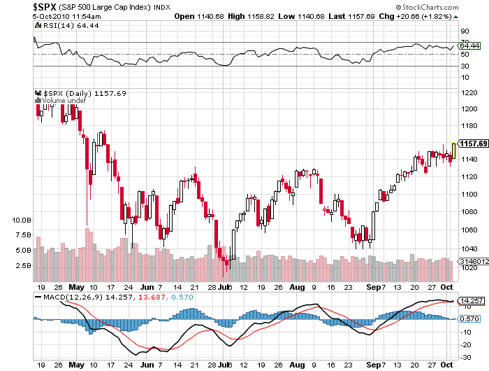
This is the S&P 500 priced in a basket of 17 commodities that most people use through yesterday. Today, that price is lower yet again. While it seemed like the stock market was making everyone richer last month, when priced in a basket of goods most people need to survive, the market went nowhere. As a matter of fact, as you can see, since May of this year, the stock market is 16% LOWER against the price of goods. The S&P 500 that you see printed in the financial news is priced in US Dollars. This is what that chart looks like:

Is it just me, or do you see anything different between the two?
This tells me there is a great fraud being committed against the American people, and its name is undercover inflation. It also makes me realize that America needs a new direction of leadership from the kind it has seen the past 30+ years since fiat currency was allowed to steal from the prudent. Make sure you vote next month with this in mind.
Finally, it tells me that things aren't as rosy as the media wants to tell you or the market is saying. For that reason, we suggest you remain as we are, "optimistically scared" when you choose investments, and own only companies who sell products people have to buy and pay dividends to you in the meantime.

The Worst Sports Reporter in the World

Wildlife Photographer of the Year

The best images from the Veolia Environnement Wildlife Photographer of the Year contest have been announced
Wildlife Photographer: Olivier Puccia
The world's most prestigious wildlife photography competition, Veolia Environnement Wildlife Photographer of the Year, has revealed the commended images from this year's competition, 2 of which can be seen here.

They are part of the selection that will join more than 100 other prize-winning photographs, including the overall winning images, when the exhibition debuts at the Natural History Museum, London, on 22 October. It will then tour nationally and internationally after it's debut in the capital after 11 March 2011. More than one million visitors are expected to have seen the exhibition once the tour is complete.
Now in its 46th year, the Wildlife Photographer of the Year competition is an international showcase for the very best nature photography. The competition is owned by two UK institutions that pride themselves on revealing and championing the diversity of life on Earth - the Natural History Museum and BBC Wildlife Magazine. It is an international leader in the artistic representation of the natural world and a competition that photographers worldwide, professional and amateur, aspire to win.
Each year thousands of entries are received and judged by a specially selected expert panel. The winners are announced at an awards ceremony that takes place later this month at the Natural History Museum, London.

The 2011 Wildlife Photographer of the Year competition opens for entries in January.
© Juergen Ross/ Veolia Environnement Wildlife Photographer of the Year 2010
Photo captions: (Above) A carcass-eye view by Juergen Ross (Germany). Category: Behaviour: Mammals -Highly Commended. A feeding lioness is framed by the carcass of a giraffe at South Africa's Kruger National Park.
(Top of page)Sunset moment by Olivier Puccia (France). Category: Urban Wildlife - Highly Commended. Overlooking Ramtek in Maharashtra, western India, Hanuman langurs find the highest point from which to admire the sunset. Squeezed out of their forest homes by deforestation, Hanuman langurs have become part of urban life in many parts of India.

Tuesday, October 05, 2010

China's army of coach potatoes

Obese patients take their lunch at the Aimin Fat Reduction Hospital in Tianjin, China
A new survey has revealed that more than a quarter of China's 1.3 billion people have now officially been classified as overweight or obese Photo: AP
Despite hopes that the 2008 Games would instil a healthy new appetite for sport, the vast majority of the host nation will spend the entire fortnight watching their heroes on television rather than emulating them in swimming pools or running tracks.
There is, however, a good excuse for such slothfulness: while the Peoples' Republic has spent vast amounts of money hothousing individual athletes through intensive training programmes, hardly any has been spent on public sporting facilities.
As a result, China is home to to what could one day become the world's largest army of couch potatoes - their ranks boosted an increasing fondness for Western junk food.
Beijing teenager Wang Sen is among them. Aged 14, he already weighs 12.5 stone, and is well aware of why. "I like Big Macs and pizza," he admitted to The Sunday Telegraph. However, it is not just his diet alone that is to blame. Although he attends two PE lessons a week at school, his parents - anxious for him to succeed in a highly-competitive job market - would prefer to see him get into university rather than spending time on an athletics track.
"I prefer playing computer games, I think they're more interesting," said Wang. "My parents would rather I concentrate on my studies than sport. I have an English lesson with an American teacher every day after school and do music lessons as well."
For all the attention lavished on the Olympic Games by the state, a new survey has revealed that more than a quarter of the country's 1.3 billion people have now officially been classified as overweight or obese. Experts predicting that could double by 2028, posing a serious threat to China's health system and putting a brake on the country's economic growth.
"The impact of poor diet, inactivity and obesity on medical costs, labour productivity and national production are very large," said the author of the study Barry M Popkin, a professor of nutrition at the University of North Carolina's Population Centre.
More demanding jobs and increasingly hectic lifestyles mean that even those Chinese keen on sport have no chance to do any. More.

SHOOT: This means over 300 million Chinese are obese or overweight; that's the entire population of the USA.  I shouldn't talk, I'm overweight right now.  My BMI is 26 and it should be 18-23.  What's yours?

The one-in-a-million photo of Tiger Woods

Tiger Woods gives us the greatest golf photo you'll ever see


Follow Jay Busbee on Twitter at @jaybusbee.
Check that photo from the weekend's Ryder Cup action. No, it's not staged or Photoshopped. That's really Tiger Woods hitting a golf ball straight at the camera.
How'd it happen? By mistake. The cameraman, Mark Pain of the Daily Mail, was in the proper position on the 18th hole when Woods flat-out duffed his shot. The ball hit Pain's camera and dropped to the ground. But unlike many instances when Woods and caddy Stevie Williams have taken issue with photographers, Tiger had nothing to say here. He knew he was in the wrong, not Pain.
(Aside: best part of the gallery in this picture? The smiling dude with the cigar on the right side of the frame. He's the only thing about this photo that looks fake.) 
[Photos: See more of Tiger Woods at the Ryder Cup ]
Of course, the fact that the photographer was in the right didn't stop Woods from offering Pain a withering glare as he left the course:

Bravo, Mr. Pain. It's the rare photographer that can claim to have taken a golf shot to the face.

Rachel [Black & White Photography]


Monday, October 04, 2010

The Scale of the Universe

Click here.

The View from my Bicycle [COLUMN]

What's Natural? - by Nick van der Leek

Over the past 8 days I have visited 4 different private game reserves, and the 2 game drives per day had become a routine.  Yesterday, driving back to Port Elizabeth, and the sea, through the grotty, litter strewn landscape of areas such as Motherwell, I felt a very deep paradigm shift.  Shacks piled onto the verges of open cesspools, flapping garbage on a landscape as far as the eye could see, and human locusts moving about through the slum.  The only thing I saw that left me with a little hope were solar geezers fitted to a few dozen shacks, with at least one of them already vandalised.  What was this paradigm shift you ask?

During just 8 days in the wild, barely a week, and just 1/50th of a year, I came to appreciate the plight of animals in nature that I'm not sure if I have before.  Against the background of Rhino poaching in South Africa [and on route to these reserves were advertisements for Rhino 'tip off' lines], I started to appreciate the daily toll on animals. 
For example in Shamwari we came across a slain adult male lion.  It had been killed by an enormous cat, a rival younger male, who did not countenance this last foray into his territory.  You must remember, all these creatures are driven by instinct, but they are buffeted by the limits [the fences] of a reserve.  If a territory is lost, a lion can't go off and find another one.  In any event, the old male [born at Shamwari] had its hip broken by the new king, the sounds of their 2am tussle heard by the rangers at Eagle's Cragg.  Later in the morning, the king breathed his last.

It is interesting to see the reaction the rangers and tourists have to a dead lion.  Lying in the road, I even felt disinclined to take photos.  The rangers also say that this is an animal they won't allow to just lie there; they will bury it.  Our ranger noted the extent to which the rangers become attached to individual animals, their minds filled with a cache of recollections - where these same animals enthralled celebrities and ordinary visitors.

It is not only the large animals that made an impression.  At a camp called Idwala a Rock Thrush repeatedly pecked at its reflection in my bathroom window.  A unit below mine had sunbirds doing the same thing.  One was so actively chasing its own reflection it found its way into the room and the next resident had to shoo it out.  These are birds are simply doing what nature has hardwired into them, an effective strategy to keep their species in the survival game.  See, being territorial is a personality trait which invites confrontation between the same species.  So if it isn't bad enough trying to survive the depredations of man, and other predators [for sunbirds it might be snakes, cats, crows and other raptors], they also have to stay fit enough to maintain their own territories against rivals.

On a game drive in Addo my guide played the beautiful call of an Olive Bush Shrike and sure enough, the shrike stopped its own song and cautiously approached the vehicle.  In spite of our presence, it was driven to find tghe intruder.  But the shrike always cleverly remained in the thick core of bushes, not once sitting in an exposed branch poking into the sky.  Bokmakkieries were even more aggressive.

At one point we witnessed 3 lions moving over a wide plains.  Zebra, Blesbok and one or two other species all froze in unison, and for around half an hour all activity, among perhaps a hundred animals or more, came to a compete standstill.  There was no eating, all horned heads turned to watch the lions.  All waiting for the move from a lion, and that would mean certain death for one of the herd.  The move never materialised while we were there, and at dusk, the lions were still resting.  But it occurred to me as we left, that while we could go home to dinner and a warm shelter, both the lions and the Blesbok [which were still near to each other] would go through the night - either the lions would go hungry or the Blesbok would have to find a way to get enough rest and stay alert.  Imagine that; having a killer occupying an area where you are meant to be sleeping.  Sleep too soundly and you're dead.  Sleep too little and the deprivation could ruin your ability to respond to an attack.  All the while you are exposed to the elements.  And even a small injury can be disastrous - cutting a leg on a piece of wire, or a thorn, or a sharp stone.  Catching an infection off a tick or a bird or another animal.

All of these dramas played out, and I had to remind myself that beyond the confines of a reserve the pressure would be even more immense.  Returning to Port Elizabeth I read about Andre Nel attempting suicide after his pregnant wife discovered he had been sleeping with several prostitutes.  Malema bleating greedily about mine nationalisation.  And not much else.  It occurred to me then, as it does now, how petty our individual wants and needs are, next to the ordinary but immense pressures of survival.  It seemed to me that many of the animals I encountered were happy.  And perhaps happiness is a fleeting opportunity to be young and strong, and in one's prime.  That is why we are here.  And when we ask ourselves, what is natural, the answers may be surprising.  Should we wash our teeth with toothpaste, when animals can live out the course of their lives without?  What should we be eating to discount the use of toothpaste then?  When we wash dishes, is it really necessary to use soap, given that immediately after cooking dishes are covered in soft water-based fluids and oils.  Each time we use soap we foul the environment at the end of the drain.

When I think of those fragile, long-beaked sunbirds flying into their own reflections, I cannot help but feel sorry for the animals, and the painstaking efforts and sensitivities programmed into them to assure their survival.  The presence of man creates havoc.  Think of moths that fly circles around lights all night.  As Richard Dawkins writes in THE GREATEST SHOW ON EARTH, "The fact of our own existence is almost too surprising to bear."  But when one considers the existence of the other creatures that used to be part of our common experience, when one considers how our normal experience has been replaced with lights and signals and noise, we humans have become divorced from nature.  In the cities we develop injuries of the soul that never heal.  We only feel those wounds out here, with the animals.  But all too soon, we're back at our machines and distractions, forgetful of what is natural and good.

The Fisher King [PHOTOGRAPHY]