I feel like I have a brand new computer, but I just have another hard disk installed, and am at the moment selecting only the eseential stuff to copy from what is now my slave drive. Really can't thank Brian enough for coming and opening up my computer last night, and toiling and tricking it into its current guise as Mr Zippy.
Despite feeling a lot of fatigue after running very hard last night, I had a restless sleep (maybe just 3-4 hours sleep). Today was the perfect candidate for a temper tantrum, and the kids were rowdy in almost all the classes. Just one of those days.
What I do if a kid just won't shutup or do anything, is I ask him if he wants a drink of water (or needs to use the restroom) and they almost always run out of the classroom, taking the noise factor with them. That's one way of regaining control of the less rowdy kids.
One little girl, Jenny, who I usually find utterly adorable, couldn't copy the sentence: I bought a book.
Number one she jumbled all the words on top of each other, so that she eventually produced:
Ibougntbook.
She's 7 years old but seems to have very poor concentration skills. How hard is it to copy shapes and lines down that are right in front of you? Frustrating to watch.
But I was pretty relaxed today, and took most of the mayhem in my stride.
There was also a new face, a new teacher sitting in the staffroom today, that I thought was a 21 or 22 year old graduate. Partly because she is just very young looking and pretty, but also because she comes across very shy and sweet. 22? Minjung turns out to be a 30 year old who studied in Tasmania (Computer Programming) and now has 2 children. Minjung's replacing Alicia's husband who is now also has two children.
The kids said they saw Sharon crying today. When I asked her about it she said she was feeling sick.
When Alicia's husband introduced me to Minjung he said, "The school materials are good, but the school's structure isn't. But that's okay, Nick's a nice guy, so you can enjoy it here."
Sometimes a small comment like that can really brighten things up.
Caught the airport bus after work, filled with air stewardesses and long distance travellers. Drew money (had W100 000 more than I expected) and then went to Newcore to buy some healthy fruit and vegetables, and some salmon. They're selling brand new bikes, quite nice, for just W59 000.
Think I'm definitely going to have an early night tonight. I have to meet a contact for extra work tomorrow at 10am at a Starbucks near here. Want to be bright eyed and bushy tailed for that.
Tuesday, August 30, 2005


Piracy crackdown spurs shift in online file-sharing By Adam Pasick
Mon Aug 29,10:30 AM ET
LONDON (Reuters) - Traffic in the popular file-sharing network BitTorrent has fallen in the wake of a crackdown on piracy, but file sharers have merely shifted to another network, eDonkey, new data released on Monday showed.
Popular movies like "Star Wars: Episode III - Revenge of the Sith" have surfaced on BitTorrent before they even appeared in theatres.
A study by the Cambridge-based Internet analysis firm CacheLogic found that eDonkey is now roughly on par with BitTorrent in the United States, China, Japan and Britain.
It is the dominant peer-to-peer file-sharing network in South Korea, which has the world's highest percentage of high-speed Internet use, and also in Italy, Spain and Germany.
LONDON (Reuters) - Traffic in the popular file-sharing network BitTorrent has fallen in the wake of a crackdown on piracy, but file sharers have merely shifted to another network, eDonkey, new data released on Monday showed.
Popular movies like "Star Wars: Episode III - Revenge of the Sith" have surfaced on BitTorrent before they even appeared in theatres.
A study by the Cambridge-based Internet analysis firm CacheLogic found that eDonkey is now roughly on par with BitTorrent in the United States, China, Japan and Britain.
It is the dominant peer-to-peer file-sharing network in South Korea, which has the world's highest percentage of high-speed Internet use, and also in Italy, Spain and Germany.
What's normal, what's healthy?
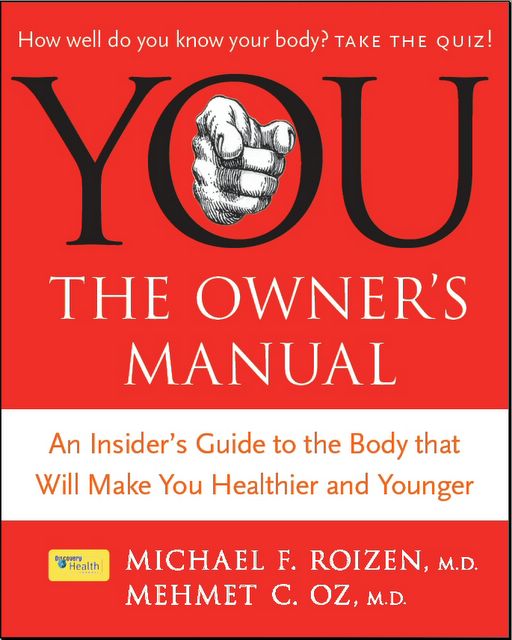
 This book tells you. For example:
- every day we should eat whole grains (nuts), fruits, wholewheat bread
- 3 times a week we should consume fish, like salmon, not tuna which contains mercury and other toxins
- red wine is very healthy as an anti-oxidant
- the colon is the most closely related organ to our brains, in structure and composition, and is constantly releasing all sorts of chemicals into the body which effects our brains, mood, energy, and general ability to function, including the levels of antibodies
- fat attached to the colon is far more dangerous (and mobile) than any other fat in the body, say on the arms and legs
- on average, everyone, men and women, pass gas (fart, make a stink, poof etc) 14 times a day
- one should visit the toilet (for number two) once a day, once in two days is also acceptable
- drinking lots of water helps flush out the colon. It's a long convoluted pipe inside of you, and all that food you eat everyday goes through it all the time. Keep it clean. If it gets dirty, it gets like dirty skin. Pimply, and those pimples will become permanent and will give off permanent and painful toxins
- poops are ideally s-shaped, and should come out all at once, and be most. They shouldn't be hard and disconnected
- raisins and other food rich in magnesium (foods that look the way they look when they come out the ground) are good for colon maintenance, especially when combined with calcium
- cancers happen when cells are born deformed
3 things you can do to reduce the risk of cancer by 50%
folic acid - spinach, orange juice
vitamin d - sunshine, orange juice
take aspirin
also consume broccoli, tomatoes and tomato sauce
Is coffee good or bad for you?
Coffee is good for you. It has some side effects, but can reduce liver cancer

What You Should Know If You're Intending To Get Married
HOW DO YOU DECIDE WHO TO MARRY?
(1) You got to find somebody who likes the same stuff. Like, if you like sports, she should like it that you like sports, and she should keep the chips and dip coming.
-- Alan, age 10
(2) No person really decides before they grow up who they're going to marry.
God decides it all way before, and you get to find out later who you're stuck with.
-- Kristen, age 10
WHAT IS THE RIGHT AGE TO GET MARRIED?
(1) Twenty-three is the best age because you know the person FOREVER
by then.
-- Camille, age 10
(2) No age is good to get married at. You got to be a fool to get
married.
-- Freddie, age 6
HOW CAN A STRANGER TELL IF TWO PEOPLE ARE MARRIED?
(1) You might have to guess, based on whether they seem to be yelling
at the same kids.
-- Derrick, age 8
WHAT DO YOU THINK YOUR MOM AND DAD HAVE IN COMMON?
(1) Both don't want any more kids.
-- Lori, age 8
WHAT DO MOST PEOPLE DO ON A DATE?
(1) Dates are for having fun, and people should use them to get to
know each other. Even boys have something to say if you listen long enough.
-- Lynnette, age 8 (isn't she a treasure)
(2) On the first date, they just tell each other lies and that usually
gets them interested enough to go for a second date.
-- Martin, age 10
WHAT WOULD YOU DO ON A FIRST DATE THAT WAS TURNING SOUR?
(1) I'd run home and play dead. The next day I would call all the
newspapers and make sure they wrote about me in all the dead columns.
-- Craig, age 9
WHEN IS IT OKAY TO KISS SOMEONE?
(9) When they're rich.
-- Pam, age 7
(2) The law says you have to be eighteen, so I wouldn't want to mess
with that.
- - Curt, age 7
(3 ) The rule goes like this: If you kiss someone, then you should
marry them and have kids with them. It's the right thing to do.
-- Howard, age 8
IS IT BETTER TO BE SINGLE OR MARRIED?
(1 ) It's better for girls to be single but not for boys. Boys need
someone to clean up after them.
-- Anita, age 9
HOW WOULD THE WORLD BE DIFFERENT IF PEOPLE DIDN'T GET MARRIED?
(1 ) There sure would be a lot of kids to explain, wouldn't there?
-- Kelvin, age 8
And the #1 Favorite is........
HOW WOULD YOU MAKE A MARRIAGE WORK?
(1 ) Tell your wife that she looks pretty, even if she looks like a
truck.
-- Ricky, age 10
(1) You got to find somebody who likes the same stuff. Like, if you like sports, she should like it that you like sports, and she should keep the chips and dip coming.
-- Alan, age 10
(2) No person really decides before they grow up who they're going to marry.
God decides it all way before, and you get to find out later who you're stuck with.
-- Kristen, age 10
WHAT IS THE RIGHT AGE TO GET MARRIED?
(1) Twenty-three is the best age because you know the person FOREVER
by then.
-- Camille, age 10
(2) No age is good to get married at. You got to be a fool to get
married.
-- Freddie, age 6
HOW CAN A STRANGER TELL IF TWO PEOPLE ARE MARRIED?
(1) You might have to guess, based on whether they seem to be yelling
at the same kids.
-- Derrick, age 8
WHAT DO YOU THINK YOUR MOM AND DAD HAVE IN COMMON?
(1) Both don't want any more kids.
-- Lori, age 8
WHAT DO MOST PEOPLE DO ON A DATE?
(1) Dates are for having fun, and people should use them to get to
know each other. Even boys have something to say if you listen long enough.
-- Lynnette, age 8 (isn't she a treasure)
(2) On the first date, they just tell each other lies and that usually
gets them interested enough to go for a second date.
-- Martin, age 10
WHAT WOULD YOU DO ON A FIRST DATE THAT WAS TURNING SOUR?
(1) I'd run home and play dead. The next day I would call all the
newspapers and make sure they wrote about me in all the dead columns.
-- Craig, age 9
WHEN IS IT OKAY TO KISS SOMEONE?
(9) When they're rich.
-- Pam, age 7
(2) The law says you have to be eighteen, so I wouldn't want to mess
with that.
- - Curt, age 7
(3 ) The rule goes like this: If you kiss someone, then you should
marry them and have kids with them. It's the right thing to do.
-- Howard, age 8
IS IT BETTER TO BE SINGLE OR MARRIED?
(1 ) It's better for girls to be single but not for boys. Boys need
someone to clean up after them.
-- Anita, age 9
HOW WOULD THE WORLD BE DIFFERENT IF PEOPLE DIDN'T GET MARRIED?
(1 ) There sure would be a lot of kids to explain, wouldn't there?
-- Kelvin, age 8
And the #1 Favorite is........
HOW WOULD YOU MAKE A MARRIAGE WORK?
(1 ) Tell your wife that she looks pretty, even if she looks like a
truck.
-- Ricky, age 10
What I will do back in South Africa
We have a farm in Africa (sounds kind've poetic, doesn't it), with a lot of wild veld, and some lovely settings around the river that flows through it. It's a tranquil setting, a lovely place to hear the birds sing and the grass whisper.
I got an email from my father this morning, before his departure to Greece tomorrow.
He writes:
A lodge/conference/wedding facility at the farm should work...The process to get it going has started in earnest and you can get involved with that when you come back and maybe some property developement.
So that should be interesting, and an exciting and welcome departure from what I've been doing for the last couple of years ;-)
I got an email from my father this morning, before his departure to Greece tomorrow.
He writes:
A lodge/conference/wedding facility at the farm should work...The process to get it going has started in earnest and you can get involved with that when you come back and maybe some property developement.
So that should be interesting, and an exciting and welcome departure from what I've been doing for the last couple of years ;-)
#1 Run
I started this run at a comfortable pace with Corneli. She actually did her longest outdoor run ever, over an hour (and 2 laps) so well done.
After about 2 laps I did 10 pullups. I am definitely getting stronger, as I could barely manage 10 pullups when I weighed 75kg, almost 10kg lighter than I am now.
Felt a little uncomfortable on the run. Stiff, needed the loo for number two, and felt like a swallowed a bug.
Run: 1:36
Distance: 14km
Heart rate: 144 average (181 max - Phoof!)
KCal: 1531
Temperature average: 29C (but felt cool and wet)
Pullups: 10
On cue, as I started my last lap, a Korean guy came trotting past me. I had already picked up my pace, and now I picked it up even more.
I knew I wasn't going to outrun this guy, but I thought I'd try to keep him company for at least a kilometre. I made the big bridge my target.
I really didn't want him to feel threatened and run away from me, so just tucked in gently on his shoulder. I'm sure he could hear me breathing, so he probably knew I was just measuring myself against his pace, not taking him on. Unlike all the other guys I chased, he didn't change his pace much at all.
Once or twice it just felt too hard, and then I had to dig deep. About three hundred metres from the bridge I started to fade again, and he slowed up slightly, and made a friendly gesture and said something like, "English guy, go in front".
I chuckled and gave him a few claps of my hand, and then fell back a step.
I clung on like a limpet though, and then did a last surge to stay on his shoulder as we passed under the bridge. As we did I reached forward and tapped his shoulder, barely capable of spluttering the world "Jarasayeo": well done.
Then I eased down from an absolutely exploding heartbeat (181) and shuffled slowly home. Must run at least once more this week.
It's actually a good feeling running so hard. I really feel that I'm burning it when I do. I can't imagine you can stay too heavy when you're pushing yourself as hard as I was...obviously need to do it more.
I've abandoned the Day X (X) format as I've decided to take a much more simplistic approach to training, for now; my form is not good, so I'm not going to do Ulgin. I'll just concentrate on improving my run, and very gradually work on the fitness of the other two sports.
For the record, today was Day 28. No training over the weekend.
Why Kunstler, Simmons and Peak Oil Now Makes Sense
ON WHY HIGH IQ FAILS US, THE FREAKONOMICS OF PEAK OIL, AND HORSE BREEDING, MANHATTAN STYLE
by Dimitri Podborits
Part One
I find myself in a very strange situation. Everywhere I look I see very smart people expressing confident opinions about some future developments of various large and small-scale financial and economic phenomena. One might assume that these opinions should somehow filter into various decision making processes for for various kinds of analytical, strategic and tactical thinking. Therefore, one might hope that the opinions expressed by the smartest people with the most confidence are the most informed, balanced and rational.
However, often I observe the opposite trend: the smarter the people are, the less they are interested in the world around them and the more confident their opinions become. Under these conditions, high IQ becomes almost a handicap. It is almost as if a storm would be forecast and a person would be warned to seek shelter, and his response would be – "Don't try to scare me – I am too smart to seek shelter. I am confident in my ability to always outsmart the storm".
You would think that his level of confidence would be correlated with the information the person has about the severity of the coming storm. But no, the person is not even interested in the storm. He cheerfully observes that he has little understanding of storms in general and has not even bothered to look into the information gathered by others about this particular approaching storm. He is not interested in these things. This, however, does not affect the confidence of his opinion or forecast which (the confidence) is based solely on understanding himself as a smart, high-IQ person. And this is something that is hard to argue with – yes, he is smart, "high IQ" is written all over his forehead. Nevertheless, you almost wish he wasn't, since high IQ makes him more vulnerable, not less, and his forecast more flawed.
One can speculate on the origins of this paradox. There is a well-researched phenomenon in evolutionary biology called Zahavi's handicap principle, which establishes that certain types of animal morphology and behavior evolve precisely because they reduce the animal's fitness and penalize its chance for survival. A peacock's tail is an obvious example. One can observe that a peacock's tail is almost "deliberately designed" to introduce a higher cost for survival for the host animal and therefore to communicate to others (including predators and potential mates) that the peacock-carrier of the larger tail is the animal with superior genes.
I propose that a very smart person deliberately ignoring reality and expressing extremely shallow opinions with extreme confidence based on no thinking at all behaves much like a peacock advertising to predators his costly tail. The message that he broadcasts is basically this: "Look at me -- I am so obviously smart that I can deliberately make extremely dumb statements with a very high degree of confidence; it takes a really high-IQ person to totally ignore reality and still be this confident in his forecast".
Under these circumstances, the worst possible thing someone on the receiving end of an "opinion" can do is to assume that smarter people express more informed, more based-on-reality, and more rational opinions. I cannot warn people strongly enough: beware of smart people expressing confident opinions or forecasts.
A case in point – a recent series of commentaries on the topic of "Peak Oil" by two eminent economists (and self-described "rogue" economists) who wrote an award-winning and best-selling book, Freakonomics. The book, which I greatly enjoyed (in the audio version) discusses various phenomena traditionally viewed outside the realm of economics from the classical economics standpoint. The book is well-written, insightful, makes a number of interesting observations and very quickly appeared on multiple bestseller lists.
I'd like to note, however, that the self-definition of the Freakonomics' authors as "rogue" economists is largely misleading. The success of the book is based on the application of the known patterns of human behavior -- the chief of which is the generalization that "people respond to incentives" -- to the analysis of human dynamics nontraditional to the economics at large, such as illicit drug dealing and abortion. Obviously, if one can talk about "the economics of Hollywood" and "the economics of healthcare", one can also talk about the economics of crack-cocaine, because in all cases it is ultimately the human behavior that underlines all of these dynamics. In this sense, the authors are not really "rogue" economists, as they do not undermine any of the reigning economic principles; they embrace them and apply them to the areas of human behavior unfamiliar to the economics as practices by the "economic establishment" (if there is such an institution).
The problem starts, however, when the "freakonomists" begin to obnoxiously profess that since some dynamics can be understood within the context of human behavioral patterns, then all dynamics can be understood with human behavioral patterns.
One such dynamic of supreme importance centers around the Peak Oil phenomena that has finally entered into the mainstream of public debate, as evidenced by the Peter Maass' article in New York Times magazine. Jim Kunstler criticized Maass' article last week for being wishy-washy about the issue of Peak Oil; to his criticism I would add that Maass in the article dedicated in part to the research by Matt Simmons noncritically repeats the official Saudi number for total recoverable Saudi oil reserves as 260 billion barrels (the claim never substantiated in public statements by field-by-field breakdown by Saudi Aramco or the Saudi government), while analyses abound by Simmons, Campbell, McKillop and other authoritative industry observers claiming that the official number has no basis in reality.
Nevertheless, I believe that the Maass' article is a valuable and welcome development since it increases, not decreases the overall public understanding of the Peak Oil phenomenon.
Freakonomists, however, confidently claim that the Peak Oil will be a non-event. In the leading commentary on the topic in the authors' blog, titled "Peak Oil: welcome to the new media's version of shark attacks," and then in the follow-up commentary, they ridicule the PO phenomena as a media-fabricated frenzy and portray the people analyzing this topic as a new incarnation of obscure alchemist tinkerers -- charmingly ridiculous in their doomed determination, but harmless.
On what basis? After all, the freakonomists cheerfully state that "I don't know much about world oil reserves. I'm not even necessarily arguing with their facts about how much the output from existing oil fields is going to decline, or that world demand for oil is increasing. But these changes in supply and demand are slow and gradual -- a few percent each year."
Well, this is how they describe their worldview:
"What most of these doomsday scenarios have gotten wrong is the fundamental idea of economics: people respond to incentives. If the price of a good goes up, people demand less of it, the companies that make it figure out how to make more of it, and everyone tries to figure out how to produce substitutes for it. Add to that the march of technological innovation (like the green revolution, birth control,
etc.). The end result: markets figure out how to deal with problems of
supply and demand.
Which is exactly the situation with oil right now. I don't know much about world oil reserves. I'm not even necessarily arguing with their facts about how much the output from existing oil fields is going to decline, or that world demand for oil is increasing. But these changes in supply and demand are slow and gradual -- a few percent each year.
Markets have a way with dealing with situations like this: prices rise a little bit. That is not a catastrophe, it is a message that some things that used to be worth doing at low oil prices are no longer worth doing. Some people will switch from SUVs to hybrids, for instance. Maybe we'll be willing to build some nuclear power plants,
or it will become worth it to put solar panels on more houses."
And finally, the last nail in the coffin of these pesky Peak Oil doomsayers:
"As [Maass] notes, high prices lead people to develop substitutes.
Which is exactly why we don't need to panic over peak oil in the first place."
The scariest thing for me here is not the flimsiness and the stupidity of the rebuttal, but the CONFIDENCE and the LACK OF INTEREST IN THE REALITIES OF THE WORLD that they are pronounced with. Even scarier,
however, is that these commentators are smart people with high IQ, regarded throughout the world as authorities in economics. When these two talk, many listen.
Of course people respond to incentives! Of course markets will attempt (as they have been attempting for a long time, without success) to find substitutes within the same basic economic structure.
However, is there a physical law stating that an adequate substitute, fitting into any existing infrastructure and cost structure, and satisfying the needs of any living arrangement, has to exist? I wish the freakonomists were there with me during my various travels -- from Mexico to Greece to Alaska -- where I saw communities of various scales abandoned and in ruins because the populace couldn't find at sufficient cost and quantities the resources they have come to depend upon, from water to arable soil to fish in the sea to mineable minerals. What if the vast literature dedicated to discussing the inadequacy of all currently known putative replacements for cheap oil has a point?
So, if we are not lucky enough to find a sufficient replacement for cheap oil, what will our response be? How will we, so to speak, respond to incentives?
Well, as Kunstler euphemistically puts it, "we will have to make other arrangements." This will basically mean that the society will change its very fabric and structure in response to the post-cheap oil circumstances.
The structure of the "new arrangements" arrangement may be, however, very unfamiliar from the point of view of "the world as we know it" -- a Maass' term that the freakonomists disagree with. I also think that a better term would be "the world as we practice it".
For example, one of the "responses to incentives" can be described as "making do with less", as in malnutrition or starvation.
Another response under the same circumstances can be described as "going to war".
Yet another response can be described as "mass migration away from the areas that have become uninhabitable, into the still habitable areas whose longtime residents would not be too happy to share their own resources with the newcomers".
And yet another response could be described as "reorganizing the economy around local food production".
Of course, there could be still other arrangements including elements of several or all of the previous four, plus some other yet unmentioned. However, they all would reflect "the new equilibrium" of the post-cheap oil world.
If someone can show me that a perfect market and even a lessaiz fair economy cannot respond to incentives along these lines, I would be very interested. I think that a big mistake that the freakonomists make even in their "pure economic," i.e. maximally abstract, nonspecific and detached-from-reality considerations when they dismiss any changes, is that they equate the notion of a market economy with the notion of a growing economy, and also with a consumer economy. These, however, are not the same things. A market economy, for example, can remain such even while becoming, under post-cheap oil circumstances, a contracting or imploding economy. How this scenario would correspond to the notion of the consumer economy I would leave as an exercise to the esteemed freakonomists.
Furthermore. I have carefully looked at the economic side of the argument and have not found any substantiation of the claim that "the changes in supply and demand would be slow and gradual – a few percent per year." I don't see how even against the backdrop of a perfect market economy, say, Ghawar's production cannot collapse fairly quickly due to geological maturity and overinjection of seawater, as Simmons suggests. I don't see how the same cannot happen with any other of the currently producing fields, or several fields at once at some point in the fairly near future. What cutting-edge economic thinking precludes, for example, the oil province of Saudi Arabia to start declining at the rate of, say, North Sea or Alaska's North Slope?
The authors claim:
"If oil prices rise, consumers of oil will be (a little) worse off.
But, we are talking about needing to cut demand by a few percent a
year. That doesn't mean putting windmills on cars, it means cutting
out a few low value trips. It doesn't mean abandoning North Dakota, it
means keeping the thermostat a degree or two cooler in the winter."
It appears to me that the authors somehow missed in their analysis that the decline of, say, 5% per year in consumption of fossil fuels (against the backdrop of, say, 1% of overall population growth due to demographic reasons and mass migration away from the areas hit the hardest) would translate into a roughly 50% of fossil fuel usage reduction after 10 years. That's the core of the PO argument with which the authors "are not necessarily arguing with" -- that past peak, the oil production will continue to fall, as it will take ever-increasing heroic expenses to keep it flat, and any successes in keeping it flat will be necessarily temporary.
So, in a dozen of years in this scenario -- probably still within the economic life time of a brand new Hummer H2, which has by then recently descended from a factory conveyer somewhere in the state of Michigan on the day the oil has peaked (that day will be known only post factum, of course), purchased through an employee incentives discount and financed on credit, the owner will have to cut a nonessential 50% of his overall driving, keep the thermostata mere 25 or 30 degrees lower and face doing more of the same in subsequent years, all without abandoning North Dakota, or making any other lifestyle changes.
One could comment that the "freakonomists" seem to have gone pretty far in life for people exhibiting the kind of thinking (as well as the level of confidence in their own thinking) that they demonstrate. This observation helps matters very little, though. It is not the shallowness of their analysis, total lack of interest to the underlying realities, and a 15 second attention span -- it is how widely and noncritically such views are accepted that I find most disturbing here.
by Dimitri Podborits
Part One
I find myself in a very strange situation. Everywhere I look I see very smart people expressing confident opinions about some future developments of various large and small-scale financial and economic phenomena. One might assume that these opinions should somehow filter into various decision making processes for for various kinds of analytical, strategic and tactical thinking. Therefore, one might hope that the opinions expressed by the smartest people with the most confidence are the most informed, balanced and rational.
However, often I observe the opposite trend: the smarter the people are, the less they are interested in the world around them and the more confident their opinions become. Under these conditions, high IQ becomes almost a handicap. It is almost as if a storm would be forecast and a person would be warned to seek shelter, and his response would be – "Don't try to scare me – I am too smart to seek shelter. I am confident in my ability to always outsmart the storm".
You would think that his level of confidence would be correlated with the information the person has about the severity of the coming storm. But no, the person is not even interested in the storm. He cheerfully observes that he has little understanding of storms in general and has not even bothered to look into the information gathered by others about this particular approaching storm. He is not interested in these things. This, however, does not affect the confidence of his opinion or forecast which (the confidence) is based solely on understanding himself as a smart, high-IQ person. And this is something that is hard to argue with – yes, he is smart, "high IQ" is written all over his forehead. Nevertheless, you almost wish he wasn't, since high IQ makes him more vulnerable, not less, and his forecast more flawed.
One can speculate on the origins of this paradox. There is a well-researched phenomenon in evolutionary biology called Zahavi's handicap principle, which establishes that certain types of animal morphology and behavior evolve precisely because they reduce the animal's fitness and penalize its chance for survival. A peacock's tail is an obvious example. One can observe that a peacock's tail is almost "deliberately designed" to introduce a higher cost for survival for the host animal and therefore to communicate to others (including predators and potential mates) that the peacock-carrier of the larger tail is the animal with superior genes.
I propose that a very smart person deliberately ignoring reality and expressing extremely shallow opinions with extreme confidence based on no thinking at all behaves much like a peacock advertising to predators his costly tail. The message that he broadcasts is basically this: "Look at me -- I am so obviously smart that I can deliberately make extremely dumb statements with a very high degree of confidence; it takes a really high-IQ person to totally ignore reality and still be this confident in his forecast".
Under these circumstances, the worst possible thing someone on the receiving end of an "opinion" can do is to assume that smarter people express more informed, more based-on-reality, and more rational opinions. I cannot warn people strongly enough: beware of smart people expressing confident opinions or forecasts.
A case in point – a recent series of commentaries on the topic of "Peak Oil" by two eminent economists (and self-described "rogue" economists) who wrote an award-winning and best-selling book, Freakonomics. The book, which I greatly enjoyed (in the audio version) discusses various phenomena traditionally viewed outside the realm of economics from the classical economics standpoint. The book is well-written, insightful, makes a number of interesting observations and very quickly appeared on multiple bestseller lists.
I'd like to note, however, that the self-definition of the Freakonomics' authors as "rogue" economists is largely misleading. The success of the book is based on the application of the known patterns of human behavior -- the chief of which is the generalization that "people respond to incentives" -- to the analysis of human dynamics nontraditional to the economics at large, such as illicit drug dealing and abortion. Obviously, if one can talk about "the economics of Hollywood" and "the economics of healthcare", one can also talk about the economics of crack-cocaine, because in all cases it is ultimately the human behavior that underlines all of these dynamics. In this sense, the authors are not really "rogue" economists, as they do not undermine any of the reigning economic principles; they embrace them and apply them to the areas of human behavior unfamiliar to the economics as practices by the "economic establishment" (if there is such an institution).
The problem starts, however, when the "freakonomists" begin to obnoxiously profess that since some dynamics can be understood within the context of human behavioral patterns, then all dynamics can be understood with human behavioral patterns.
One such dynamic of supreme importance centers around the Peak Oil phenomena that has finally entered into the mainstream of public debate, as evidenced by the Peter Maass' article in New York Times magazine. Jim Kunstler criticized Maass' article last week for being wishy-washy about the issue of Peak Oil; to his criticism I would add that Maass in the article dedicated in part to the research by Matt Simmons noncritically repeats the official Saudi number for total recoverable Saudi oil reserves as 260 billion barrels (the claim never substantiated in public statements by field-by-field breakdown by Saudi Aramco or the Saudi government), while analyses abound by Simmons, Campbell, McKillop and other authoritative industry observers claiming that the official number has no basis in reality.
Nevertheless, I believe that the Maass' article is a valuable and welcome development since it increases, not decreases the overall public understanding of the Peak Oil phenomenon.
Freakonomists, however, confidently claim that the Peak Oil will be a non-event. In the leading commentary on the topic in the authors' blog, titled "Peak Oil: welcome to the new media's version of shark attacks," and then in the follow-up commentary, they ridicule the PO phenomena as a media-fabricated frenzy and portray the people analyzing this topic as a new incarnation of obscure alchemist tinkerers -- charmingly ridiculous in their doomed determination, but harmless.
On what basis? After all, the freakonomists cheerfully state that "I don't know much about world oil reserves. I'm not even necessarily arguing with their facts about how much the output from existing oil fields is going to decline, or that world demand for oil is increasing. But these changes in supply and demand are slow and gradual -- a few percent each year."
Well, this is how they describe their worldview:
"What most of these doomsday scenarios have gotten wrong is the fundamental idea of economics: people respond to incentives. If the price of a good goes up, people demand less of it, the companies that make it figure out how to make more of it, and everyone tries to figure out how to produce substitutes for it. Add to that the march of technological innovation (like the green revolution, birth control,
etc.). The end result: markets figure out how to deal with problems of
supply and demand.
Which is exactly the situation with oil right now. I don't know much about world oil reserves. I'm not even necessarily arguing with their facts about how much the output from existing oil fields is going to decline, or that world demand for oil is increasing. But these changes in supply and demand are slow and gradual -- a few percent each year.
Markets have a way with dealing with situations like this: prices rise a little bit. That is not a catastrophe, it is a message that some things that used to be worth doing at low oil prices are no longer worth doing. Some people will switch from SUVs to hybrids, for instance. Maybe we'll be willing to build some nuclear power plants,
or it will become worth it to put solar panels on more houses."
And finally, the last nail in the coffin of these pesky Peak Oil doomsayers:
"As [Maass] notes, high prices lead people to develop substitutes.
Which is exactly why we don't need to panic over peak oil in the first place."
The scariest thing for me here is not the flimsiness and the stupidity of the rebuttal, but the CONFIDENCE and the LACK OF INTEREST IN THE REALITIES OF THE WORLD that they are pronounced with. Even scarier,
however, is that these commentators are smart people with high IQ, regarded throughout the world as authorities in economics. When these two talk, many listen.
Of course people respond to incentives! Of course markets will attempt (as they have been attempting for a long time, without success) to find substitutes within the same basic economic structure.
However, is there a physical law stating that an adequate substitute, fitting into any existing infrastructure and cost structure, and satisfying the needs of any living arrangement, has to exist? I wish the freakonomists were there with me during my various travels -- from Mexico to Greece to Alaska -- where I saw communities of various scales abandoned and in ruins because the populace couldn't find at sufficient cost and quantities the resources they have come to depend upon, from water to arable soil to fish in the sea to mineable minerals. What if the vast literature dedicated to discussing the inadequacy of all currently known putative replacements for cheap oil has a point?
So, if we are not lucky enough to find a sufficient replacement for cheap oil, what will our response be? How will we, so to speak, respond to incentives?
Well, as Kunstler euphemistically puts it, "we will have to make other arrangements." This will basically mean that the society will change its very fabric and structure in response to the post-cheap oil circumstances.
The structure of the "new arrangements" arrangement may be, however, very unfamiliar from the point of view of "the world as we know it" -- a Maass' term that the freakonomists disagree with. I also think that a better term would be "the world as we practice it".
For example, one of the "responses to incentives" can be described as "making do with less", as in malnutrition or starvation.
Another response under the same circumstances can be described as "going to war".
Yet another response can be described as "mass migration away from the areas that have become uninhabitable, into the still habitable areas whose longtime residents would not be too happy to share their own resources with the newcomers".
And yet another response could be described as "reorganizing the economy around local food production".
Of course, there could be still other arrangements including elements of several or all of the previous four, plus some other yet unmentioned. However, they all would reflect "the new equilibrium" of the post-cheap oil world.
If someone can show me that a perfect market and even a lessaiz fair economy cannot respond to incentives along these lines, I would be very interested. I think that a big mistake that the freakonomists make even in their "pure economic," i.e. maximally abstract, nonspecific and detached-from-reality considerations when they dismiss any changes, is that they equate the notion of a market economy with the notion of a growing economy, and also with a consumer economy. These, however, are not the same things. A market economy, for example, can remain such even while becoming, under post-cheap oil circumstances, a contracting or imploding economy. How this scenario would correspond to the notion of the consumer economy I would leave as an exercise to the esteemed freakonomists.
Furthermore. I have carefully looked at the economic side of the argument and have not found any substantiation of the claim that "the changes in supply and demand would be slow and gradual – a few percent per year." I don't see how even against the backdrop of a perfect market economy, say, Ghawar's production cannot collapse fairly quickly due to geological maturity and overinjection of seawater, as Simmons suggests. I don't see how the same cannot happen with any other of the currently producing fields, or several fields at once at some point in the fairly near future. What cutting-edge economic thinking precludes, for example, the oil province of Saudi Arabia to start declining at the rate of, say, North Sea or Alaska's North Slope?
The authors claim:
"If oil prices rise, consumers of oil will be (a little) worse off.
But, we are talking about needing to cut demand by a few percent a
year. That doesn't mean putting windmills on cars, it means cutting
out a few low value trips. It doesn't mean abandoning North Dakota, it
means keeping the thermostat a degree or two cooler in the winter."
It appears to me that the authors somehow missed in their analysis that the decline of, say, 5% per year in consumption of fossil fuels (against the backdrop of, say, 1% of overall population growth due to demographic reasons and mass migration away from the areas hit the hardest) would translate into a roughly 50% of fossil fuel usage reduction after 10 years. That's the core of the PO argument with which the authors "are not necessarily arguing with" -- that past peak, the oil production will continue to fall, as it will take ever-increasing heroic expenses to keep it flat, and any successes in keeping it flat will be necessarily temporary.
So, in a dozen of years in this scenario -- probably still within the economic life time of a brand new Hummer H2, which has by then recently descended from a factory conveyer somewhere in the state of Michigan on the day the oil has peaked (that day will be known only post factum, of course), purchased through an employee incentives discount and financed on credit, the owner will have to cut a nonessential 50% of his overall driving, keep the thermostata mere 25 or 30 degrees lower and face doing more of the same in subsequent years, all without abandoning North Dakota, or making any other lifestyle changes.
One could comment that the "freakonomists" seem to have gone pretty far in life for people exhibiting the kind of thinking (as well as the level of confidence in their own thinking) that they demonstrate. This observation helps matters very little, though. It is not the shallowness of their analysis, total lack of interest to the underlying realities, and a 15 second attention span -- it is how widely and noncritically such views are accepted that I find most disturbing here.
Monday, August 29, 2005


This photo was taken with Corneli's new Canon camera, bought on Saturday in Yongsan. 5 Megapixels. I need to upgrade my camera, which is 1.3 megapixels. Have my eye on a Canon Sd300 powershot. A bit expensive at W500 000, but obviously it's a good buy because it seems to be sold out everywhere. Even on some websites it's sold out.

Katrina may be 'our Asian tsunami'

Sunday, August 28, 2005; Posted: 10:46 p.m. EDT (02:46 GMT)
(CNN) -- Flooding expected from Hurricane Katrina could wreak catastrophe on New Orleans, overwhelming its water and sewage systems, damaging its structures and leaving survivors in a bowl of toxic soup, a top hurricane expert said Sunday.
Landfall is expected early Monday. (Latest report)
"We need to recognize we may be about to experience our equivalent of the Asian tsunami, in terms of the damage and the numbers of people that can be killed," said Ivor van Heerden, director of the Louisiana State University Public Health Research Center in Baton Rouge.
Some 25 feet of standing water is expected in many parts of the city -- almost twice the height of the average home -- and computer models suggest that more than 80 percent of buildings would be badly damaged or destroyed, he said. (Watch a report on the worst-case scenario)
Floodwaters from the east will carry toxic waste from the "Industrial Canal" area, nicknamed after the chemical plants there. From the west, floodwaters would flow through the Norco Destrehan Industrial Complex, which includes refineries and chemical plants, said van Heerden, who has studied computer models about the impact of a strong hurricane for four years.
"These chemical plants are going to start flying apart, just as the other buildings do," he predicted. "So, we have the potential for release of benzene, hydrochloric acid, chlorine and so on."
That could result in severe air and water pollution, he said.
In New Orleans, which lies below sea level, gas and diesel tanks are all located above ground for the same reason that bodies are buried above ground. In the event of a flood, "those tanks will start to float, shear their couplings, and we'll have the release of these rather volatile compounds," van Heerden added.
Because gasoline floats on water, "we could end up with some pretty severe and large -- area-wise -- fires."
"So, we're looking at a bowl full of highly contaminated water with contaminated air flowing around and, literally, very few places for anybody to go where they'll be safe."
He went further.
"So, imagine you're the poor person who decides not to evacuate: Your house will disintegrate around you. The best you'll be able to do is hang on to a light pole, and while you're hanging on, the fire ants from all the mounds -- of which there is two per yard on average -- will clamber up that same pole. And, eventually, the fire ants will win."
The levees intended to protect the city vary in height, from as low as 10 feet above sea level to about 14 feet, he said. They too are vulnerable, because they are made of earth, he said.
Disaster waiting to happen
Previous studies have suggested a catastrophic toll in lives and property if a major hurricane were to hit the New Orleans area, where about 1.3 million people live.
Walter Maestri, the emergency management chief in neighboring Jefferson Parish, said Hurricane Georges in 1998 could have killed as many as 44,000 people had it struck the city directly.
"The way it's described, we describe it here, is Lake Pontchartrain has now become Lake New Orleans," he told CNN in 2004.
Van Heerden said levees built to protect New Orleans from Lake Pontchartrain could be buffeted by waves from the lake, which is about 23 miles by 35 miles in area.
"You're going to have enormous waves develop on that lake, especially with as much as 14 hours of hurricane-force winds." Those waves will erode the levees, raising the possibility of their collapse, he said.
"This is what we've been saying has been going to happen for years," he said. "Unfortunately, it's coming true."
Rick Luettich, a professor at the University of North Carolina's Institute of Marine Sciences, compared Katrina's expected impact on areas far up the Mississippi to "grabbing the end of the bed cover and giving it a hard snap."
That snap will push "probably in excess of 10 feet" of floodwater up the river, he predicted. "It will propagate up the river like a wave," past Baton Rouge, more than 70 miles away, he said.
For 15 years, Luettich has been developing a hydrodynamic circulation model -- called AdCirc -- that he said the Federal Emergency Management Agency has endorsed to help emergency managers predict storm damage.
Apologizing for the possibility that his comment could be interpreted as somewhat ghoulish, he said, "This is, in some ways, a little bit exciting for us, because it's a real opportunity to test this technology we've developed and see how well it works."
37/1 Good Day
Am having a good and productive day despite the dire predictions for Louisiana. Not sure why President Bush is still on vacation. If anything, he should be ordering a massive airlift using military transports - apparently there are still 10 000 people still in the New Orleans area. Things can turn out really really badly there. Time will tell.
Going to run tonight. Did not train at all this weekend, but am fairly comfortable with that. Drank a little and watched the rugby and had quite a good time.
Also going to add a slave drive to my computer tonight, and format the other drive with Brian's help tonight.
Still hot here.
Going to run tonight. Did not train at all this weekend, but am fairly comfortable with that. Drank a little and watched the rugby and had quite a good time.
Also going to add a slave drive to my computer tonight, and format the other drive with Brian's help tonight.
Still hot here.
$70

Here's a prime example of why changing our climate matters:
Oil surges over $70 on Katrina
By Paul Marriott 43 minutes ago
SYDNEY (Reuters) - U.S. oil prices surged to a record above $70 a barrel on Monday as one of the country's biggest storms tore through the U.S. Gulf of Mexico, forcing oil producers and refiners to shut down operations.
U.S. crude oil futures soared nearly $5 a barrel in opening trade to touch a fresh peak of $70.80 a barrel, surpassing last week's $68 high to the highest price since the New York Mercantile Exchange (NYMEX) began trading contracts in 1983.
It later traded up $3.42 a barrel, 5.2 percent, at $69.55.
Oil product and natural gas prices also shot higher to records, with gasoline soaring 10 percent to $2.13 a gallon and heating oil rocketing past $2 a gallon for the first time. Natural gas prices were up 20 percent.
Prices leapt as Hurricane Katrina, the eleventh named storm of what is expected to be an unusually severe season, threatened to do lasting damage to the vital U.S. oil and refining region, further straining an industry that has struggled to keep up with two years of strongly rising oil demand.
New Orleans braces for monster hurricane

Sunday, August 28, 2005; Posted: 8:29 p.m. EDT (00:29 GMT)
NEW ORLEANS, Louisiana (CNN) -- New Orleans braced for a catastrophic blow from Hurricane Katrina overnight, as forecasters predicted the Category 5 storm could drive a wall of water over the city's levees.
The huge storm, packing 160 mph winds, is expected to hit the northern Gulf Coast in the next 12 hours and make landfall as a Category 4 or 5 hurricane Monday morning.
The National Hurricane Center reports that conditions are already deteriorating along the central and northeastern coast.
A statement from the National Weather Service in Slidell, near New Orleans, Louisiana, warned that much of the affected area "will be uninhabitable for weeks, perhaps longer."
Low-rise, wood-frame buildings will be destroyed, and concrete apartment buildings "will sustain major damage," it said.
"High-rise office and apartment buildings will sway dangerously, a few to the point of total collapse," the warning read.
"All windows will blow out. Airborne debris will be widespread, and may include heavy items such as household appliances and even light vehicles."
New Orleans Mayor Ray Nagin declared a state of emergency Sunday and ordered a mandatory evacuation of the city.
Nagin exempted essential federal, state, and local personnel; emergency and utility workers; transit workers; media; hotel workers; and patrons from the evacuation order."We are facing a storm that most of us have feared," Nagin said. "I do not want to create panic, but I do want the citizens to understand that this is very serious and it's of the highest nature.
Hurricane KATRINA Public Advisory
 BULLETIN
HURRICANE KATRINA INTERMEDIATE ADVISORY NUMBER 24A
NWS TPC/NATIONAL HURRICANE CENTER MIAMI FL
7 PM CDT SUN AUG 28 2005
...POTENTIALLY CATASTROPHIC HURRICANE KATRINA NOW MOVING
NORTH-NORTHWESTWARD TOWARD THE NORTHERN GULF COAST...
A HURRICANE WARNING IS IN EFFECT FOR THE NORTH CENTRAL GULF COAST
FROM MORGAN CITY LOUISIANA EASTWARD TO THE ALABAMA/FLORIDA
BORDER...INCLUDING THE CITY OF NEW ORLEANS AND LAKE PONTCHARTRAIN.
PREPARATIONS TO PROTECT LIFE AND PROPERTY SHOULD BE COMPLETED THIS
EVENING.KATRINA IS MOVING TOWARD THE NORTH-NORTHWEST NEAR 11 MPH...AND A
TURN TO THE NORTH IS EXPECTED OVER THE NEXT 24 HOURS. ON THIS TRACK
THE CENTER OF THE HURRICANE WILL BE NEAR THE NORTHERN GULF COAST
EARLY MONDAY. HOWEVER...CONDITIONS ARE ALREADY BEGINNING TO
DETERIORATE ALONG PORTIONS OF THE CENTRAL AND NORTHEASTERN GULF
COAST...AND WILL CONTINUE TO WORSEN THROUGH THE NIGHT.
MAXIMUM SUSTAINED WINDS ARE NEAR 160 MPH...WITH HIGHER GUSTS.
KATRINA IS A POTENTIALLY CATASTROPHIC CATEGORY FIVE HURRICANE ON
THE SAFFIR-SIMPSON SCALE. SOME FLUCTUATIONS IN STRENGTH ARE LIKELY
PRIOR TO LANDFALL...AND KATRINA IS EXPECTED TO MAKE LANDFALL AT
CATEGORY FOUR OR FIVE INTENSITY. WINDS AFFECTING THE UPPER FLOORS
OF HIGH-RISE BUILDINGS WILL BE SIGNIFICANTLY STRONGER THAN THOSE
NEAR GROUND LEVEL.
KATRINA IS A LARGE HURRICANE. HURRICANE FORCE WINDS EXTEND OUTWARD
UP TO 105 MILES FROM THE CENTER...AND TROPICAL STORM FORCE WINDS
EXTEND OUTWARD UP TO 230 MILES. SUSTAINED TROPICAL STORM FORCE
WINDS ARE ALREADY OCCURRING OVER THE SOUTHEAST LOUISIANA COAST.
A NOAA HURRICANE HUNTER PLANE REPORTED A MINIMUM CENTRAL PRESSURE OF
904 MB...26.69 INCHES.
COASTAL STORM SURGE FLOODING OF 18 TO 22 FEET ABOVE NORMAL TIDE
LEVELS...LOCALLY AS HIGH AS 28 FEET...ALONG WITH LARGE AND DANGEROUS
BATTERING WAVES...CAN BE EXPECTED NEAR AND TO THE EAST OF WHERE THE
CENTER MAKES LANDFALL. SOME LEVEES IN THE GREATER NEW ORLEANS AREA
COULD BE OVERTOPPED. SIGNIFICANT STORM SURGE FLOODING WILL OCCUR
ELSEWHERE ALONG THE CENTRAL AND NORTHEASTERN GULF OF MEXICO COAST.
RAINFALL TOTALS OF 5 TO 10 INCHES...WITH ISOLATED MAXIMUM AMOUNTS OF
15 INCHES...ARE POSSIBLE ALONG THE PATH OF KATRINA ACROSS THE GULF
COAST AND THE TENNESSEE VALLEY. RAINFALL TOTALS OF 4 TO 8 INCHES
ARE POSSIBLE ACROSS THE OHIO VALLEY INTO THE EASTERN GREAT LAKES
REGION TUESDAY AND WEDNESDAY.
ISOLATED TORNADOES WILL BE POSSIBLE THIS EVENING OVER SOUTHERN
PORTIONS OF LOUISIANA...MISSISSIPPI...AND ALABAMA...AND OVER THE
FLORIDA PANHANDLE.
REPEATING THE 7 PM CDT POSITION...27.2 N... 89.1 W. MOVEMENT
TOWARD...NORTH-NORTHWEST NEAR 11 MPH. MAXIMUM SUSTAINED WINDS...160
MPH. MINIMUM CENTRAL PRESSURE... 904 MB.
THE NEXT ADVISORY WILL BE ISSUED BY THE NATIONAL
HURRICANE CENTER AT 10 PM CDT.
FORECASTER FRANKLIN
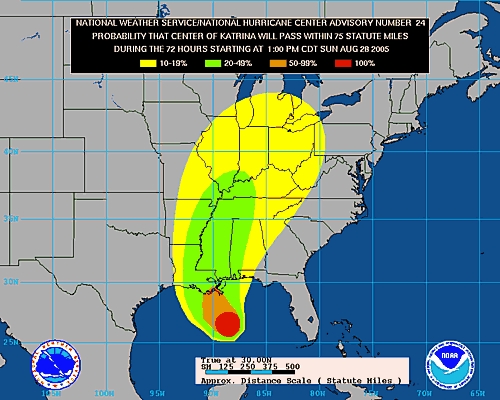
Strike Probabilities
This display shows the probability, in percent, that the center of the tropical cyclone will pass within 75 statute miles of a location during the 72 hours beginning at the time indicated in the caption. The caption also provides the name of the tropical cyclone and the advisory number from which the probabilities were generated. Contour levels shown are 10%, 20%, 50% and 100%.

Subscribe to:
Posts (Atom)