Wednesday, March 15, 2006

High And Dry


That's the title of a book I've tentatively started work on. I'm collecting scraps from a number of newspapers and filing them, actually have been doing so for some months, but will need to arrange a few interviews with high flying energy ministers and local experts. I would like High and Dry to be an authoritative, useful book, one that will give South Africans a sharp prod and wake them up? Ambitious?

I received a call this morning from Louise, who works at reporter.co.za. She called to say that one of my photographs had won me a year long subscription to PIX magazine, and that 23 articles and images had been published (up to a certain date - it's actually more), and I'd receive an automatic eletronic payment in my bank account in a few days. That's good news. Over the past few weeks I there has been a worrying trend - a lot of money flowing out, fairly consistently, and nothing going back in.

I had my hopes on Heartland and on The Friend, but there is very little word on 'showing the money'. There's lots to do of course, but the bottom line is not covered, which is not a positive thing for me at this point.

I am trying to concentrate on what is positive, and continuing to work on new ideas. Writers need to be resilient, and that's being tested now.

My right calf is still sensitive. I really hurt it going up Suikerbossie. I realise over and over again that I was pushing pretty hard.

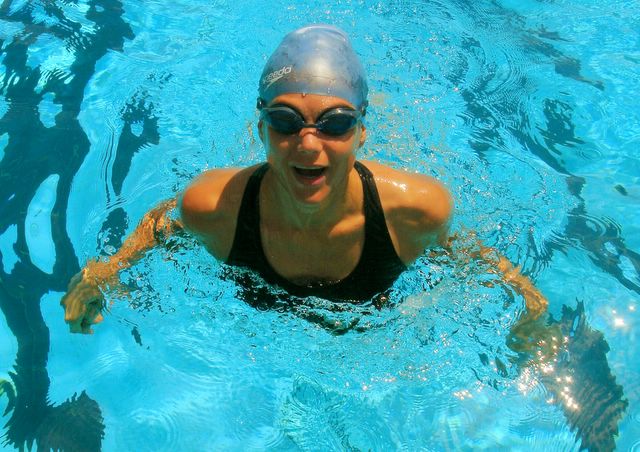
After my tutorial tonight I think I'll go for a swim.


Today, on CNN I watched a guy called Todd saying that the deficit wasn't anything to be concerned about. The problem was easily solved over the long term by Americans that simply need to start saving, or that the dollar would weaken and foreign companies would naturally curb their exports. His explanation says a lot about American psychology. Do nothing, it will all take care of itself. That's also a fat person's attitude to getting thin. Actually, how it work is: No pain, no gain.

When $8 Trillion Isn't Enough
Wednesday, March 15, 2006; Page A18

THE GOVERNMENT, Treasury Secretary John W. Snow informed Congress last week, has now taken "all prudent and legal actions" to avoid bumping up against the debt ceiling. The limit, Mr. Snow told lawmakers, will need to be raised from its current level: $8,184,000,000,000. If you aren't used to deciphering that parade of zeros, let us translate for you: $8.184 trillion isn't enough. The administration is asking for an additional $781 billion.

The inevitable increase will be the fourth such hike in five years, for a total rise in the national credit limit of more than $3 trillion. During his time in office, President Bush has presided over a 46 percent increase in the federal debt, from about $5.6 trillion. By contrast, during President Bill Clinton's two terms, the debt grew from less than $4 trillion to $5.6 trillion, a 28 percent increase -- and during the last few years of his presidency, Mr. Clinton actually began to pay down the country's "real" debt, that is, debt held by the public, as opposed to the IOUs in Social Security and other government accounts.

Put another way, Mr. Bush has managed to rack up more new debt during his five years in office than the entire debt amassed by the United States through 1988. And there is more to come: The president's budget envisions the debt rising to $11.5 trillion by 2011. This means that an increasing share of an increasingly tight budget must be devoted simply to paying interest -- an estimated $220 billion this fiscal year alone. Remember: This is the president who entered office promising to pay off $2 trillion in debt held by the public over the next decade. Far from being paid down, the debt held by the public has grown, from $3.3 trillion in 2001 to $5 trillion this year.

In the end, of course, Congress will vote to raise the debt ceiling, as it must. Indeed, the House has already done so, quietly, under a rule designed to let members take that step without having any politically damaging attention called to it. The Senate is to take up the issue this week, most likely just before it leaves on its latest recess; there, too, the hope of the majority is to get this unpleasant business over with as quickly as possible. But Democrats have secured an agreement to vote on several amendments, including tying the debt increase to restoring pay-as-you-go requirements on new entitlement spending or tax cuts. This is mostly for purposes of political point-scoring -- the amendment's not likely to be approved -- but that doesn't take away from the importance of doing something to get the budget under control.

Because, as the debt ceiling approaches $9 trillion, it's time to pause and consider the unabashed recklessness of the Bush administration's fiscal policies and its unwillingness to alter its tax-cutting course to accommodate new budgetary realities. "Future generations shouldn't be forced to pay back money that we have borrowed," Mr. Bush said in March 2001. "We owe this kind of responsibility to our children and grandchildren." Where is that responsibility now?
The West Coast


Put the Wind in your Sails
by Nick van der Leek

If you, or a loved one, have been through austerity, then the landscapes of the West Coast will listen to you, and understand you, and you may understand its demands. The West Coast is a place of poverty and hardship, but a life emerges out of the hills, in the light and windy spirit that blows hard at you from the riches beneath the ice cold sea.

Beauty is not easy to find on the West Coast. It’s hidden. But it’s there. It has the severity of the karoo, tempered by the silver sea, and withered by dry winds and hot sun.
There are mists that lie over the scrub, and dunes that drift well inland. It appears to be a lifeless place, with a giant mine its sheer steel silhouette grotesquely poking into the sky, like leftover rigging from a Mad Max movie, whilst its innards are pawing at the metal endoskeleton under the sands of Saldanha Bay.

But then the paradigm shifts. At Langebaan you come across the square white villas of Club Mykonos, sparkling in the sun like a flotilla on a slow wave. It’s quaint, and the barrenness is the perfect place for the stark white walls with their colorful windows and balconies.

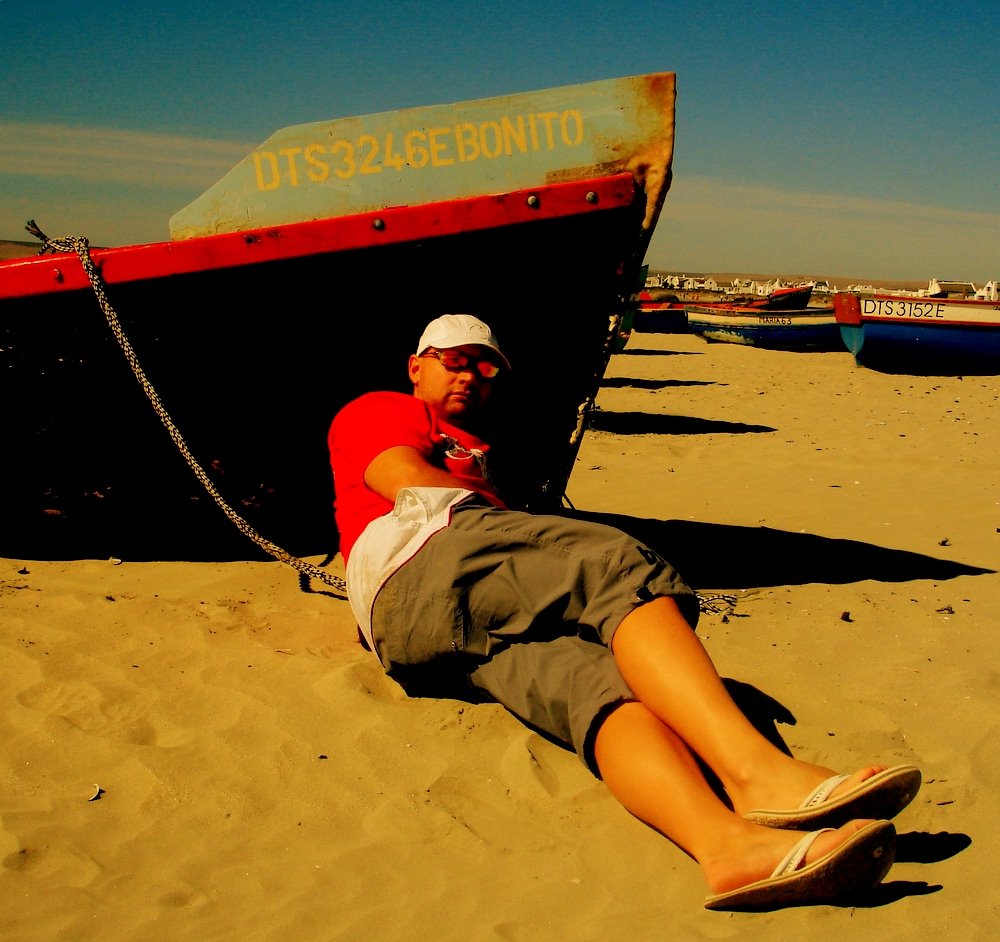
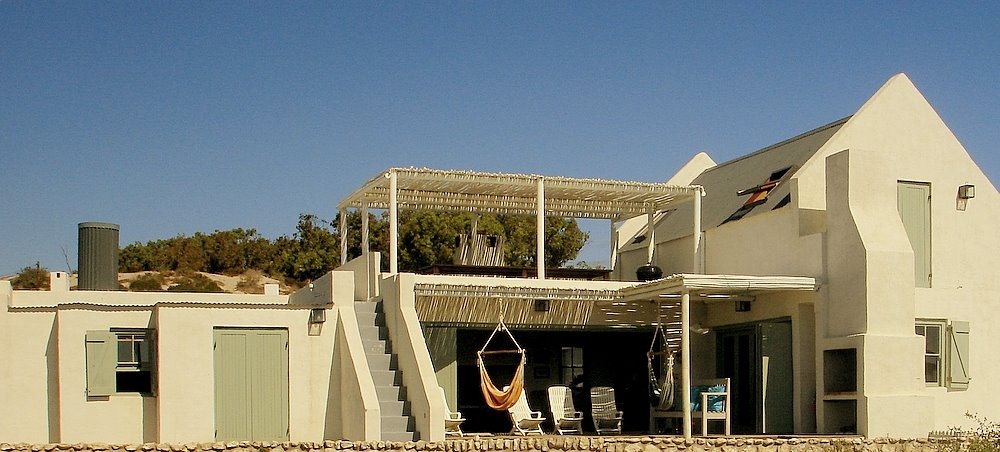
Beyond Mykonos are places like Paternoster, which represents the homegrown custom to living on the West Coast even more appropriately. My girlfriend loved Paternoster’s charming simplicity. The fisherman’s huts are also uncomplicated, plastered with white, and sometimes covered in dark gray thatch. It’s a functional, Cape Dutch style that can be seen all over the Cape. The blinding white clusters of these houses accentuate the rugged beauty of the area, and hint at the stormy seas that toss the occupants of these abodes about – they belong invariably to fisherfolk.

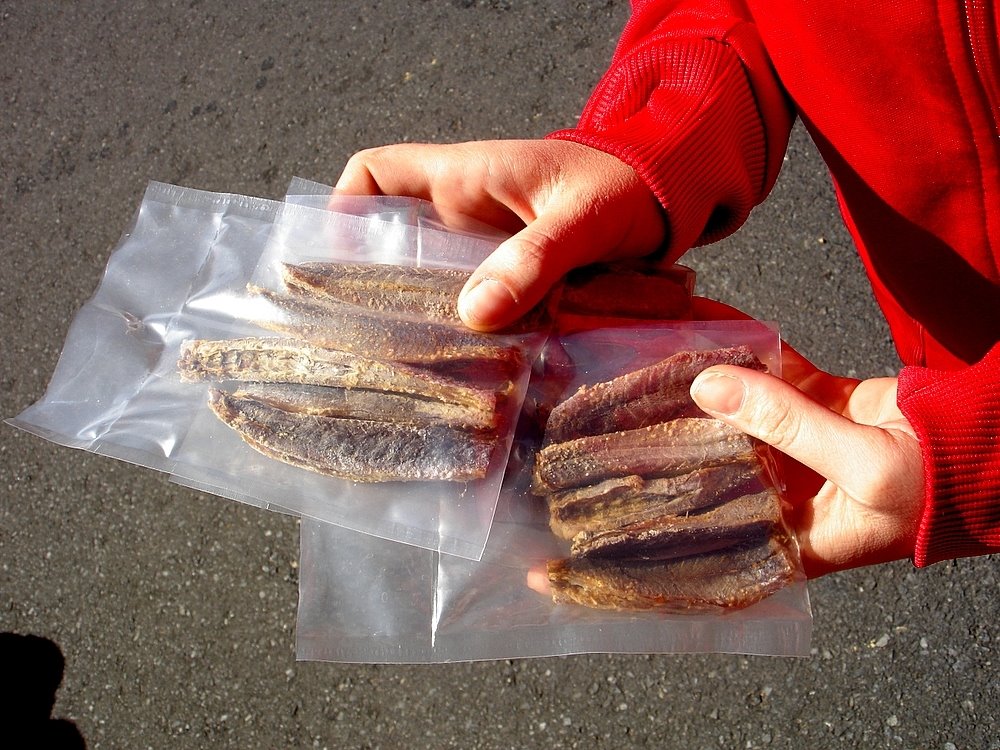
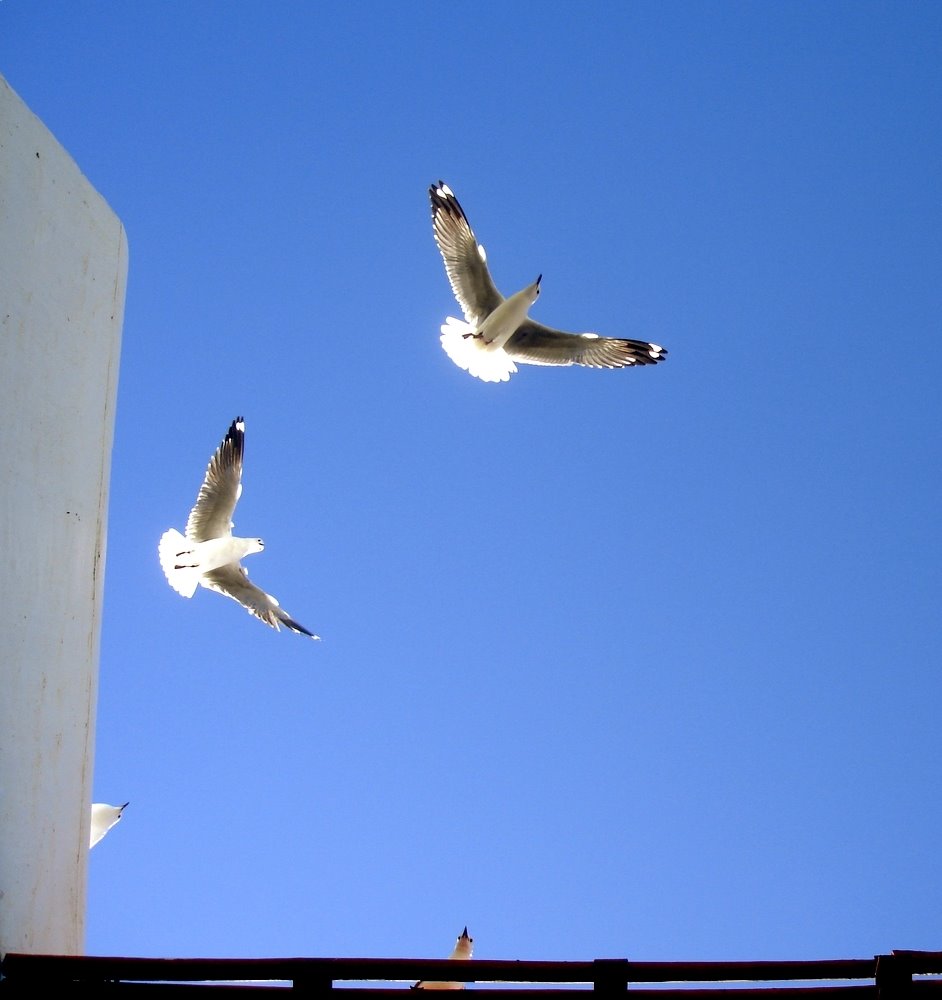
Their boats lie on the beaches, and dried fish, called bokkems, dry in the sun, not far away. Seagulls wheel in the empty blue sky; some flocks come to these empty shores from as far as the Caspian Sea, drawn by shimmering seawaters filled with migrating shoals of Pelagic fish. On a lonely road a Jackal Buzzard suddenly opens large dappled black and white wings against the sky, lifting quickly with the wind. In the land and the sea, there is life, even if it seems an abandoned, God forsaken country.

The people have always struggled here. Sheep farmers eek out a marginal existence on land that becomes saltier every year. Miners sweep at the sands in search of diamonds. The fishermen seem merrier, and hardier, and their children shout and chase one another, and play games along the shore. There is history here. There are shipwrecks too, but not as many as one might expect. Near Hondeklipbaai, furious seas drove a ship about 80 metres inland. The shipwreck now lies on its side, on a bed of rocks, blasted by wind and sun, while waves play innocently in the distance.

There used to be thousands of Bushmen here, and many beasts – from Springbuck to Hippopotamus and lion. Some Bushman art suggests that animals like the Eland once looked very different – having bichrome bodies, brown with white necks, legs and heads. Before that, the palaeo-Berg river erupted into the sea 20km from its present location (at Veldrif), into the basin of Saldanha. Then the sea was 25 metres higher, and Sabre toothed cats prowled alongside lions. There are great dunes filled with bones that tell of a different world, filled with tribes and creatures that stir the imagination as one moves through the West Coast’s vast emptiness. .

At Tittiesbaai, around the corner from Paternoster, the pristine wilderness is absorbed by a growing cult of campers, who merge khaki tents and canvas with the landscape in a way that seems subtle and benign. They form a kind of tribe for a few days – gathering around their fires and in their tents, eating fish that the local boys have caught or speared.

On our way back to Cape Town, we passed through Paternoster, and found a large crowd on the beach. A helicopter, rubber boat and vehicle from the NSRI were in the sand, and as we arrived, the dead body of a local man, who had fallen off a boat into the freezing water, was covered and loaded into an ambulance.

The words of Uys Krige that we’d seen on the wall of a nearby restaurant somehow seemed appropriate:

Ken jy die see, Meneer, ken jy die see?
Hy lyk nou soos jou voorstoep blinkgeskuur
En kalm soos min dinge hier benee,
maar, hy’s gevaarliker as vlam of vuur.
Dan se jy nog, Meneer, die vis is duur.


We were offered crayfish for sale, R40 for 1 or R160 for 4, by a local fisherman. It’s illegal to buy them from the locals, but seeing the dead man on the beach made me want to give the local children something. Some were selling shells on long lines of string. It occurred to me that there are plots of land selling for R2 million at Paternoster, and right beside them are desperately poor fisherfolk. How is this possible?

The light is soft and filled with an approaching front – a dark band of cloud rolling towards us. The wind tugs at the car as if to dislodge a feeling from a hardened heart.
The West Coast is a wonderful place to connect to the land, and to slow down so that you can breathe the free air again.

Official Results


For my official Argus Race results, click on the title of this post.

Group Position: 17/627
Overall Position: 2996/27737

Today my right calf is quite sensitive. Feel quite gloomy as there is a lot of uncertainty surrounding where I am going to earn an income. Have called The Friend a few times, and been unable to speak to the lady who seemed very eager to work with me when we met.

My test is also not marked, and Spook, the guy who said he'd make copies for me, hasn't responded to my calls either. Feel a bit depressed.

It's cold in Bloem, but hopefully tomorrow, after a good swim, I'll feel better.

Tuesday, March 14, 2006


Kunstler: Mommy and Daddy

March 13, 2006
Politics is the way we work out our collective national psychology -- if you believe in such a thing (and I do). American politics have fallen into a gothic family melodrama, and the theme is the same one being played out on the micro level all over the country: failed parenting.

The Republicans have made themselves into the Daddy Party and the Democrats have become Mommy and both are failing.
George W. Bush is our "Ward Cleaver," the very visible head of the household with no apparent duties other than being visible. The mission of the Daddy Party is pure Daddy stuff: to prevent the daughters from getting in trouble (having fun) with boys, to grub as much money as possible via mysterious corporate activities to support the family, and to defend the household if necessary. So, we get the "right-to-life" campaign (which is becoming the anti-contraception and anti-sex campaign), and the tacit support for any kind of corporate mischief in pursuit of profits in the "marketplace," and the prosecution of war against "the terrorists."

The Mommy Party wants everybody to feel good and for all outcomes to be fair, even if Mommy has to use force to make it happen. Since the Mommy Party is not afraid of appearing cultivated and is in charge of the family's education, the Mommy Party has taken defacto control of the universities, where justice and fairness are the main courses of study. Mommy's discipline there is very severe for those who cross Mommy -- ask Larry Summers over at Harvard. The men of the Mommy Party are uniformly pussy-whipped and must submit to an ideology that regards gender confusion as an achievement -- because all daddies are such losers.

The Daddy Party has entered a zone of failure both frightening and abject. Daddy has mismanaged the family finances so badly that the re-po man may take the house away. He's on a rampage against his daughters (some of whom remain romantically infatuated with Daddy and still wish to please him at all costs). He's addicted to a petroleum-based smack and refuses to consider any behavioral changes that might get him off the stuff. And he's gone and poked a stick into the largest hornets' nest in his drug dealer's 'hood."

The Mommy Party doesn't want to talk about the mismanagement of the household and its relations with other households. The Mommy Party is excessively concerned with appearances (sometimes at the expense of the truth). The Mommy Party gets around these inconveniences by focusing on everybody's feelings. The Mommy Party is like an Oprah show that never ends and resolves nothing.

Because Daddy is failing so badly, and the family anxiety level is so high, the children allied with Mommy have fantasized a dark Daddy alter-ego that they transfer their fears to. That's Vice-president Dick Cheney. Daddy's activities may be mysterious, but his alter-ego's duties are clear: to keep those corporate systems running things in the background happy and productive by any means necessary. Nobody doubts the alter-ego's power and influence in these matters. He is considered as adept as Daddy is inept. If you cross him, he might even blow your head off, so watch out.

With the Daddy Party entering what appears to be terminal failure, all eyes are now turned to the Mommy Party and its presumed figurehead, Mommy-with-a-vengence, Hillary. There is still the hope that she can carry on as the head of a single-parent family, keep the corporate flywheels spinning, and even look after the family's security from the thugs coming into the 'hood.

My own guess is that actual conditions in the household may be too far gone for even Mommy to set things right. Our situation with oil and natural gas are much more dire than the kid's realize. Dad's investments were idiotic and his portfolio is shredded. Not only is the house about to be repossessed, but the car and the home theater will be going with it. The bad 'hoods around the world are set to explode. The kids are going to have to grow up fast. Some will just go feral. Some will become Mommies and Daddies themselves, and they will try to form new households with the remnants of the old one. Maybe they can cobble together something like an American common culture out of whatever's left, and recreate some organizing principles for a family life that make sense.

Let's just hope that social services doesn't have to come in to clean up the mess.

Argus: A Hard Day


While South Africa were playing their 4th cricket match, I said: "If they win this, I have to go under 3 hours." They didn't win. Nevertheless, I was aiming for a decent time.

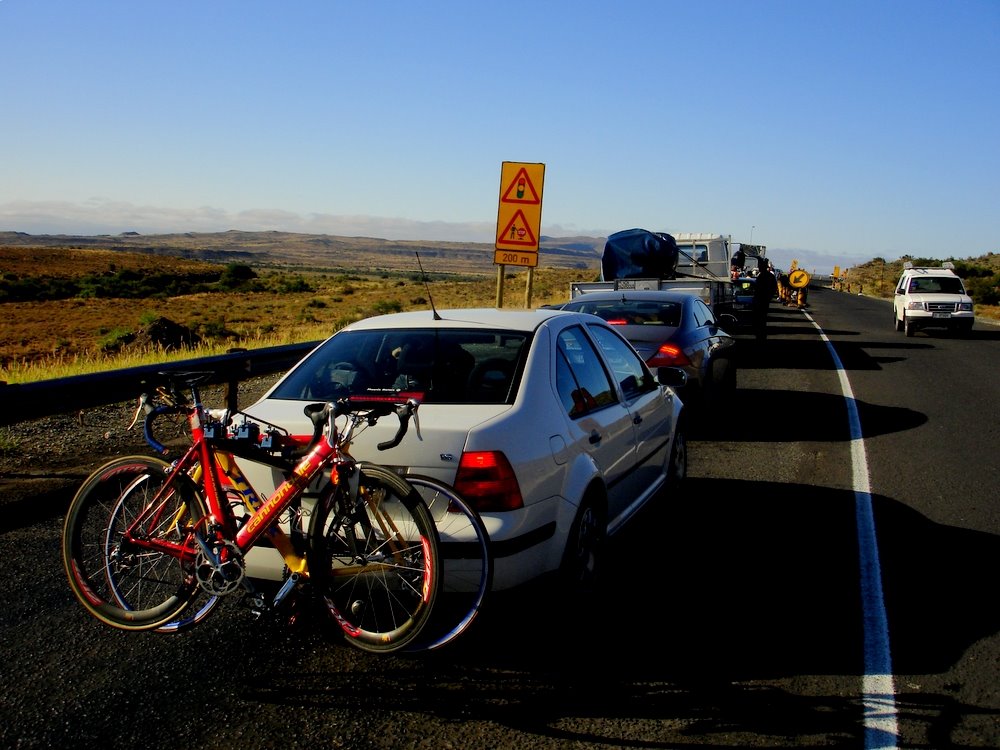
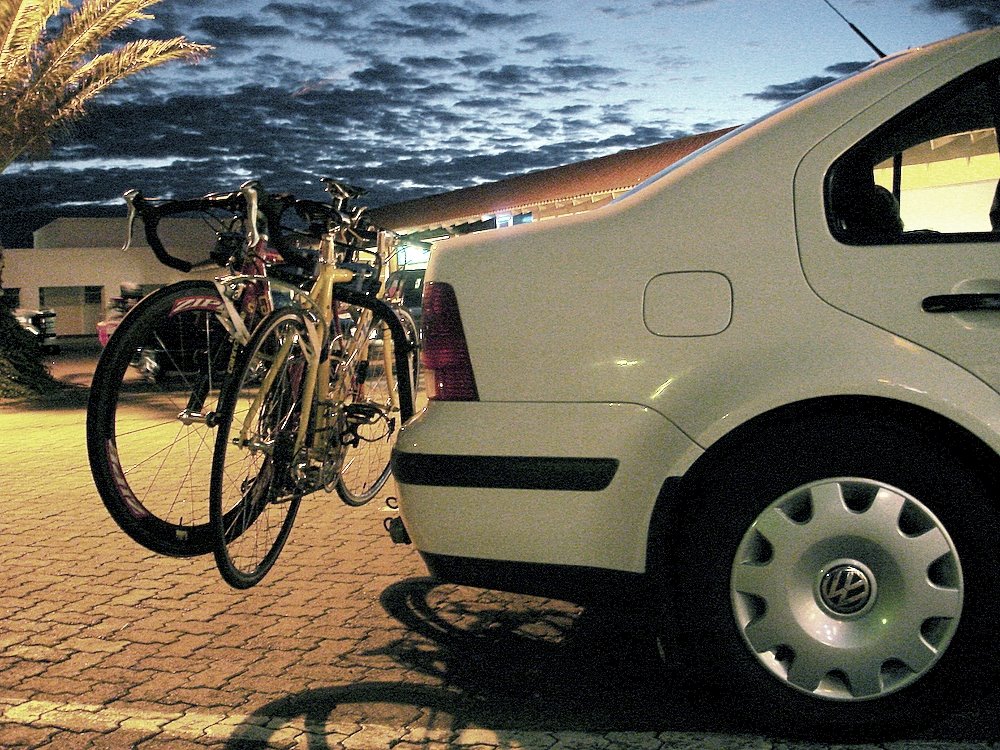
We got up at about 4:30am, and were on the road at about 5:10am, heading towards wind and cloud and thedark bulk of Table Mountain.
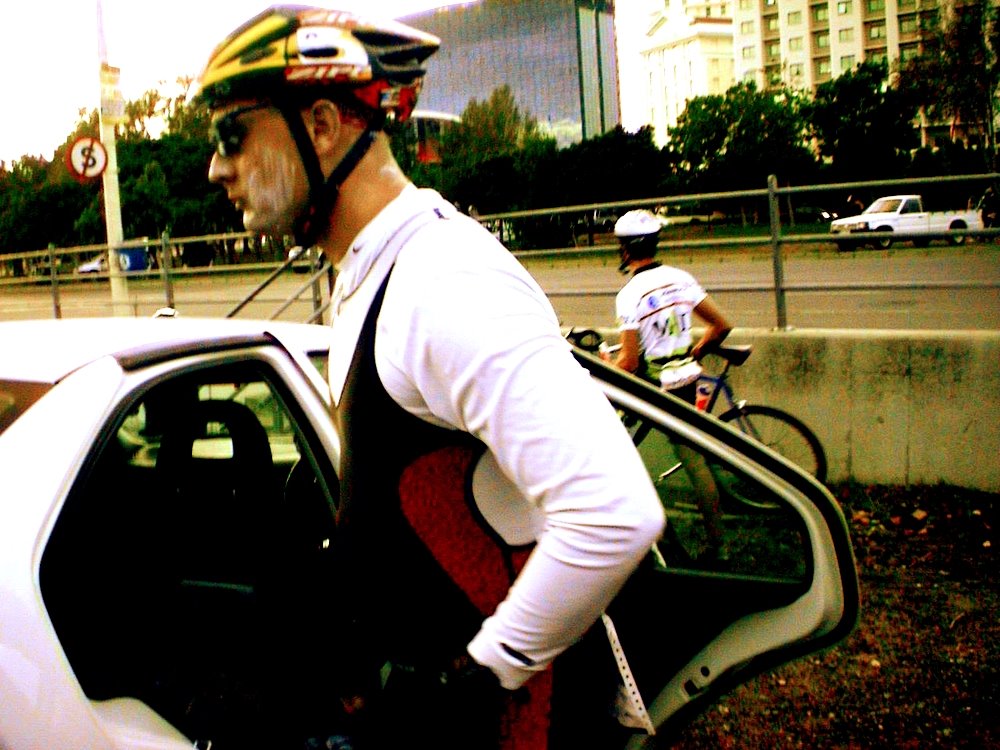
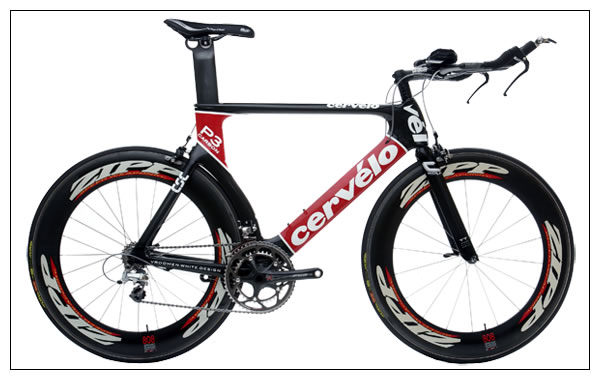
It was chilly, so I pulled on a long white sleeve top. Over that I jad a sleeveless Ironman speedsuit. I caught a glimpse of myself in a Kalk Bay window and I thought I was seeing a large seal basking on the saddle of a red bicycle.

I took a big gamble going into this race. Because I had no tubby (spare tyre in case of a puncture - the expo weren't selling any), I decided to take off the brass 16g CO2 rockets, two of them, to make my ride as light as possible. I also decided to toss my first water bottle at Kommetjie, so I'd be climbing Chapman's and beyond even lighter.

Mica gave me the Winning Time sensor at the start. I'd neglected to buy one at the expo, and I gace R100 to Deon, who'd paid for it. Then I mingled with M group. Spoke to a guy who was doing his 21st Argus, and when it started raining, someone else moaned that he'd wished he'd stayed in bed and watched the Formula 1. I suggested the rain would just be in dribs and drabs, but a lady on the back end of a tandem insisted that there was rain in Constantia and Wynberg. It was a slightly gloomy start as drizzle got heavier, and chilled already cold cyclists even more.

At 07:50, on schedule, M got moving. The roads were slick. The climbs beyond Hospital Bend really hurt, and I got a glimpse of last year. If you start a race pushing your limits, you know the big climbs at the end are going to hurt even more.
But I could feel on the Blue Route, as the Zipps kicked in, that I wasn't suffering nearly as much as the previous year, and my heart rate was in a healthy range. But a saved myself, knowing pain was waiting for me close to halfway, at Smitswinkel (around the corner from Cape Point).

A bunch from M soon formed, consisting of a tandem, a Caltex rider, a guy wearing long black leg warmers and a blue top, a mountain biker on a yellow bike, and one or two other guys. We sucked up some hopeful riders in L, but eventually moved as far up as H and I.
When we cruised into Simonstown, we were a huge bunch (a few M guys with a lot of L's hanging on), and approaching the other half of L. Here the road narrowed, and someone had parked a car on the road. It seemed like sheer luck that we got through that bottleneck in one piece. Remember, the roads were wet, full of potholes and puddles, and the fast M guys were trying to sneak through on the right side, hopping over ditches and holes. I tried a few stunts too, picking up speed and then having to slow down in a hurry in the wet - a recipe for a tyre to lock, and then a fall. But I managed to get through. In fact, I went right to the front of this superbunch, at Miller's Point, anticipating the long climb, and wanting to minimise its impact. Now, no one wanted to work, or face the stiff breeze pushing at us in the front.

After a few hills the real climbing began, and as it did, I switched over to the small chainring. My chain fell completely off! Horror. I suddenly slowed down, and as I was about to stop and dismount, I tried using the gear lever to put it on a big gear - and it slipped back on. I lost some momentum but not nearly as much as I would have if I'd gotten off my bike. Now I climbed back to some of the stronger guys on M. Smitswinkel took forever, but I reminded myself that the conditions last year, with powerful gusts blasting us to a virtual standstill - compared to that, this was easy. We finally got over the top to the sounds of a minstrel playing a trumpet. Quite a nice touch.

Now the wind was at our backs, and I picked off all the guys that had passed me from the top of Smitswinkel to Noordhoek. I also caught and passed the black Cannondale for the third or fourth time. I'd see them again on Suikerbossie.

Going through Noordhoek and Kommetjie, there was plenty of braaivleis smoke and locals shouting. I tossed my water bottle, and I'm sure someone on the sidewalk picked it up.
I spent very little time checking the scenery on this ride. I had a little look at Scarborough, and going up Chapman's, but no look down into Hout Bay, or Llandudno, or Clifton. Quite sad really.
I seemed to be the one setting the pace right through to Chapman's, riding second or third from the front, and then taking the lead until reaching another pack. Chapman's proved to be hard, but I just tried to settle down and get through it. My buddy, the Caltex guy, was around me, and another Ironman guy with Zipps emerged at the same time. The top of Chapman's took a long long time to reach. I was going on my easiest gears, and struggling to turn the pedals around.

Down Chapman's was awesome, and since the road was a little drier, I took a lot more chances. On the little hill before Suikerbossie I gave the Caltex guy a little push, and then quickly swallowed a Gu, heading towards Suikerbossie. My legs were fine, as long as they weren't climbing.
After the race I heard that a 60 year old man had had a heart attack at the top of Suikerbossie, and died. I'm not surprised. The black tandem caught me, and the Caltex guy jumped on behind them. I had a touch of cramp...felt a pull in my calf near the top of Suikerbossie, and so had to ride a little easier to get rid of it. I think I passed Caltex again because at the summit he passed me, flicking my back with his fingers to say, "Come with us."

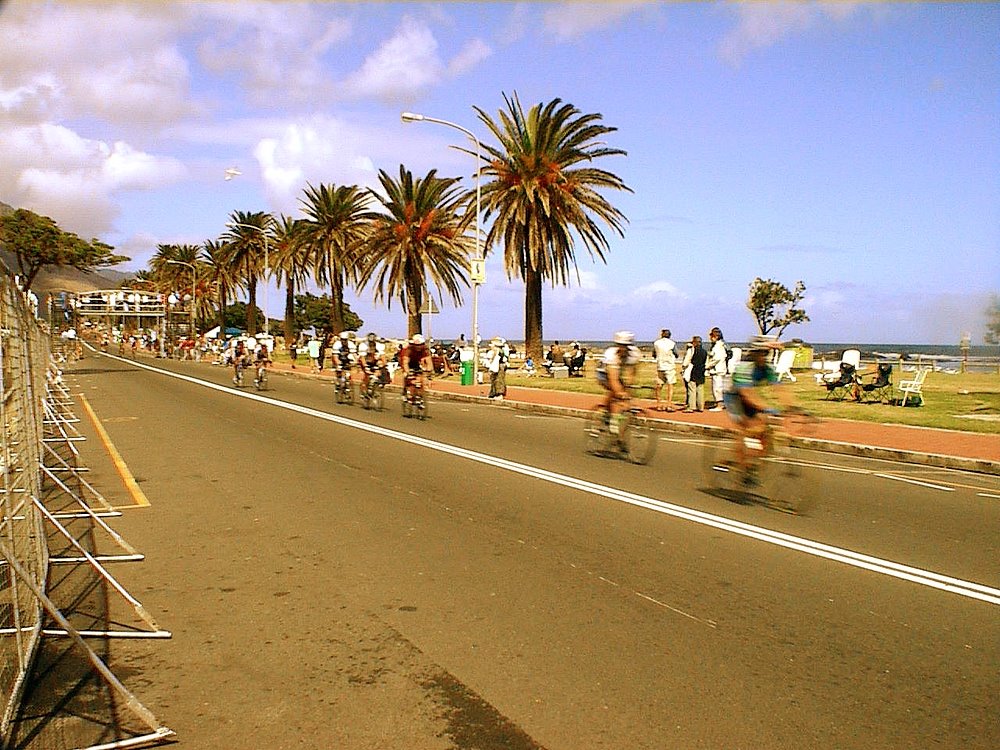
It took the entire downhill, from Suikerbossie to Bakoven, to reach that group. That's a long chase, most of it tucking down, and by the end of it my arms and fingers, and back, was aching. I was able to catch a few stragglers that were falling off, rest a little, and then jump onto the next straggler. I was riding at my limit through Camps Bay, and somehow hung on on the uphill into Clifton. From Suikerbossie to the end was really riding at my limit.
Now, in Greenpoint, with 2km to go, I was riding side by side with Caltex. I was starting to feel dizzy and seeing spots - there just wasn't time to eat since Suikerbossie. I pushed far into the red, approaching the finish line with Caltex just ahead of me. With two or 3 metres to go he relaxed and I inched my wheel just ahead of his. We gave each other a little nod afterwards.

Distance: 109km (with plenty of hills)
Time: 3:18
Average Speed: 33.03km/h (last year 29.7km/h)
Average Heart rate: 159 (last year 157) (possible 161 since I left my monitor on for 3 minutes after finishing. (Max: 171)
Improvement on last year: 28 minutes

Met a school buddy after the race, Hugo van Zyl, and went to have tea at his house in Green Point. At that stage the Australian cricket team were posting a score of over 400...
Fransa was in Camps Bay and I only saw them about 4 hours after I finished the race, at about 3pm, which, of course, was quite annoying as I'd left my change of clothes and something to eat with them.

I went on my own to Theo's and had a burger there, and then watched the sea for a bit at Seapoint, before meeting the others in front of MacDonalds. I was pretty much comatose for the test of the day.

I wonder what bunch I'll start in next year. Maybe E. Starting in M this year made a big difference to KK last year, because the road is less cluttered with slow coaches that you have to dodge or wait behind. Next year ought to be even better.

Sunday, March 12, 2006

West Coast: Time Warp

Today was weird. Interesting, but also disconcerting. A dead body on the beach at Paternoster, an eerie Iron ore mine on a desert landscape...looking like the set of a Mad Max movie, a young girls jiggling boobs at Vredenburg, fossils of sabre toothed cats on ancient dunes and a place called Tittiesbaai (Titsbay), filled with a cult of campers.

5 million years ago this place, Mykonos, was submerged under 20-25metres of water. Sabre toothed cats (curved teeth as long as your foot) roamed, until the climate changed. Now, the Berg River erupts into the ocean more than 20km to the north. Originally, the Berg river flowed into the sea here, where we are. The whole landscape has changed. Where we walk used to be submerged.

Yesterday was very windy. I cycled 25km in just over an hour. Felt okay. Slight swollen throat yesterday, but it's better today. Tried to eat light, mostly seafood, rice and fruit.

There is not time to write about the man who drowned at Paternoster. But death drew a crowd, a rescue boat, and a helicopter, as well as two ambulances. This morning, and it was a perfectly good morning, a man decided to go paddling out to sea. He fell in the water and froze to death. And then, life goes on.

Tomorrow we drive back into Cape Town for the 108km Argus Cycle Race. My Polar Heart Rate monitor rates my fitness at 58 (down from 60 a few days ago). A puts my maximum heart rate at 180. Going to try very hard to come in close to 3 hours.

Have taken a number of beautiful photos. Watch this space!

Thursday, March 09, 2006

Suspended Animation

Had a decent sleep, but woke up coughing fitfully, and feeling worse than I did yesterday. I thought, since I felt an improvement Tuesday (0ver Monday) that this would continue today. It didn't.

Fransa's mom in law was discharged from hospital late, and more dilly dallying meant we never left for Cape Town today. I'm glad we didn't as each day represents an expense, and Wednesday just seemed too soon for me. The other thing is I have missed all my Wednesday tutorials (last week was a holiday) and so it was important I attended this one. Good thing I did as we were asked to make 2 presentations, and catch up with a lot of work for the next one. I also arranged to get copies of the book (The gods are not to blame).

It seems to me that man has survived a number of cataclysms. I'm talking about plagues, wars and the like. Each time a number of survivors develop a mythology to deal with those difficult times. Then, as we put poverty and misery behind us, we grow proud and vain, and lacking in discipline. The opposite of discipline is immorality. And it is no fluke that people have found, through the ages, a connection between the physical and spiritual world.

As an athlete, it is very clear how energy, vital to process of performing at a maximum, gets drained away by stress, by a lack of discipline and focus, by indulgences, by being reckless with one's own soul, one's own spirit.

We have survived cataclyms before, and developed a mythology to deal with it in future. For the Spanish flu we developed hat tipping and the curtsy (to avoid physical contact). There are plenty of other sayings that we dismiss in the modern era, as traditional and irrelevant.

Homosexuality presents an interesting case. There are many issues in society that determine how we treat each other and ourselves, how we govern ourselves, our view of the world and how to live, and thrive. Abortion is another, capital punishment another, attitudes towards bankruptcy and adultery and plenty more. In itself, being gay (being born as opposed to being conditioned) is perfectly fine, as long as it's a natural desire, and a natural expression of sexuality. When it is a choice, an indulgence, as in the case of being bisexual, then it encourages reckless promiscuity. Being promiscuous might be fine if it did not involve families and body fluids. But it does involve these, leading to disease of the body and infection of the family. Neither of these are healthy, or one, or all.

The stigma related to homosexuality is not completely undeserved. It is not so much a homosexual who is to blame, but the impact of that person on someone else who may begin to express sexuality in a way that is no longer healthy. Many homosexuals do epitomise a reckless, whoever's-available, attitude to sex.

As a modern thinker, I accept gays and lesbians. I have trouble accepting people who have a vague sense of their sexual identity, who have been conditioned through abuse, lack of acceptance or desperation/depression - because this can lead to prolonged heartache. At the same time, I'm aware that homosexuals lie at the source of a kind of moral malaise, where we (who are not homosexual) begin to question certain normative behaviour, entertain fantasies and indulgent behaviour, and cast aside basic inhibitions. Disease proves that this ought not to be encouraged, and by implication, the homosexual community ought to be reined in, if only in our thoughts.

Perhaps legitimising gay marriage is a good thing. What worries me are people suffering from an identity crisis, people switching and swapping partners willy nilly, out of a base desire for sexual gratification. Obviously as the number of sexual partners increases, so does one's capacity to be fulfilled decrease, leading one to risky experimentation, a road which leads to same sex sex.

It is these simple, but self evident truths, that we are in danger of losing, when we abandon our myths. Similarly, holding onto myths for the wrong reasons, is equally damaging.

In a world where people are unable to think for themselves, or their thoughts are troubled with matters of small consequence, myths and stereotypes (thinkling without thinking) becomes all the more important, and dangerous. Wield your thoughts with care, and be orginal if you dare.

The cycle works as follows. Struggle - develop coping attitude/philosophy/morals/codes/discipline - success - forget lessons learned - collapse - repeat.

The Moon: one small step for man after all?


Nick van der Leek plays Devil’s Advocate, examining the veracity of Conspiracy Theory claims that the moon landing was a hoax.

I’m not playing games. I wrote an article for reporter.co.za saying I would bet money that the moon landings were a hoax. I’ve done even more digging since, and now I’m still willing to bet money, but no more than R100.

It’s difficult to be certain about the moon, simply because it lies beyond our collective experience. A simple example is the point about a boot print on the powdery surface of the moon. The Conspiracy Theorists say it is impossible for dry soil to hold an impression at such a high, shall we say, resolution. Obviously the surface of the moon is dry, and everyone knows, you can’t really leave footprints (like the ones you see on the moon) on dry beach or desert sand. Why? Because dry sand doesn’t stick together. Well, there are exceptions. Silica, for example, can form fairly strong bonds, especially at extreme temperatures. Some crystalline structures, like sugar, can also maintain the shape of a spoon shoveled into its crust. So there’s an argument, but I’m not sure if it’s a very strong one.

The bootprint does suggest quite a thick layer of baking powder like dust. Once again, when the lunar module descended, whipping up a cloud of dust, why did the dust not coat the legs of the LM? Well, because dust on the moon doesn’t act the way it does on the Earth. It would quickly dissipate into sparse particles. Once again, it’s an argument, but how plausible is hard to say if you’ve never been on the moon.

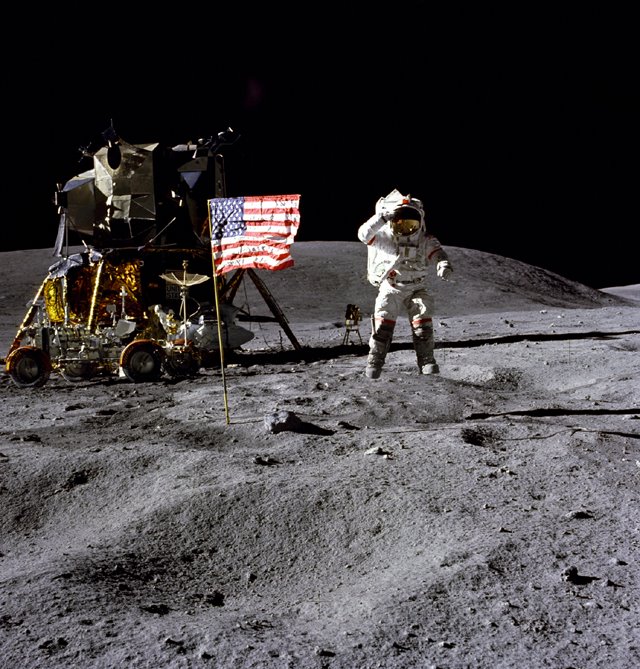
The reason there is no blast crater, the believers say, is because the layer of dust on the surface of the moon is only an inch or two thick, everywhere. Thus, when the LM landed, it blew away the dust, leaving behind a hard almost impenetrable bare crust. This same crust proved hard to drive the flags into, which is why, they say, the flags flap about so much. I’d like to know if a narrow thin rod has been inserted in the top of the flag, to keep it straight. This would not be necessary on the moon, and my guess is, something has been placed inside the material on the upper edge, to maintain the flags perpendicular line to the post.

I still maintain that the circumstances surrounding the launch – the pressure from the soviets, the expectations of the American people, Kennedy’s promise, make a good case for the need to fake the landings. I don’t doubt that man is capable of it, but I believe they ran out of time. It’s a nice story to say we landed on the moon on July 1969, but a real effort would have probably taken another decade, and a lot more money to accomplish, with still very slim chances of success, above all surviving the Van Allen Radiation belts. The proponents of the moon landing say this radioactive field was passed through at high speed, in about an hour, greatly reducing radioactive absorption. Once again, having no hard evidence about the Van Allen belts, who can say for sure what effects it could have on astronauts? To reiterate what I said in the previous article: no manned missions before or since Apollo have approached the Van Allen belt and this implies that they are indeed lethal.

It’s an important question, whether the moon landings were rigged, because if we were deliberately and brilliantly swindled by agents in the government and the media in 1969, that may have set the tone, and changed the course of history, in subtle ways that would benefit from our observation. We may at present and in future, be swindled on the same basis – TV footage – into wars at worst. We know we’re manipulated on daily basis towards certain kinds of buying behavior. Like many people, I would like to believe we achieved great things, and that we’re a gifted species.

I know it is not very scientific, but something as truly momentous as reaching the moon, having it on our doorstep (as opposed to faraway Mars), would have meant making it into a playground, or a military base, long before now. I would have expected hundreds of trips to date, and the emergence of some kind of lunar Las Vegas. The fact that we haven’t followed up on moon missions, but have instead built a rickety space station, seems ample evidence that our space actions since the 60’s speak louder and more clearly than the ghostly TV images.

The lesson we learn from taking this subject seriously, is to think critically about ourselves and the world. Things are not always what they seem, and some people seem to think they are more intelligent than we are.

Iran Threatens U.S. With 'Harm and Pain'


This is a deceptive headline. For starters, this is really all about America's interference in the Middle east, about America desire to widen the conflict from Iraq to Iran, on the same pretence - the threat of nuclear weapons. America really wants a legitimate but illegal means to invade Iran, as oil moves into an increasing state of flux. That means instability, and higher oil prices - Simmons predicts $200 before 2010 - will blast through the world markets like a cannonball in a china shop. Whether that threat is real, seems to me to be virtually irrelevant, simply because it is one nation with thousands of nuclear weapons, telling another nation, that rightfully feels imperilled, it can't have any.

I am not saying it is a simple situation. I am not saying the US is wrong to prevent Iran from developing weapons. What I am saying is that these media reports will slowly butter us up for another war. Remember that whenever you have a war, your chances of creating an embittered people, your chances of creating terror, increase. That's why the words: war on terror are simply nonsense. War is terror. Terror on terror makes as much sense as fighting fire with fire.

My suggestion is that the US removes itself to its own borders, focusses on developing alternatives, developing its railway system and upgrading its power grid - develop local capability...before being forced to do so, by becoming bankrupt. Based on the deficit, it almost is.
Perhaps, when faced with that, it will seize control over oil as a means to leverage its financial system. The military may be the final hope of an Empire, otherwise facing ruin. This obviously does not bode well for either the world or the America that seeks to make it into its own image.

By GEORGE JAHN, Associated Press Writer
45 minutes ago

VIENNA, Austria - Iran threatened the United States with "harm and pain" Wednesday for its role in hauling Tehran before the U.N. Security Council over its nuclear program.

But the United States and its European allies said Iran's nuclear intransigence left the world no choice but to seek Security Council action. The council could impose economic and political sanctions on Iran.

The statements were delivered to the 35-member board of the International Atomic Energy Agency, which is meeting to focus on Tehran's refusal to freeze uranium enrichment.

The White House dismissed the rhetoric out of Tehran.

"I think that provocative statements and actions only further isolate Iran from the rest of the world," White House press secretary Scott McClellan told reporters traveling with President Bush to hurricane-affected states in the Gulf Coast. "And the international community has spelled out to Iran what it needs to do."


Who is the international community? America and the UK?

Wednesday, March 08, 2006

Gone Fishing...I mean, cycling


By the time you read this, I may be in Cape Town. I'm leaving tomorrow at 5am, going with my girlfriend and her family. We'll do 1000km, possibly in 10 hours or less. That's 2 or three times across the length of South Korea, in a day.

I'm hoping to improve on last years time of just under 3:46. In my favour is the fact that I was sick on the day of the race, suffering from an elevated heart rate and just feeling tired and unfit. Also, race day turned out to be extremely windy, virtually gale force, which cost us all a lot of time.
I'd like to go under 3 hours, but I'm predicting 3:07 (somewhere between 3:05 and 3:10). I think the hills are going to wear my legs out, as I am still a bit heavy, and there are plenty of climbs on the course. The last few climbs are going to cost me a lot of time I imagine.

I'm going to enjoy being at the sea though. Will take some photos to add to my collection.

Other news: The story below, on the moon, has been accepted for publication at Reporter.co.za. This means that only two stories, titled: Ntini Takes 6 Scalps, and an H5N1 update, have been rejected, out of 29 submissions. Since I have a number of stories approved and in a queue to be published, I'm going to ease up for the rest of the week.

When I get back I'll do a piece on the Argus and maybe the windfarm at Darling.


The Magic and Chaos of us in God, and God in us

Expressing can bring something into existence by focussing attention on something that, unfocussed, does not exist. This creates the magic and chaos of the universe at an individual level. You and I are co-creators, and together, the part and whole of God.

We ought to be very sensitive, then, where we focus our thoughts and actions, as this creates a reality for ourselves and everyone else. Everything we think, everything we say, all we do, matters.

Tuesday, March 07, 2006

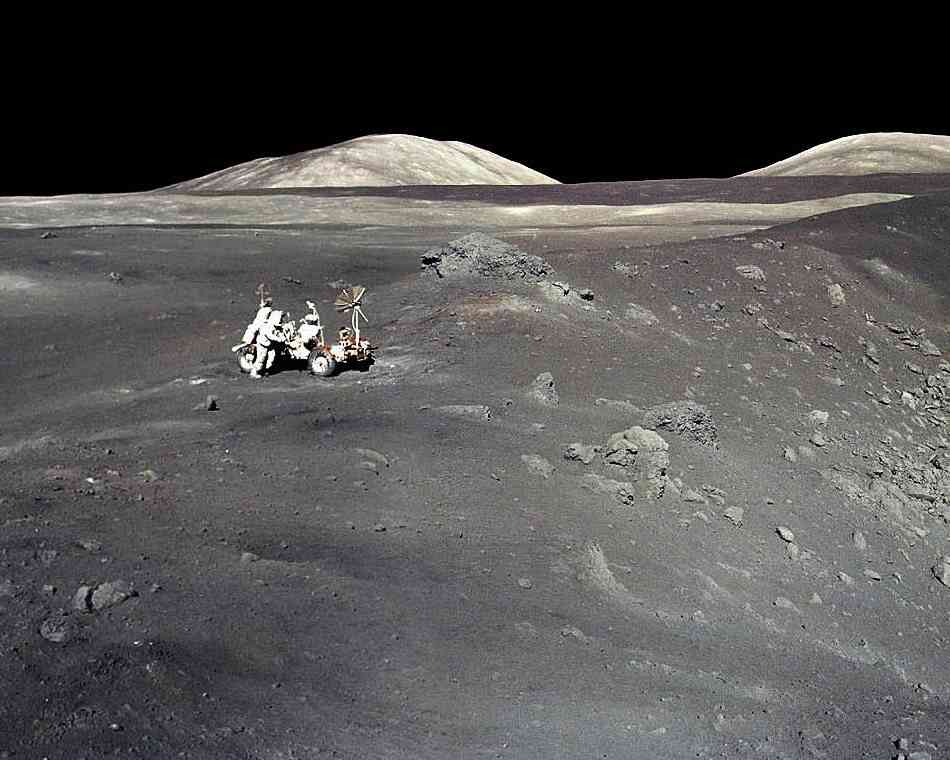
Did we really land on the moon?


There is plenty of evidence that suggests otherwise.
by Nick van der Leek

When I was just a boy, my father said to me: “Son, when you’re my age, you’ll be going for holidays on the moon.” In the late 70’s, it seemed like a sensible and exciting statement, and I didn’t doubt it. But then the 80’s and 90’s rolled by, with just a few shuttle missions, but no more trips to the moon, and now we are approaching over three decades since the last moon landing. With a few million, I might pay my way for a trip into space, but the moon remains out of reach for me, and it seems, everyone else, since the Apollo missions. No one seems to be going there again, if they even went there in the first place.

For starters, how come the Russians never went to the moon? I mean, they put the first man into space, why not go to the moon, even if that meant coming second in the space race. Why just give up?
Why no subsequent trips to the moon since the 70’s, and why build a space station hanging in footless halls of space (to borrow a line from a poem) when we have already stuck flags and parked dune buggies on the lunar surface? Why, because the moon landings never happened. 20% of Americans believe that, and I’m willing to bet money on it too.

When you first begin to study the evidence, photos and possibilities surrounding this subject, it’s hard to believe this wasn’t the greatest hoax of the 20th century.
On July 16th, 1969, Apollo 11 lifted off on an 8 day voyage. Their destination was a place no man had been before. But did they really get there? Well, of course they did, it was there for everyone to see on TV. After all, what you see on TV is real, isn’t it?

The movie Capricorn 1 explored this subject a number of years ago. At the time the idea of studio-like hangers in the high desert of Nevada, filled with fine sand and a copy of the lunar module, and astronauts pretending to be on the moon, well, it seemed outlandish. It seemed like an interesting story for a movie, but patently unlikely. What, a whole Space Agency, the government, in on a hoax? How many people would that involve? Surely not.

But once you research this topic, it’s hard to believe otherwise. Here’s why.

After Kennedy’s prediction to put a man on the moon by the end of the decade, the pressure was on American scientists, and NASA, to deliver, especially after Russia took the lead in the Space Race.

What probably happened is America realized how high the stakes were, and if they couldn’t make it, they would have to do something phony. With a $40 billion budget, they probably did send astronauts into space, and while orbiting for 8 days, NASA beamed fake pictures, and then the astronauts returned to Earth. It was a ploy that outwitted everyone, but most importantly, the Russians.
Flag Waving

Let’s get the most obvious piece of evidence out of the way first. In video footage (and there’s plenty, even some in color) of astronauts planting an American flag on the moon, the flag twists and swings, and flaps slightly. This is not due just to the momentum of being inserted. There’s an obvious draft coming from somewhere, and in the vacuum of space, there ought to be no wind.

Deadly Radiation

Few people are aware that, beyond about 800km from the Earth’s surface of our planet, the Van Allen Radiation Belts, thousands of kilometers wide, sizzle with solar radiation that is fiercely intense and deadly. This is why every space mission, from Gemini to Skylab, all the Russian missions, all those involving the space station, the shuttles and space walks are all conducted fairly close to the Earth. The only manned missions to ever pass through the Van Allen Radiation belts were, we’re asked to believe, the Apollo Missions.
Scientists say that 6 feet of lead shielding would have been required to protect the astronauts. Guess how thick the lunar module was? Very thin. Aluminum (maybe an inch thick), and even thinner, were the suits the astronauts wore. Now ask yourself this: why do dentists stand behind a thick slab of lead when taking an X-ray, but the astronauts are able to move as they do in conditions many, many times more radioactive?

Here’s some more:

The gold plated limb of the lander is polished. It is clean, shining and reflective, despite having just landed on fine, powdery dust.
There’s no blast crater, and no sign of a spark or exhaust plume when the Apollo detaches and rockets back into space. It looks instead like it’s hoisted very quickly on a cable.
When footage of the astronauts bouncing in the low gravity of the moon is speeded up at twice its usual speed, it looks like they’re running on the Earth.

Photos

Photos taken by astronauts are perfectly proportioned, even though the cameras had no view finders, and were attached to their chests.
Photos have crosshairs stenciled into the lenses, meaning these reference points ought to be in front of all objects. In some photographs, objects (like the flag or the edge of a buggy) obstruct portions of these crosshairs, which, in reality, is not possible.
The lighting in images shows that more than one light source is being used, based on shadows of different angles coming off the men, and rocks in the background, which does suggest the use of a studio.
Objects in shadow are clearly lit (backlit)when they ought to be in total darkness. There are also no pinpricks, no stars in any of the photos.

Armstrong, Grissom and Baron

Why also, do we not see Neil Armstrong at events like the Olympics (handing out medals) or on Oprah? Does anyone remember seeing Armstrong in an interview ever? Shouldn’t he be singing from the rooftops about his experience?
Between 1964 and 1967, 15% of NASA astronauts died in freak accidents. Many of these deaths occurred under unexplained circumstances, and were possibly particular to astronauts who became critical of NASA, such as Gus Grissom. On April 21, 1967, Thomas Ronald Baron appeared on TV to respond to his statements in testimony before congress that the Apollo mission was a mess and America would almost certainly face a failure in their attempts to put a man on the moon. He offered a 500 page report to back up his claims. One week after testifying, Baron and his family died in a car wreck, and the report was never seen again.

There’s more, but if you’re not feeling a bit doubtful at this point, chances are you never will. It’s discouraging that arguably man’s greatest achievement may have never happened, and even more discouraging that mankind may have tricked his fellow human beings into believing himself to be greater, cleverer, than what he really is. In a time where we’re entertained by unending make believe, and where pretenders (actors) make as much news as world leaders, I find this result both troubling and rational.

But here’s a parting thought or two. The Japanese are sending a probe to photograph the surface of the moon. The Chinese have indicated their wish to put a man on the moon, and the Americans have responded by expressing similar notions. If we did land on the moon, there should be evidence lying on the moon. Flags and equipment left behind. A few photos showing a lonely flag or an abandoned buggy shouldn’t be too much to ask for. We ought to know, for sure, in the near future. And it will be fascinating to see to what kind of expense, the kind of strange and new equipment, and the kind of footage the next trips to the moon will turn up. It’s either that or we’ll be going to watch an expensive movie all over again. I’m not holding my breath for Japanese photos of flags though. I am one of a growing minority who believes the 1969 and subsequent landings were faked.

Man landing on the moon was all a charade; the most expensive made-for-TV movie ever. What do you think?

Early Bird


Thanks to a bevy of beasts, I was up fairly early this morning. Needed to be as I'd missed EAL (English in Applied Linguistics) last night, and wanted to catch up the lecture in this mornings alternative class. I'm glad I did. Really enjoyed Dr. Susan Brokensha's lecture.

Still no word from 'The Friend'. Am a little concerned. I'll possibly give them a call this afternoon. Last night I emailed them a proposal.

People in this town really seem to lack urgency.

Cold and Achy


I've been feeling it coming along for quite a while; the chills, the irritibility. After Sunday's race, I've been coughing a lot, feeling swollen headed and my back aches.

Today I interviewed Francois Vorster, who is competing at the World Standard Triathlon Champs in Lucerne, Switzerland, later this year. He also briefed me on some points that I made or may not need if I take over his group of swimmers (as a coach).

I've also received verification that I am registered and seeded for the Argus (thanks for doing so today). I'm in group M, which is I think a little better than group KK, the one I was in last year. My group leaves quite early, at 7:50 am. That's an early start, but the good news is I will beat a lot of the heat and wind. Like most coastal cities, the wind picks up from mid morning onwards. So hopefully I can avoid some of that.

Class was interesting. I only attended one of the two. I can attend the second lecture tomorrow morning at 10am, so I'll be sure to do that.

I've heard nothing from the people at The Friend. Will give them a call tomorrow sometime I expect, to find out what is happening.

Am going home shortly to snuggle up with some dinner, coffee and the Oscars. My father is in Botswana with Ruth so I have the whole house to myself and my ailment. Will type out the interview some time tonight or tomorrow I expect.

And finally, I have two reviews on reporter.co.za. One is a review of the movie Syriana and the other is a review of Kunstler's book, The Long Emergency. There are plenty of other stories that have been approved, but are in a queue.

Grrr. My stomach just growled at me. Better go before I get eaten alive by my stomach. Snakes alive!

Kunstler: Hustle and Flow

March 6, 2006
You've heard of "Pimp My Ride." Well, the New York Times is running a new joint called "Pimp My Read." This week's Sunday Time Magazine devoted itself to the idea that housing bubble is (in Martha Stewart's words) a good thing. In fact, Martha herself is getting into the racket, lending her name to a 650-unit (they're just units) suburban subdivision outside of Raleigh, North Carolina. If she was shrewd about the deal (could it be otherwise?) than Martha will get paid whether the project tanks or not.

Really, the whole issue of the Mag was just an opportunity for the financially-strapped Times to sell a shitload of advertising to the real estate investment trusts, the luxury condo hucksters, and the home furnishing industry. It will probably go down in history, along with Yale economist Irving Fisher's 1929 proclamation that the US had achieved "permanent prosperity," as one of the seminal documents of societal cluelessness in the face of obvious calamity.

My favorite story in the joint was "Home Economics" about Harvard whiz Edward L. Glaeser, 38, "a genius" urban theorist, who sports bespoke English suits (with watch-fobs!) and who has managed to construct a comprehensive view of how we live in America without factoring in the global energy predicament. Apparently Glaeser's major contribution to the field is the arresting idea that whatever has been happening out there in America will certainly continue to happen --exactly in the Irving Fisher tradition. For instance, people have been moving to the Sunbelt for sixty years because there's no winter there to hassle with, so that trend will continue. Also, suburban sprawl is just fine, no problem, let's get more of it up-and-running. (Glaeser's theory is related to Times columnist David Brooks's incisive formulation that suburbia must be okay because the public seems to like it.)

What these pimps and geniuses don't get is that America's future is all about discontinuity. Virtually everything you see out there will not keep going. We will discontinue granting interest only, adjustable rate mortgage loans for half-million-dollar McHouses to schlemiels one paycheck away from bankruptcy -- because the practice will prove to be reckless and ruinous not only for the schlemiels, but for the financial system as a whole. Americans will stop moving to the Sunbelt when they discover what life is really like in Phoenix and Houston without cheap air conditioning. After the suburbs implode financially from a pandemic of defaulted mortgages, we will see how well they operate on $5-a-gallon gasoline (or higher), and how carefree it is to heat a 4000-square-foot McHouse in a permanent natural gas crisis. We'll also discover that telecommuting over the Internet is not so "cool" in brownout nation.

Obviously these clowns are whistling past the graveyard as the air audibly hisses out of the housing bubble, and the very appearance of these fatuous reassurances in America's chief enabling organ of popular delusion ought to be a signal to the still-alert out there to run shrieking for safety. It's interesting to note, by the way, that the New York Times ran an editorial last week titled "The End of Oil," by Robert B. Semple, stating starkly that the global oil production peak was for real. The catch was that the chickenshit Times editors only ran the piece on their Web edition, not in the printed newspaper. The next day, in the print edition, they ran a big display ad from Exxon-Mobil saying that peak oil was just a shuck-and-jive by a claque of alarmists. Of course, one of the wonderful things about democracy is that people are free to believe whatever they like.

from www.kunstler.com

Please note, I(Nick) have posted a review of Kunstler's book, The Long Emergency, on reporter.co.za. There is also an incisive review of the movie Syriana by the talented writer, Nick van der Leek. When, I wonder, will he publish a new book?

Oil drying up 'faster than we think'

06 March 2006
By ANDREW JANES

Long-addicted to cheap abundant Middle East oil, the United States – and the rest of the world – may soon have to go on the methadone programme.

That is the message from American oil industry insider Matthew Simmons, who is in New Zealand to speak at Crown Minerals' 2006 Petroleum Conference, which starts today.

Mr Simmons is the founder, chairman and chief executive of Simmons and Co, an investment bank specialising in the oil industry, which counts Halliburton, General Electric and the World Bank among its clients. He served as an energy adviser on the Bush-Cheney 2000 presidential campaign and most recently caused a stir in energy circles with his book – Twilight in the Desert – The Coming Saudi Oil Shock and the World Economy, published last year.

His basic thesis, which he came to after poring over thousands of pages of technical reports, is that some of the world's largest oil fields are running out a lot quicker than what he calls the "infinitely smug" forecasts coming out of organisations such as the International Energy Agency suggest.

In his book Mr Simmons predicts that the price of a barrel of oil (currently about $US60) will be in the high triple digits within a few years. And he is willing to put his money where his mouth his, making a highly public $US5000 bet with a New York Times columnist that oil prices will be at $US200 a barrel by 2010.

"I'm not sure about the exact date but it's well within the realms of possibility," Mr Simmons says.

"I wouldn't have just said that for the publicity."
Simmons says that more than 30 years running Simmons and Co has made him a highly cynical observer of conventional wisdom in the oil and gas industry.

He kept wondering how energy industry analysts could come up with such specific predictions about how much oil could be produced when most of the data on the fields was kept secret by the large oil companies.

"This is an industry that's being run by anecdote."

One of the main things Simmons calls for in his book is energy data reform – requiring the oil majors, including Saudi Arabia's state-owned oil company Saudi Aramco, to provide quarterly reports on all of their oil fields.

But unlike many in the peak oil movement – who predict a doomsday scenario of economic collapse and wars over scarce resources – Mr Simmons is optimistic that the world will figure out ways to deal with permanently high oil prices.

"I think we are primarily going to figure out how to use a lot less energy through changes in the way we distribute goods over long distances and by letting more people work from where they want."

He says he is still close to the Bush administration and recently met US Secretary of Energy Sam Bodman, whom he says is taking the issue seriously.

And he describes President George Bush's State of the Union speech in January, in which Mr Bush talked of breaking America's addiction to oil and ramping up investment in alternative energy, as "one of the really great turning points in America's history".

"I think the message of breaking our addiction to oil is one that we are going to hear a lot more of from Bush and whoever replaces him."

Road Rage


The roads in the Free State are crumbling, by Nick van der Leek

A road is a lot like car. If you don’t maintain it, it breaks. And the longer you wait, the more you pay.
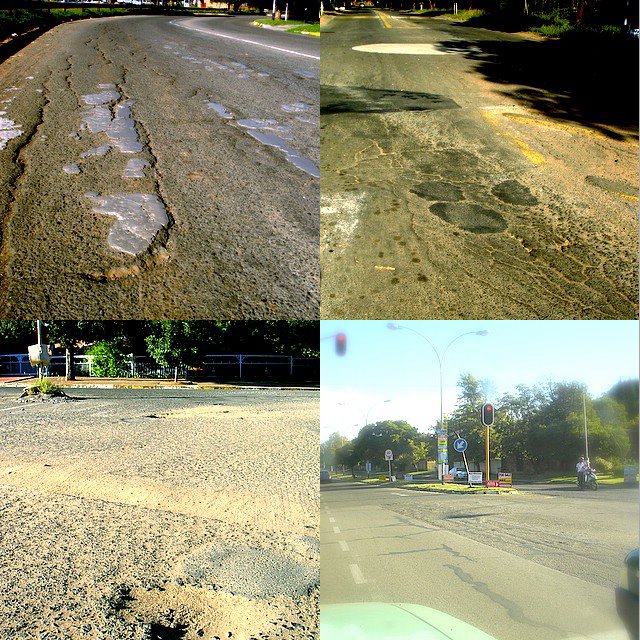
A road though, also has implications for cars. When roads start to fall apart, they start to shake, rattle and roll the cars and trucks driving over them, wearing out tyres. When it gets bad enough, the drivers going over them start looking like epileptics. In Bloemfontein, it’s that bad.

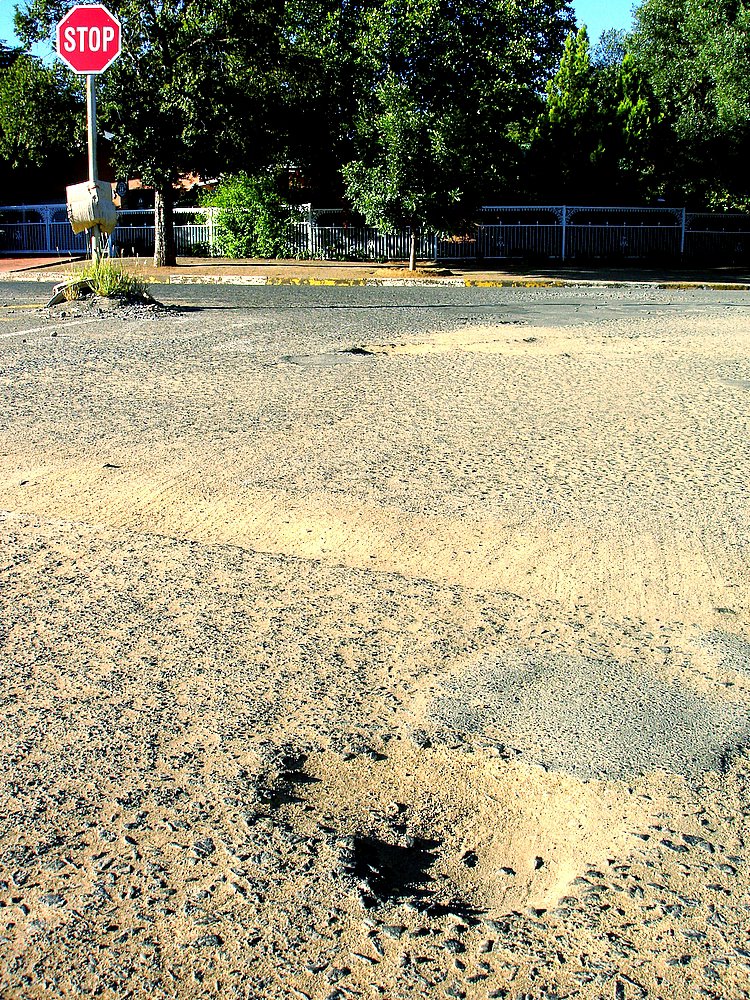
As a cyclist, I literally feel the r-r-r-roads around here, and the situation is quite serious. Not just in Bloemfontein, but on roads surrounding the city as well. On some roads, if you’re not careful, you can get your tyre stuck in a crack – that’s how wide they are. Gravel blocks are pulling loose, so that roads are issuing large black crumbs all over the tar. Every day we see the yellow adipose under the tar being exposed, in one pothole after another. These are on major arteries in Bloemfontein, like Gen Dan Pienaar Drive, and Andries Pretorius Street.

Recently a pothole emerged on the busy Nelson Mandela intersection near Mimosa Mall. A few days later a blob of tar was applied. Then a square block of exposed gravel, half a foot deep, and 4 feet wide, appeared at the intersection close to Saint Andrews School. It was such a big gash that you had to swerve around it, or else be jolted vertically. A pothole at an intersection is a dangerous distraction. After a few days a strip of black tar was applied as a sort of patch. Problem solved?

The problem is, roads all over Bloemfontein have become threadbare. The roads can’t be maintained on a one-pothole-at-a-time basis. In the street where I live, potholes are beginning to appear. The roads are in need of a full service, probably a whole new surface, and at least a new layer of paint. I know of two sections of road where this is happening, but both are beyond the city limits.
One might argue that there are more important things to take care of, like housing. Ignoring the state of roads is expensive and foolish. Roads are how we are conveyed through cities, and its avenues and suburbs. It’s our daily reality. A country is judged by outsiders, and more importantly, by its own residents, based on its roads. Imagine what a road full of potholes or cracks does to the perception for foreign or local investors, or the perception of value for a neighborhood. A bad road implies a poor community. The community ought to demand a rapid response to this issue.

Free State Premier Beatrice Marshoff has outlined a number of priorities for the province. These include eliminating fees for education, building 12 000 housing units, increasing the number of anti-retroviral sites to nine, and making changes relating to governance and land restitution. These may be valid priorities, but the maintenance of roads should also be at the top of her agenda.
I’m aware, from this year’s Free State Provincial Government Report Card* that the city coffers are full to overflowing with tax money. A total amount of R359 079 million was allocated for 2005/2006, and of this amount, R218 047 has already been spent. There’s still a lot left. Where is it going? The community ought to get involved in offering suggestions.

To report bad road surfaces in Bloemfontein, please call the Municipality at 051 4058011

Writer’s note: Slip-sliding into cynicism is an article by Barry Ronge in the latest Sunday Times magazine. It’s about his experience with regard to the deterioration of roads. What’s yours? Send your story and pictures to reporter.co.za and let’s gauge the national extent of the problem.

*Quoted from FSPGRC: Article 19. Government will allocate R146 million for roads and R68 million for new infrastructure projects as well as rehabilitate and maintain existing infrastructure in line with EPWP.

Sunday, March 05, 2006

An Acceptable Performance


Got out of bed on a crisp morning, leaving the cat to lie cozily on the still warm, bed. The sheets were still buzzing with body heat and electricity, while I pulled on cold to the touch lycra.

It proved to be my best race so far this year, although speedwise it's the second best performance. Lost touch with the elite guys climbing up Lucas Steyn, and then formed a strong bunch of about 8 that rapidly closed in on the front pack. At halfway (40km) we were a merely 35 seconds from them, a bunch of about 6 riders, and another 20km later we'd picked off two riders, who joined our group.

One rider, on a blue Cannondale, was, to my mind, just not working hard enough. See, we were trying to catch the bunch, so we needed to maintain a fast pace. Whenever it was the blue Cannondales turn, the whole pack slowed down, undoing essentially, a lot of valuable contributions. So I slotted myself in behind him, and then waited behind him, making sure he had a fairly long turn to work, even though he wasn't working hard. Then, selecting a beacon, I'd break. Because he'd just worked and I and the other guys were fresh, the chances were good that we could break him. This happened after my third break, most of the way up a gradual climb.

We whittled down to a bunch of 6, which later broke into two groups of three. I was in the second group, with two black riders. Each of us had a turn putting pressure on the others, the black guys on two uphills (and couldn't get away), and me on the downhill. So it came down to a sprint. I was tucked in nicely behind one of them and then kicked at 250m to go. I stayed ahead, clenching my teeth, until I reached the line. The one behind struggled to stay on my tail, and since I was powered by Zipp, it was a taal order getting around me. He had one Zipp, but it wasn't enough. I'm still on a bit of a high after ending so strong, and dominating a lot of the race.

Cycle: 2:12 (with Zipps)
Distance: 79km
Heart rate: 157 (average) 173 (max)
Calories: 2366 Kcal
Time per kilometre: 1:40 (best is 1:38)
Average speed: 36.6km/h with strong crosswind in both directions.

After the race I coughed a lot in the cold air.

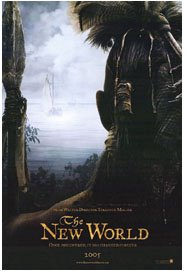
Movie Review: The New World


I missed the first two minutes of this film. Each sweep of the camera is so exquisite that I can’t help wanting to watch the film again just to see how it started.

The film is based on a true story, the discovery of the New World, and its native inhabitants. It is beautifully crafted. The first sweeps, where man is covered in metal or plastered with paint and feathers, are powerful. The untouched wilderness fills us with longing and quiet respect. German born Q'Orianka Kilcher, which means "golden eagle" in Quechua, puts in an authentic performance as the Indian princess (who is not given a name). She is wonderful to watch, and it is around her that the New World, at first, seems to turn. Her calm, compassionate spirit costs her tribe dearly.

Will Farrell puts in a restrained but realistic performance as Captain Smith. The film is beautifully balanced, and at times feels like a window into the wilderness of long ago, and the wild, authentic character of human beings. The film represents a sensitive and delicate appreciation of the miraculous: in life, love and nature. This film brings something that we don’t often see, to the cinema: purity and honor of a person and an environment.

Terence Mallick (The Thin Red Line)directs The New World, and shows us human beings in all their guises. It does not take sides, but perhaps it asks us, which side of ourselves we’ll choose to be. It is a better representation of the Native Americans and the British than Dances With Wolves, and that’s saying something. The images in the last 15 minutes of the film (I won’t give them away) are particularly fascinating, as we once again see our civilization as both absurd and comforting.
We learn, I think, that something that people once had, a closeness to each other, and to nature, has been lost, despite the awesome towers and machines that we have. Perhaps, the film also seems to convey, it is a basic sense of life, the waters shining with light around us, and grasses whispering, that is now beyond our reach.

When the Indian princess puts on western garb, including heeled shoes, we have the chance to see how absurdly civil we are, rigid and disconnected from ourselves and our world.
It is through her that we connect to the goodness of the Earth, and ponder with a quiet smile the meaning of Christopher Plummer’s words, drifting in the background: “Our inexperience is our wisdom.” It is through her that we wonder about the goodness in ourselves.

This is a very rich, very deep and touching film, and it is easily the film I have enjoyed the most so far this year.

Saturday, March 04, 2006


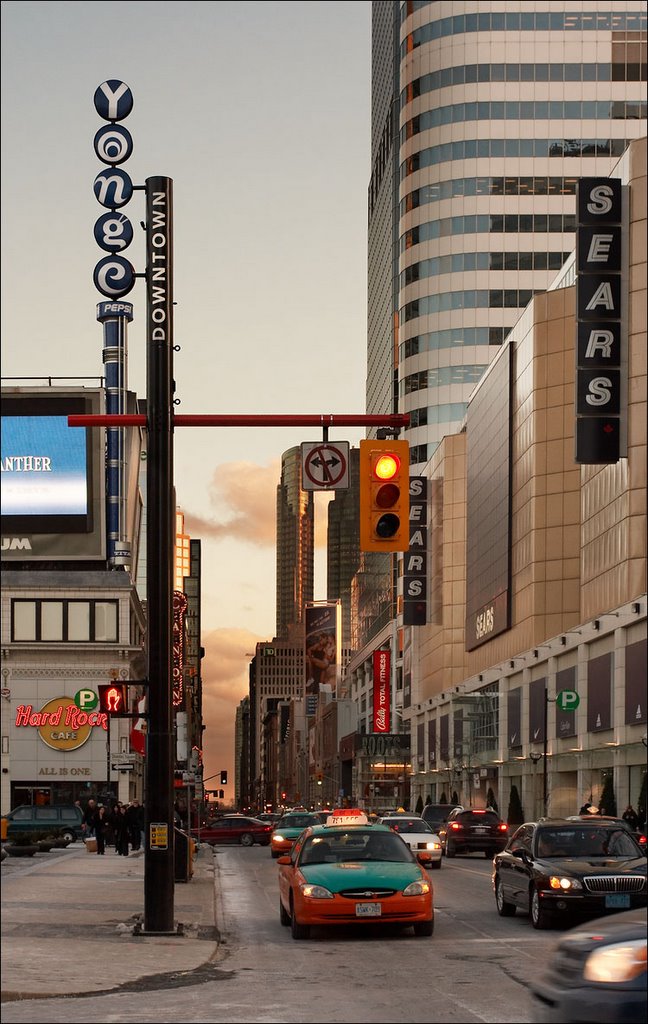
Photo courtesy www.topleftpixel.com


 Posted by Picasa

 Posted by Picasa

Alert: Switzerland finds four more H5 bird flu cases

03 Mar 2006 11:38:08 GMT
Source: Reuters
ZURICH, March 3 (Reuters) - Switzerland found four more cases of H5 bird flu in wild birds, the federal veterinary office said on Friday, adding it expected to find further cases in the coming days.

 Posted by Picasa

Went to Mystic Boer. It was busy, but the cold weather definitely thinned the crowd out a little. I didn't stay long. About 20 minutes, then walked back home. Posted by Picasa

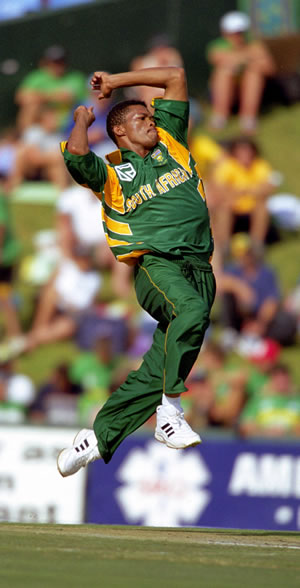
Ntini Takes 6 Scalps


Ntini's 6 wickets in 22 balls brought the world champions to their knees in a crushing victory for South Africa.

by Nick van der Leek

Newlands: Makhaya Ntini's performance is the best-ever one-day for a South African bowler, improving on Allan Donald's 6/23. Australia were all out for just 93 runs - their fourth lowest one-day total.

After winning the toss, South Africa elected to bat on a ground which favors the side batting first, at a rate of about 80%. The Aussies had to beat an impressive 289 runs with crucial contributions made by Herschelle Gibbs (66), Justin Kemp (51 not out) and Shaun Pollock (38 off 27 deliveries).

When the Australians came out to bat, Ntini immediately struck. At one stage the score stood at just 7 runs, with 4 wickets already taken. The damage was done. Watson put on the best performance for an Aussie batsman, at a mere 27 runs.

Andre Nel withered much of the rest of the line-up, taking 3/30, in 8 overs, and Ntini cleaned up what was left (including Watson), earning himself a place in the record books.

The third of five One Day Internationals is in Port Elizabeth on Sunday. The South Africans go in with a lead of 2-0.

In the swim/hospital?


 Posted by PicasaFransa took me to the Medi-Clinic today. We went to visit a fiesty swimmer called Riette, who has been in hospital since yesterday because of a suspected tumor on the brain.
She swims with Simon Gray and is quite spirited. When she smiles the corners of her mouyth turn into sharp corners, like Dennis Quaid's (The picture above is not Riette, incidentally).

After Riette we visited Ronel, who is being fed antibiotics through a drip. Dinner was served while we were visiting, and blood pressure was also being measured. I asked the nurse if she would measure mine:

115/69

My pulse came in at 44 and set off the alarms. Seems like my heart is still in decent shape.

Cross your heart and attempt to vote


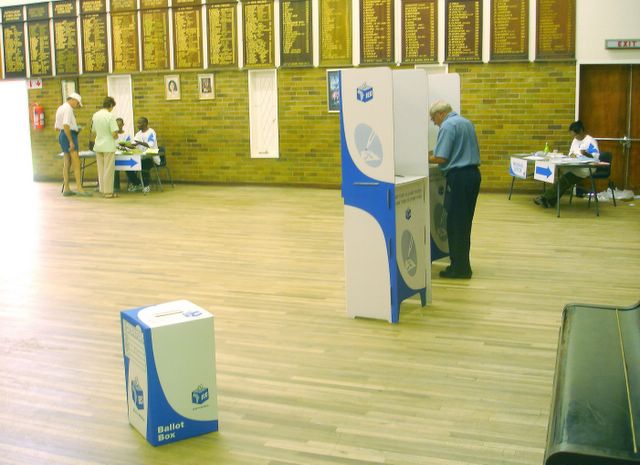
I tried to vote in South Africa's latest municipal (local) government elections. I registered to vote for the referendum, in 1994, but had since been out of the country. When I tried to vote they said I wasn't registered with them, and I should vote where I had last voted. That ward had been replaced by the one I was at!

I wasn't the only one who didn't get to make a cross - a large proportion of the locals seemed to take the day off and do just about anything besides vote. Posted by Picasa

Email from Peter Malherbe


Dear Nick

I am Peter Malherbe [who was the former managing editor of the Sunday Times], content editor for the www.reporter site. This is just to get into contact with you, as you have become a regular contributor to the site. Thanks for all the hard work you have put into the reports and the great variety and volume of
material you have been sending us.

Basically, I would be very happy to assist you whenever you need advice about articles - whether to do them, how to do them, any legal queries, etc.

I would be most happy to assist in any way I can. I read your earlier email asking for suggestions, so I will make recommendations when the need arises or a
great idea springs to mind.

Keep in contact through this email address for personal assistance, use the main info@reporter for administration queries and other issues.

Regards
Peter

PS: Really enjoyed your piece on Kob Inn, as that is my part of the world. I come from a small town called Komga in the East Cape, have a holiday home at Haga
Haga down the coast towards EL and have spend many great holidays on the Wild Coast!

Friday, March 03, 2006

Argus Entry

I seem to have entered the Argus, but can't seem to confirm my seeding online. Will try to be patient. Meanwhile I have two articles on reporter.co.za, one is a top story and another is an opinion piece of why the Argus is so popular.

Go here to check them out:
https://www.reporter.co.za/home.aspx?page=RP21P62802
or click on the title of this paste.

Serbia/France report first/new cases of bird flu

March 3, 2006 - 6:14AM


Iraq, Serbia and Germany have reported their latest cases of bird flu as health officials and researchers around the world prepare to fight a possible deadly avian flu pandemic among humans.

The latest cases in Europe and the Middle East came hours after US Health and Human Services Secretary Michael Leavitt said it was "just a matter of time" before wild birds and possibly poultry flocks in America contracted H5N1.

US officials said they bought more than 14 million courses of antiviral treatments from GlaxoSmithKline and Roche to prepare for a possible human bird flu pandemic.

The United States plans to have enough medication to treat 25 per cent of its population in the event of an outbreak.

In Tokyo, Japanese researchers said they had developed a new way of producing the anti-flu drug Tamiflu, considered one of the best defences against bird flu in humans, that does not rely on natural ingredients and may help ensure more stable supplies.

The H5N1 avian flu virus has killed 94 people in seven countries - Turkey, Iraq, Indonesia, Thailand, Vietnam, China and Cambodia. It has infected 174, giving it a more than 50 per cent fatality rate, but experts are unsure if some people may have had less serious infections that went undetected. Since 2003, H5N1 bird flu has been found in more than 30 countries.

Experts fear H5N1 will mutate just enough to allow it to pass easily from person to person. If it does, it could cause a catastrophic pandemic, killing tens of millions of people.

Iraq said a woman had died in a suspected case of the H5N1 bird flu virus and Serbia said it had detected its first case of bird flu in a dead swan that was being tested to see if it had the deadly strain.

A cat in Germany was confirmed as testing positive for H5N1, causing some concern in Europe despite the World Health Organisation saying it did not increase the risk to humans.

Iraq said the woman who died of the suspected case of H5N1 lived in the province around the town of Nassiriya in southern Iraq and more tests were being carried out in Baghdad and Cairo.

Two fatal cases of human bird flu, in a teenage girl and her uncle last month, were previously confirmed in the northern Iraqi province of Sulaimaniya, close to the border with Turkey.

Serbia said it had detected its first case of bird flu in a swan found dead in the region of Sombor, close to the Croatian border.

France reports 11 new cases og H5N1 bird flu
02/03/2006 - 17:03:33

France reported 11 new cases of H5N1 bird flu in wild birds today in an area already hit by the lethal virus.

Laboratory tests detected the virus in a heron, a duck and in nine swans, raising to 29 the total number of cases found among wild birds in the southeastern Ain region, the farming ministry said in a statement.

In response to the new cases, the government was expanding a protection zone to about 300 towns in the area, from about 70 when the first cases of bird flu were confirmed there.

Dozens of countries have banned poultry imports from France after the H5N1 bird flu strain was found on a turkey farm last week in Ain, the first infection of the virus in commercial EU poultry stocks.

Thursday, March 02, 2006

Introducing: iPod Hi-Fi


Pure performance

World-class acoustic design produces incredible warmth, depth, and clarity without the bulk or expense of traditional home stereos.

In concert with iPod

iPod Hi-Fi works beautifully with any iPod* and even adds a new menu feature: Tone Control, so you can adjust for different kinds of rooms and music.**

Move with the music

Compact and light, iPod Hi-Fi has integrated handles and runs on AC or battery power. So put it anywhere and hear your music like never before.
 Posted by Picasa

Climate Change: No Doubt It's Us


 Posted by Picasa

Just as the energy debate in Washington is focusing in on the question of our addiction and dependence, the world's scientific community is making sure we don't forget what some, like Tony Blair's science advisor, consider to be a bigger threat than terrorism: global warming.

A BBC article published today reports that the Intergovernmental Panel on Climate Change will announce that global warming is unequivocally driven by athropogenic greenhouse gas emissions; in other words, by human activity. Gone is the carefully hedged possibility that there may be natural factors at play, like changes in solar intensity or cyclical terrestrial processes. This problem is home-made. Here's a snip:

The BBC has learnt the report will state that greenhouse gas emissions are the only explanation for changing patterns of weather across the globe.

It will say rising concentrations of gases such as carbon dioxide in the atmosphere must be the cause of simultaneous freak patterns in sea ice, glaciers, droughts, floods, ecosystems, ocean acidification and wildlife migrations.


Since the question for the scientific community is not whether, but how fast, man-made climate change is occurring, the question before politicians must be not whether, but how, to adapt the world's interconnected economies. Skipping ahead a few steps, leaders are about to realize that global warming has become a major geo-political issue. The big question will be: How do the big economies, the U.S., Europe, Japan and China adapt in concert?

Adaptation, adaptation, adaptation.
Whether our goal is to forstall or to mitigate catastrophic warming, this is now an issue of national security. Diane Sawyer, commenting on her own network's reporting of the likelihood that the Greenland ice sheet will melt and raise the world's sea levels, summarized the threat well: "21 feet." In addition, a Pentagon-sponsored study showed that should such a melting come to pass, international energy, food, and freshwater supplies would be so disrupted as to cause major regional wars and large-scale population migrations away from the coasts here in the U.S.

This time, however, the tools for securing our nation will be economic and they will be domestic. American leadership in adapting--at home first--to the global warming threat can turn the tide in this battle. And the military will have to take a back seat. Done right, adaptation, with its necessary focus on renewable energy and sustainable development, will also undermine the appeal of Islamic extremism and strategic competition with China.

The timing is actually quite propitious. George Bush is daily demonstrating the impossibility of defending our current economic engine, designed in the late 1940s and the 1950s, from the massive changes in the global economy and now, the global ecosystem. It is time for a fulsome re-think about how we can shape a sustainable market economy and integrating the real and growing threat of climate change into our planning is essential.

With two-thirds of Americans wanting a new national direction, the political incentive is there. In fact, there is the chance for a new grand bargain among the majority in America that listen to scientists seriously, those who would rather invest in long-term sustainable prosperity over short-sighted profits, and those who want good jobs, safe communities, and a secure future.

What is missing so far is the leadership to get us there.
--Patrick Doherty | Wednesday, March 1, 2006 10:39 AM

Kunstler: Inflection


February 27, 2006,

As the bombing of the Golden Dome in Samarra last week resolves into the Iraq civil war that everyone has feared, expect a more widespread uproar against western interests generally through the Islamic world, with Iran doing everything possible behind the scenes to incite the main actors: underemployed young men from Algiers to Jakarta.

The west and Islam have reached an inflection point. American influence in the eastern hemisphere may be the main object of Islam's wrath, but Europe can no longer pretend to be a disinterested bystander. The big issues are the perceived weakness of the west, the steady draining of the Islamic world's most precious resource, oil, and the hateful presence of western persons and culture in the Islamic ummah.

Iran's wish to inflame, in effect, a world war may be based on equal parts delusion and realpolitik, but the wish itself is more powerful than any sense of consequence. Iran sees the opportunity to run America out of the Middle East and to seize leadership of the Islamic world from the corrupt sheiks who have been sucking up to the west for decades and trading Islam's chief resource for whoring sprees in Monte Carlo and Las Vegas. The religious split in Islam between Sunni and Shi'a works to Iran's advantage because Shi'a are motivated by an additional sense of grievance, and as the dominant force in Iraq can bring that country into its orbit even while Iraq is occupied by American troops -- only emphasizing America's weakness.

Meanwhile, Iran can work in the background to stimulate mob violence against western embassies and interests in Syria, Pakistan, Afghanistan, Indonesia and will directly fund the Palestinian Hamas government dedicated to wiping Israel off the map. The recent cartoon riots in many places were just a preview of coming attractions.
Many readers and correspondents have sent me anxious emails about the opening of Iran's Euro-denominated oil bourse in March. I don't share their conviction that this bourse will destroy the US dollar's advantage as the world's reserve currency. But I do imagine it will irritate an already dangerous situation. Its other objective would seem to be an effort to drive a wedge between Europe and America.

However, Europe is also addicted to Middle East oil. The attitudes of France and Germany might change drastically if their main supply point, through the Suez Canal, happened to be choked off for some reason. Another dose of civil disorder, like the riots that rocked France last fall, would also clarify their shared position vis-�-vis Islam. Europe will certainly not benefit from an Iran armed with nuclear bombs and missile delivery systems.

Iran seems to be in one of those moods that nations fall into where delusions of grandeur converge with a sense of grievance and with the appearance of opportunity to prompt extremely reckless behavior. Hitler's Germany was in that mood in 1938. The US could get run out of Iraq by sheer anarchy, and the unwillingness of the US public to endure more deaths and expenditures, and that is probably the big opportunity that Iran perceives. But somewhere further down the line Iran might have to contend with the inconvenience of American long-range tactical air power, and with the ultimate option (unthinkable as it may seem) of turning Teheran into an ashtray. President Mahmoud Ahmadinejad seems to calculate that it is a risk worth taking.

The perceived weakness of Europe is also probably overestimated. The memory of the two world wars has made France and Germany hypersensitive about international quarreling, but they may not be able to stay on the sidelines much longer. Along with Britain, Italy, and Spain, they represent an economy and population base equal to America's, with a formidable capacity to mobilize in an emergency, especially with air power. The Islamic world has an old beef with Europe, and at the very least will enjoy watching them suffer.

What has kept the big quarrel contained so far is the sheer geographical fact that most of the world's oil comes out of this likely battleground. America and Europe cannot risk the destruction of those wells, terminals, refineries, and pipelines, and none of the parties on the Islamic side are especially keen to trash all that stuff, either, since they have little besides figs and tangerines to fall back on.

The current scandal in the US about the Dubai-based company being invited to run US port facilities only underscores America's weakness, our feckless pretense that there is no fundamental conflict between Islam and the west, that we are so generous, open-minded, good-willed, and self-confident that even the boundaries of political common sense have dissolved.

Of course, some Americans may be wondering why we can't find any American company to run American ports. But the American press is too stupid to even ask that question.

from www.kunstler.com

 Posted by Picasa

Spinosaurus is the newly crowned biggest land carnivore, at 55 feet long and 8 tons. Credit: Joe Tucciarone
 Posted by Picasa

So far this week (and it's only Wednesday) I'm already over the 7 hour mark.

Swim: 0:45
Distance: 1.5km
Mixed. A fun workout with the Froggies, mixing it up, from fly, to underwater, to bunch swimming, to headup, to some indescribable stuff. Woke up today feeling sick. But felt better after the swim.

Cycle: 2:06
Distance: 57.8km
Average HR: 138 (maximum 163)
Felt very tired after this ride.

Almost 3 hours of total training today.

Going to rest up tomorrow, just do a 9km run. Not feeling 100% healthy now, but possibly just need a good nights rest. Hope so. Posted by Picasa

Brief Rant

At the pool today I took a number of shots of the swimmers, some not too bad. Today (March 1) was also a local government election, and I took some shots of this as well. I loaded these onto a disk but the computer I am using is not reading them.

Hopefully I'll have some of today's material tomorrow.

Wednesday, March 01, 2006

Run For Your Life


Yesterday

Cycle: 1:49
Distance: 48.7km
Average HR: 1425 highest hills in Bloemfontein
Total calories: 937

Today

Run: 1:11
Distance: 11.5km
Average HR: 153
Calories: 1236kcal.

Note how the workout on top is 30 minutes longer, and yet the calories consumed when running remain almost a third higher, than cycling.

Take care of your engine and it will run for a long time

Today the number of obese Americans is greater than the population of Spain. It’s not difficult to find people who are overweight. In Western society, and increasingly in the East too, they outnumber those who aren’t. It’s been called a disease, and if it is, then here is the cure.

‘A day is either a day that you went running, or didn’t go running.’
Like many endurance athletes, I did not start off being health-conscious, but performance-conscious. The result of pursuing goals like a 3 hour marathon or a 35 minute 10km, is that the runner finds he has to take care of the engine. He has to become health aware and practice a healthy lifestyle to stand the best chance of success.

Even as a younger man, lightness becomes important during racing, and so certain fatty foods must be reduced from the diet, especially ice-cream, boerewors, excess butter and margarine. Over a period of time it also becomes clear that simple sugars cause an uneven flow of energy, and are best avoided as far as possible. These include drinks such as fruit juices and sodas. Tea or coffee should be consumed with honey instead of sugar, the same principle being applied to breakfast cereals. Meals should be eaten 2-3 hours before exercising; otherwise there is a inefficient conflict between in energy absorption/digestion and release. It may seem that these habits originate in the diet, but actually they are driven over a period of time by the experience of finding greater fuel efficiency in the body. Thus, running, especially running towards a goal, drives changes in the diet. Without a goal, these changes will be more difficult, either to maintain or even rationalize.

So don’t just run, set a goal, whether to run a race, or a certain distance, or your regular route in a certain time. And then dedicate weeks of training to the pursuit of that goal.

Going into my 30’s, I’ve found that a reasonable diet without exercise isn’t enough. This is quite a shocking discovery. It means that the average, or conventional diet, makes us fat. It also means that exercise and fitness is not an option – it ought to be a lifestyle for all, for the duration of our lives. What ever made us think that we could spend the 2nd half of our lives watching TV and being, essentially, sedentary?

Breslow (1979) has shown a strong correlation between longevity and physical health according to these 7 habits:

- sleeping 7-8 hours at night
- drinking alcohol in moderation or not at all
- avoiding smoking
- eating breakfast
- eating regularly
- controlling body weight by eating moderately
- exercising regularly

It should be obvious that regular exercise necessarily drives a number of the imperatives mentioned above. If you exercise regularly you will eat regularly, including breakfast, and most disciplined runners will find excessive alcohol consumption and smoking impractical. Regular exercise is also well known to counteract insomnia.

Why running? Running is the most accessible exercise, and arguably, the cheapest. It can be done almost anywhere, with the minimum of infrastructure. People who complain that they are susceptible to injury should start off taking long walks.

One of the most powerful and underestimated effects of exercise in general, and running in particular, is its capacity to provide stress relief and flush out depression. Depression is associated with physical inactivity by numerous authors. It is a cheap and effective treatment, but requires at least a spark motivation or a glimmer of will from the depressed person. Once established, this capillary of power can be enlarged (by training with more discipline and regularity) into a major energizing channel.

If depression is associated with physical inactivity, the opposite is therefore that being fit makes us happy. Being healthy makes us happy. Being thin and looking good helps us to enjoy ourselves. The world has become a strange place; one where we find we commonly forget the obvious. It is a world of convenience, where buying a burger leads to instant weight gain. But running is just as easy, and just as convenient. Running is as close to you as your front door. Whoever coined the phrase ‘run for your life’ may not have been holding a gun. Perhaps he or she was tying the laces to a newish pair of running shoes. Shouldn’t you be doing the same?

Background for this text was sourced in The Lore of Running, by Tim Noakes.