
Wednesday, January 09, 2013


Monday, January 07, 2013
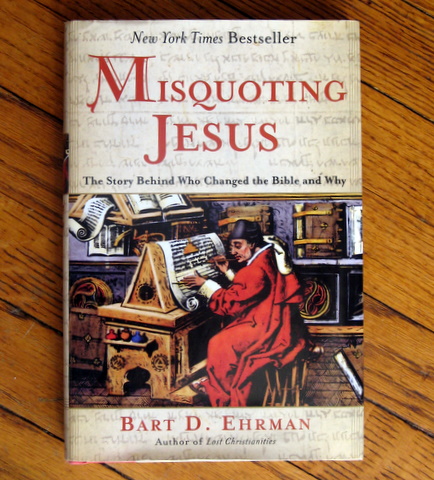
Who changed the Bible and why? Bart Ehrman’s startling answers
How often do we hear people “explaining” religious beliefs by stating ”The Bible says so,” as if the Bible fell out of the sky, pre-translated to English by God Himself? It’s not that simple, according to an impressive and clearly-written book that should be required reading for anyone who claims to know “what the Bible says.”
The 2005 bestseller, Misquoting Jesus, was not written by a raving atheist. Rather, it was written by a fellow who had a born-again experience in high school, then went on to attend the ultraconservative Moody Bible Institute in Chicago. Bart Ehrman didn’t stop there, however. He wanted to become an evangelical voice with credentials that would enable him to teach in secular settings. It was for this reason that he continued his education at Wheaton and, eventually, Princeton, picking up the ability to read the New Testament in its original Greek in the process.
As a result of his disciplined study, Ehrman increasingly questioned the fundamentalist approach that the “Bible is the inerrant Word of God. It contains no mistakes.” Through his studies, Ehrman determined that the Bible was not free of mistakes:
We have only error ridden copies, and the vast majority of these are centuries removed from the originals and different from them, evidently, in thousands of ways.(Page 7). At Princeton, Ehrman learned that mistakes had been made in the copying of the New Testament over the centuries. Upon realizing this, “the floodgates opened.” In Mark 4, for example, Jesus allegedly stated that the mustard seed is “the smallest of all seeds on the earth.” Ehrman knew that this simply was not true. The more he studied the early manuscripts, the more he realized that the Bible was full of contradictions. For instance, Mark writes that Jesus was crucified the day after the Passover meal (Mark 14:12; 15:25) while John says Jesus died the day before the Passover meal (John 19:14).
Ehrman often heard that the words of the Bible were inspired. Obviously, the Bible was not originally written in English. Perhaps, suggests Ehrman, the full meaning and nuance of the New Testament could only be grasped when it was read in its original Greek (and the Old Testament could be fully appreciated only when studied in its original Hebrew) (page 6).
Because of these language barriers and the undeniable mistakes and contradictions, Ehrman realized that the Bible could not be the “fully inspired, inerrant Word of God.” Instead, it appeared to him to be a “very human book.” Human authors had originally written the text at different times and in different places to address different needs. Certainly, the Bible does not provide an an “errant guide as to how we should live. This is the shift in my own thinking that I ended up making, and to which I am now fully committed.”
How pervasive is the belief that the Bible is inerrant, that every word of the Bible is precise and true?
Occasionally I see a bumper sticker that reads: “God said it, I believe it, and that settles it.” My response is always, what if God didn’t say it? What if the book you take as giving you God’s words instead contains human words. What if the Bible doesn’t give a foolproof answer to the questions of the modern age-abortion, women’s rights, gay rights, religious and supremacy, western style democracy and the like? What if we have to figure out how to live and what to believe on our own, without setting up the Bible as a false idol–or an oracle that gives us a direct line of communication with the Almighty.(Page 14). Ehrman continues to appreciate the Bible as an important collection of writings, but urges that it needs to be read and understood in the context of textual criticism, “a compelling and intriguing field of study of real importance not just to scholars but to everyone with an interest in the Bible.” Ehrman finds it striking that most readers of the Bible know almost nothing about textual criticism. He comments that this is not surprising, in that very few books have been written about textual criticism for a lay audience (namely, “those who know nothing about it, who don’t have the Greek and other languages necessary for the in-depth study of it who do not realize there is even any “problem” with the text).
Misquoting Jesus provides much background into how the Bible became the Bible. It happened through numerous human decisions over the centuries. For instance, the first time any Christian of record listed the 27 books of the New Testament as the books of the New Testament was 300 years after the books have been written (page 36). And those works have been radically altered over the years at the hands of the scribes “who were not only conserving scripture but also changing it.” Ehrman points out that most of the hundreds of thousands of textual changes found among the manuscripts were “completely insignificant, immaterial, of no real importance.” In short, they were innocent mistakes involving misspelling or inadvertence.
On the other hand, the very meaning of the text changed in some instances. Some Bible scholars have even concluded that it makes no sense to talk about the “original” text of the Bible. (Page 210). As a result of studying surviving Greek manuscripts of the New Testament, Ehrman concluded that we simply don’t have the original words constituting the New Testament.
Not only do we not have the originals, we don’t have the first copies of the originals. We don’t even have copies of the copies of the originals, or copies of the copies of the copies of the originals. What we have are copies made later-much later. In most instances, they are copies made many centuries later. And these copies all differ from one another, and many thousands of places . . . Possibly it is easiest to put it in comparative terms: there are more differences among our manuscripts and there are words in the New Testament.In Misquoting Jesus Bart Ehrman spells out the ways in which several critical passages of the New Testament were changed or concocted. They are startling examples:
A.) Everyone knows the story about Jesus and the woman about to be stoned by the mob. This account is only found in John 7:53-8:12. The mob asked Jesus whether they should stone the woman (the punishment required by the Old Testament) or show her mercy. Jesus doesn’t fall for this trap. Jesus allegedly states “Let the one who is without sin among you be the first to cast a stone at her.” The crowd dissipates out of shame. Ehrman states that this brilliant story was not originally in the Gospel of John or in any of the Gospels. “It was added by later scribes.” The story is not found in “our oldest and best manuscripts of the Gospel of John. Nor does its writing style comport with the rest of John. Most serious textual critics state that this story should not be considered part of the Bible (page 65).
Read the rest.
Sunday, January 06, 2013
Friday, January 04, 2013
Thursday, January 03, 2013

Wednesday, January 02, 2013
A Message to readers of my work, and this blog
Quite often the writing that I send to magazines exceeds their word limits, and the result is that the finished product is often highly abbreviated, and occasionally (I feel) lopsided. A case in point - I recently interviewed 7 different families about their approaches to the pressures of winning. Due to word limits, 5 of those interviews will probably be cut. I also researched two experts in child psychology, and had to remove the one entirely, and shorten the second to a few brief bullet points This is an extreme example where a word limit of around 1500 words is surpassed by an almost unimaginable 2000 words to reach a total of about 3500.
The reason this happens is that sometimes there are a few 'Aha' moments, and one feels the insights gathered are good enough to warrant additional time and attention.
Thus in future I will post some of the uncut versions to stories that I feel are worthy of further airing. I will provide links to the uncut versions beside the original samples (which are often merely unreadable screengrabs which simply show what the layout of the article looks like). These will necessarily only be published once the particular article and issue is superseded by the next issue.
I will also be happy to provide behind the scenes footage and descriptions in terms of how I went about my research, what was it like meeting X, or Y, and any other questions the reader may ask. The point is to make this blog slightly more interactive than it has been. Obviously in this sense I rely on the reader to also communicate what they would like to know.
A final point that I would like to mention is that while this blog was initially filled with personal observations, I've noticed that it is also the first place my enemies turn for canon fodder. (An enemy tends to be defined as: someone who has decided not to pay for work commissioned, and then needs reasons to justify this non payment). And then sentiments and statements on this blog are mined and weaponised to suit a particular agenda. Although I stand by all that I do and say, I find the technique highlighted in this paragraph by some of my opponents extremely tedious. If someone is defending themselves and all they have to accuse one is your own blog (nothing out of experience, no facts of any kind), I think it says a lot. But having said that, it makes sense for me, in my profession, not to be too honest or forthright, as unfortunately, there are a number of opportunistic scoundrels out there. And I'd rather not pander to them if I can possibly help it. Thus I regret that this blog will continue to be relatively free of personal information and minimal emotional disclosures.
I'm also a little lazy to do so; why blog for free when that time is better spent writing for cash or producing something substantive, like writing novels? Personally I don't see a blog as anywhere near the substantiveness of a book.
For any feedback feel free to email me at nickvanderleek[at][gmail][dot][com]. I do my best to answer all personal correspondence.
The reason this happens is that sometimes there are a few 'Aha' moments, and one feels the insights gathered are good enough to warrant additional time and attention.
Thus in future I will post some of the uncut versions to stories that I feel are worthy of further airing. I will provide links to the uncut versions beside the original samples (which are often merely unreadable screengrabs which simply show what the layout of the article looks like). These will necessarily only be published once the particular article and issue is superseded by the next issue.
I will also be happy to provide behind the scenes footage and descriptions in terms of how I went about my research, what was it like meeting X, or Y, and any other questions the reader may ask. The point is to make this blog slightly more interactive than it has been. Obviously in this sense I rely on the reader to also communicate what they would like to know.
A final point that I would like to mention is that while this blog was initially filled with personal observations, I've noticed that it is also the first place my enemies turn for canon fodder. (An enemy tends to be defined as: someone who has decided not to pay for work commissioned, and then needs reasons to justify this non payment). And then sentiments and statements on this blog are mined and weaponised to suit a particular agenda. Although I stand by all that I do and say, I find the technique highlighted in this paragraph by some of my opponents extremely tedious. If someone is defending themselves and all they have to accuse one is your own blog (nothing out of experience, no facts of any kind), I think it says a lot. But having said that, it makes sense for me, in my profession, not to be too honest or forthright, as unfortunately, there are a number of opportunistic scoundrels out there. And I'd rather not pander to them if I can possibly help it. Thus I regret that this blog will continue to be relatively free of personal information and minimal emotional disclosures.
I'm also a little lazy to do so; why blog for free when that time is better spent writing for cash or producing something substantive, like writing novels? Personally I don't see a blog as anywhere near the substantiveness of a book.
For any feedback feel free to email me at nickvanderleek[at][gmail][dot][com]. I do my best to answer all personal correspondence.
Tuesday, January 01, 2013
Monday, December 31, 2012
Prometheus – getting practical about meeting your maker
Ridley Scott’s film Prometheus [warning: spoilers]
ends with the words, “It is New Year’s Day, the year of our Lord 2094…and I’m
still searching.”
Audience reception to this flick has been – unsurprisingly – sharply divided. But by box office standards, the film that cost $130 million (a relatively modest amount for a science fiction film these days) has been an unequivocal success. By October 2012, Prometheus had earned over $400 million.
One of the interesting aspects of the film is how it addresses the practicality of a creation ‘manning up’ (if that is the word) in order to meet the creator.
If you think this is a silly idea, or taboo, or nonsensical, then you are probably not a true believer. Which is strange, because believers need to realise that if their beliefs are true after all, then one day, they are destined by fate to meet God himself. Prometheus offers an example of what that meeting might be like.
One of the most obvious (real-life) previews to this introduction, of course, is when parents see their own children grow up and then – subtly sometimes (sometimes very obviously) they attain parity with their parents. It might be sons or daughters growing taller than their mothers, or becoming manifestly more powerful than their fathers. It might be progeny who know more (in real terms) than their parents, or possibly become financially more powerful.
Whatever happens, this ‘parity’, in the earthly realm, is not without enormous levels of stress and discomfort. How are the roles to be maintained, for example, when the progeny find that they are in some ways more advanced than their parents?
How should parents react to their progeny bumping against them? Of course many might say that the parents and children schema has nothing to do with God (but who is often referred to as ‘Our Father…in Heaven’) and that Prometheus is a crude fiction. Nevertheless the idea of reaching parity is real – employee vis a vis employer, apprentice and master, a would be champion – acceding to the podium ahead of the previous world champion (think Le Clos vs Phelps).
In every case, parity is not reached without a tremendous exchange of energy, stress, identity crisis, angst, role flux, and of course a change in power structures. Thus, when a human being encounters God, you can expect the same extraordinary amounts of stress. Does one imagine that in the infinity of time, all will be perfect, and above reproach?
When human beings are elevated to a heavenly realm, will they find themselves perfectly aligned, ensconced in a perfect environment, one costomised to each preference (or are preferences neutered), and will that constant exposure to God (and He to us) be as wonderful as everyone would like to believe? Will that constancy of the close encounter with that infinity superior and immediate authority grow on us over time?
One blasphemous way to very practical about this process, is to intuit it. Imagine if you were God, and your creation approached you (unbidden), asking...well, whatever it is creation needs (and their needs tend to be plentiful). As God, aren't you dutibound to provide, and aren't these maintenance checks mandatory for a maker?
Prometheus covers this issue in many ways. One is to look at the role of an android, whose talents surpass those of its human makers. How does the Android feel about the shortcomings of its makers? How does the maker of an android feel about its own creation showing an unsettling amount of free will?
In Prometheus, the android David makes a few telling observations:
Doesn't everyone want their parents dead?
As the ship Prometheus hovers over the lifeless LV 223*, David says, quoting Lawrence of Arabia: There is nothing in the desert, and no man needs nothing.
When his maker, Weyland, lies critically injured, moments away from death, and splutters: There’s nothing. David responds: I know.
Elsewhere he says to Elizabeth Shaw: It must feel like your God abandoned you. And yet we feel that there is more to Prometheus than the cold logic of the machine.
*The planet is LV223...and a reference to Leviticus 22:3in the Bible:
"Say to them: 'For the generations to come, if any of your descendants is ceremonially unclean and yet comes near the sacred offerings that the Israelites consecrate to the LORD, that person must be cut off from my presence. I am the LORD. "
[This in in contrast to LV426 in Alien and the reference to Leviticus 42:6:He shall burn all the fat on the altar as he burned the fat of the fellowship offering. In this way the priest will make atonement for the leader’s sin, and he will be forgiven.]
Elizabeth Shaw demonstrates that having beliefs (even if they are misguided) possibly aid survival. Nevertheless Shaw says: We were wrong, we were so wrong…
And: you must care about something, captain. If you didn't, why are you here?
Indeed, our beliefs, or lack of, clearly shape who we are. Very misguided beliefs, or beliefs that cause us too much anxiety, probably do not aid our survival. On the other hands, affirming beliefs that are nevertheless connected to reality (not too little and not too much) help us respond and react appropriate to a range of situations.
While many who hated this film believe even the science in it is bad, I reckon the reason is that they fail to see the deeply stitched symbolism. Some have blithely called the film stupid; in fact it has been painfully and very carefully considered. In fact, in almost every line of diaologue there is either a double meaning, a symbolic meaning or something prophetic.
Such as:
Charlie Holloway: We made you because we could. David: Can you imagine how disappointing it would be for you to hear the same thing from your creator?
And:
Elizabeth Shaw: If we don't stop it, there won't be any home to go back to!
And:
Meredith Vickers: If you're really going down there, you're going to die.
Peter Weyland: Very negative way of looking at things. Exactly why you should have stayed at home.
And:
Millburn: On the behalf of scientists everywhere, I am ashamed to count you amongst us, Fifield. Really.
And finally:
Peter Weyland: And what would Charlie do now that we're so close to answering the most meaningful questions ever asked by mankind? Hm? How can you leave without knowing what they are? Or have you lost your faith, Shaw?
What we notice on this forum is that some people wish not to debate the most meaningful questions. Many people say, “Why can’t you let us believe what we want to believe, they don’t do us any harm?” Others say, “No matter how much you try, people will continue to believe (or disbelieve…” Of course, both of these statements are false.
We are seeing a tremendous rise around the world in The New Atheism, with eloquent, charming, sensible and highly qualified debaters such as Sam Harris, the late Christopher Hitchens, Lawrence Krauss and Dawkins taking the baton from the likes of Bertrand Russell. Atheism is gaining traction thanks to the incredible strides in technology - our ability to peer into and analyze the universe and form each additional thesis at increasingly high processing speeds.
One of the reasons, I believe, some people hated Prometheus, is because it asks us to be practical about our beliefs, and most believers like to keep the tenets of their faith as wishy washy as possible.
Upon closer inspection, faith tends to dissolve. Prometheus brings together the robotic atheist and the feminine, gentle, intuitive survivor (who is also a believer) and concludes: I am still searching. Yes, we are.
We ought to take that hint seriously. Believers have much to learn from logical, rational scientists. But the story doesn’t end there. There is much that remains that we don’t know about the universe, or even ourselves. We are at heart, after all, symbolic creatures, rather than wrapped up in our 'creatureliness'.
Our language is based on symbols. Ours words. And thus we are also at a very deep psychological level, also symbolic beings. It may be that we must believe in something in order not to be overcome by not only the terrors of dying, but also those of living. It is how we have come to not merely understand the world, but how we must see it in order to survive and thrive in it.
Note: If you enjoyed this article follow this link for further reading > http://www.ign.com/wikis/prometheus/Official_Quotes
Audience reception to this flick has been – unsurprisingly – sharply divided. But by box office standards, the film that cost $130 million (a relatively modest amount for a science fiction film these days) has been an unequivocal success. By October 2012, Prometheus had earned over $400 million.
One of the interesting aspects of the film is how it addresses the practicality of a creation ‘manning up’ (if that is the word) in order to meet the creator.
If you think this is a silly idea, or taboo, or nonsensical, then you are probably not a true believer. Which is strange, because believers need to realise that if their beliefs are true after all, then one day, they are destined by fate to meet God himself. Prometheus offers an example of what that meeting might be like.
One of the most obvious (real-life) previews to this introduction, of course, is when parents see their own children grow up and then – subtly sometimes (sometimes very obviously) they attain parity with their parents. It might be sons or daughters growing taller than their mothers, or becoming manifestly more powerful than their fathers. It might be progeny who know more (in real terms) than their parents, or possibly become financially more powerful.
Whatever happens, this ‘parity’, in the earthly realm, is not without enormous levels of stress and discomfort. How are the roles to be maintained, for example, when the progeny find that they are in some ways more advanced than their parents?
How should parents react to their progeny bumping against them? Of course many might say that the parents and children schema has nothing to do with God (but who is often referred to as ‘Our Father…in Heaven’) and that Prometheus is a crude fiction. Nevertheless the idea of reaching parity is real – employee vis a vis employer, apprentice and master, a would be champion – acceding to the podium ahead of the previous world champion (think Le Clos vs Phelps).
In every case, parity is not reached without a tremendous exchange of energy, stress, identity crisis, angst, role flux, and of course a change in power structures. Thus, when a human being encounters God, you can expect the same extraordinary amounts of stress. Does one imagine that in the infinity of time, all will be perfect, and above reproach?
When human beings are elevated to a heavenly realm, will they find themselves perfectly aligned, ensconced in a perfect environment, one costomised to each preference (or are preferences neutered), and will that constant exposure to God (and He to us) be as wonderful as everyone would like to believe? Will that constancy of the close encounter with that infinity superior and immediate authority grow on us over time?
One blasphemous way to very practical about this process, is to intuit it. Imagine if you were God, and your creation approached you (unbidden), asking...well, whatever it is creation needs (and their needs tend to be plentiful). As God, aren't you dutibound to provide, and aren't these maintenance checks mandatory for a maker?
Prometheus covers this issue in many ways. One is to look at the role of an android, whose talents surpass those of its human makers. How does the Android feel about the shortcomings of its makers? How does the maker of an android feel about its own creation showing an unsettling amount of free will?
In Prometheus, the android David makes a few telling observations:
Doesn't everyone want their parents dead?
As the ship Prometheus hovers over the lifeless LV 223*, David says, quoting Lawrence of Arabia: There is nothing in the desert, and no man needs nothing.
When his maker, Weyland, lies critically injured, moments away from death, and splutters: There’s nothing. David responds: I know.
Elsewhere he says to Elizabeth Shaw: It must feel like your God abandoned you. And yet we feel that there is more to Prometheus than the cold logic of the machine.
*The planet is LV223...and a reference to Leviticus 22:3in the Bible:
"Say to them: 'For the generations to come, if any of your descendants is ceremonially unclean and yet comes near the sacred offerings that the Israelites consecrate to the LORD, that person must be cut off from my presence. I am the LORD. "
[This in in contrast to LV426 in Alien and the reference to Leviticus 42:6:He shall burn all the fat on the altar as he burned the fat of the fellowship offering. In this way the priest will make atonement for the leader’s sin, and he will be forgiven.]
Elizabeth Shaw demonstrates that having beliefs (even if they are misguided) possibly aid survival. Nevertheless Shaw says: We were wrong, we were so wrong…
And: you must care about something, captain. If you didn't, why are you here?
Indeed, our beliefs, or lack of, clearly shape who we are. Very misguided beliefs, or beliefs that cause us too much anxiety, probably do not aid our survival. On the other hands, affirming beliefs that are nevertheless connected to reality (not too little and not too much) help us respond and react appropriate to a range of situations.
While many who hated this film believe even the science in it is bad, I reckon the reason is that they fail to see the deeply stitched symbolism. Some have blithely called the film stupid; in fact it has been painfully and very carefully considered. In fact, in almost every line of diaologue there is either a double meaning, a symbolic meaning or something prophetic.
Such as:
Charlie Holloway: We made you because we could. David: Can you imagine how disappointing it would be for you to hear the same thing from your creator?
And:
Elizabeth Shaw: If we don't stop it, there won't be any home to go back to!
And:
Meredith Vickers: If you're really going down there, you're going to die.
Peter Weyland: Very negative way of looking at things. Exactly why you should have stayed at home.
And:
Millburn: On the behalf of scientists everywhere, I am ashamed to count you amongst us, Fifield. Really.
And finally:
Peter Weyland: And what would Charlie do now that we're so close to answering the most meaningful questions ever asked by mankind? Hm? How can you leave without knowing what they are? Or have you lost your faith, Shaw?
What we notice on this forum is that some people wish not to debate the most meaningful questions. Many people say, “Why can’t you let us believe what we want to believe, they don’t do us any harm?” Others say, “No matter how much you try, people will continue to believe (or disbelieve…” Of course, both of these statements are false.
We are seeing a tremendous rise around the world in The New Atheism, with eloquent, charming, sensible and highly qualified debaters such as Sam Harris, the late Christopher Hitchens, Lawrence Krauss and Dawkins taking the baton from the likes of Bertrand Russell. Atheism is gaining traction thanks to the incredible strides in technology - our ability to peer into and analyze the universe and form each additional thesis at increasingly high processing speeds.
One of the reasons, I believe, some people hated Prometheus, is because it asks us to be practical about our beliefs, and most believers like to keep the tenets of their faith as wishy washy as possible.
Upon closer inspection, faith tends to dissolve. Prometheus brings together the robotic atheist and the feminine, gentle, intuitive survivor (who is also a believer) and concludes: I am still searching. Yes, we are.
We ought to take that hint seriously. Believers have much to learn from logical, rational scientists. But the story doesn’t end there. There is much that remains that we don’t know about the universe, or even ourselves. We are at heart, after all, symbolic creatures, rather than wrapped up in our 'creatureliness'.
Our language is based on symbols. Ours words. And thus we are also at a very deep psychological level, also symbolic beings. It may be that we must believe in something in order not to be overcome by not only the terrors of dying, but also those of living. It is how we have come to not merely understand the world, but how we must see it in order to survive and thrive in it.
Note: If you enjoyed this article follow this link for further reading > http://www.ign.com/wikis/prometheus/Official_Quotes
On Prometheus and Religion
Damon Lindelof: "Hey, a bunch of humans seeking out their creator. David knows exactly who created him, and he is not impressed by his creator."
Ridley Scott: "I do despair. That's a heavy word, but picking up a newspaper every day, how can you not despair at what's happening in the world, and how we're represented as human beings? The disappointments and corruption are dismaying at every level. And the biggest source of evil is of course religion. [...] Everyone is tearing each other apart in the name of their personal god. And the irony is, by definition, they're probably worshipping the same god. [...] I'm really intrigued by those eternal questions of creation and belief and faith. I don't care who you are, it's what we all think about. It's in the back of all our minds." Source: Esquire
Damon Lindelof: "I'm most definitively pro-science, but I think that the movie advances the idea that, can the two live along side each other? Is it possible to be a scientist and maintain some fungible faith in the unknown? And are you rewarded for having blind faith? I do think that the movie is making the meta-commentary in saying well Shaw is the true believer on board, and she's the one who survives. So what are we trying to say by telling that story?" Source: io9.com


Sunday, December 30, 2012


Subscribe to:
Posts (Atom)