I've been going around shocking people (and things). Don't know if it is just a certain kind of energy I'm generating (negative?) but just seem to give off shocks when I touch a car, or a door or someone else.
Finished all marks and putting marks on the system last night at about 11pm. I actually cannot believe what a monstrous amount of work it is. I am really exhausted after this week, so next week, even though I am working, ought to feel like a holiday.
Felt like I slept in a hotel last night. Stayed at Hannes' place and caught up on the news. Things in Israel and Lebanon are probably going to escalate.
Went to gym and met a SA biathlete (and triathlete). Wendy. Swam 1.5km. Weight has blubbered up to 83.8kg. Going to cycle a long way tomorrow, study for an English exam and try to catch up on sleep. Also need to sort out a number of articles that need to be changed, sent off or pitched.
Now to watch the Tour de France's penultimate stage - the time trial. Landis?
Saturday, July 22, 2006


Wednesday, July 19, 2006
Eye Shadow
Went to a spin class at 5am yesterday (a small miracle). Actually enjoyed it - legs are still sore from it - but went into zombie meltdown mode a few hours later. Doing crazy stuff like handing out exam papers before I've written down the exam marks in my file.
Also have a disagreement with the headmaster. He came and stood by the window for several minutes while I taught. After calling my kids "stupid" a few times, he turned his attention to me, objecting to me giving the kids a Business Economics and Economics test on the same day. Since it's school policy to give no more than 2 tests on a day, I wasn't too impressed to be told what to do while I am in my classroom, especially when I am allowed to do what I'm doing.
Later in his office, showing me the tip of his pinkie, he said, "You care this much for your kids." Not nice to hear, especially after spending nights and mornings marking their work and spending all my time on student's scrawl.
go! magazine said the article is possibly too big for the next edition, so will come out in the September edition.
Not sure when I'll work on changing the other one for Shape.
Meanwhile I am still not sleeping much as I go to bed marking and when I wake up I do some more. So i thu gu shu ma na bectha gazzzzz ww mm... [System Shutdown. System Restore?]
Also have a disagreement with the headmaster. He came and stood by the window for several minutes while I taught. After calling my kids "stupid" a few times, he turned his attention to me, objecting to me giving the kids a Business Economics and Economics test on the same day. Since it's school policy to give no more than 2 tests on a day, I wasn't too impressed to be told what to do while I am in my classroom, especially when I am allowed to do what I'm doing.
Later in his office, showing me the tip of his pinkie, he said, "You care this much for your kids." Not nice to hear, especially after spending nights and mornings marking their work and spending all my time on student's scrawl.
go! magazine said the article is possibly too big for the next edition, so will come out in the September edition.
Not sure when I'll work on changing the other one for Shape.
Meanwhile I am still not sleeping much as I go to bed marking and when I wake up I do some more. So i thu gu shu ma na bectha gazzzzz ww mm... [System Shutdown. System Restore?]
Tuesday, July 18, 2006
The Shape of Things to Come
Nick hi
What she’s done sounds amazing but the article isn’t Shape style at all.
For one we don’t run q&a interviews.
Would u like to give it a try and convert to a Shape article?
You can find examples of our style on www.shapemag.co.za
Kind regardsToni
What she’s done sounds amazing but the article isn’t Shape style at all.
For one we don’t run q&a interviews.
Would u like to give it a try and convert to a Shape article?
You can find examples of our style on www.shapemag.co.za
Kind regardsToni
Monday, July 17, 2006
Kunstler: No More Pretending
July 17, 2006 With the suddenly ramped up struggle between Israel and Jihadist Islam, world geopolitical opinion has entered a dark realm of pretend. Pretend that Hezbollah is defending anything. Pretend that Israel has any choice now except to disarm Hezbollah by force, and to compel Lebanon to control what goes on within its sovereign territory. Pretend that this fight can be neatly contained.
Nobody know where this fight is going, but Israel has set clear limits on the homicidal behavior of her neighbors. The terms are unambiguous: Hezbollah can no longer deploy an arsenal of dangerous toys along Lebanon's southern border; and Lebanon will either enforce better behavior down there or will be sequentially punished for failing to. If anybody else around the neighborhood wants to jump into the fight, they can expect a hearty response from Israel.
Except for the US, the rest of the world wants to pretend that Jihad is a legitimate extension of foreign policy, because the oil-producing region of the world is now under the sway of Jihad, and the West especially is under the sway of oil addiction. Germany, Italy, the UK, the Netherlands, Spain -- none of these players want to disrupt their supplies of oil coming up through Suez. France goes further in deploring Israel's self-defense, to get brownie points from its own large and restive Islamic minority. Russia has enough oil and gas for the moment to enjoy playing the West off against Jihadist Islam, which has the beneficial side-effect of taking the focus of Jihad's wrath off Russia's southern borders.
The US wants to pretend that perhaps Israel alone can take this opportunity to deal with an increasingly adventurous and crazy Iran, and Iran may provide just that opportunity if it tries to ride to Hezbollah's rescue.
Jihad is not a program that a civilized world can tolerate indefinitely because it is essentially a form of genocidal hubris. My own guess is that it has risen as a consequence of runaway population growth in a part of the world that has grossly exceeded its carrying capacity by artificial means, namely oil wealth. It is a geopolitical psychotic reaction to an ecological crisis. But that is just an explanation, not an excuse.
The great fear in the background of the current struggle is that it will permanently disable the oil markets that the advanced nations depend on -- that we will reach a point in a few days or a few weeks where a lot of things will be smashed up in that part of the world and life will not be so comfortable again. That is a valid fear, but it is not an excuse to let Jihad run roughshod through the Middle East. The truth is, somebody has to kick Jihad's crazy ass, and that unpleasant task is being left to Israel. What we seem to forget is that it is in the exact nature of heroism to act where others are too frightened and timid.
Nobody know where this fight is going, but Israel has set clear limits on the homicidal behavior of her neighbors. The terms are unambiguous: Hezbollah can no longer deploy an arsenal of dangerous toys along Lebanon's southern border; and Lebanon will either enforce better behavior down there or will be sequentially punished for failing to. If anybody else around the neighborhood wants to jump into the fight, they can expect a hearty response from Israel.
Except for the US, the rest of the world wants to pretend that Jihad is a legitimate extension of foreign policy, because the oil-producing region of the world is now under the sway of Jihad, and the West especially is under the sway of oil addiction. Germany, Italy, the UK, the Netherlands, Spain -- none of these players want to disrupt their supplies of oil coming up through Suez. France goes further in deploring Israel's self-defense, to get brownie points from its own large and restive Islamic minority. Russia has enough oil and gas for the moment to enjoy playing the West off against Jihadist Islam, which has the beneficial side-effect of taking the focus of Jihad's wrath off Russia's southern borders.
The US wants to pretend that perhaps Israel alone can take this opportunity to deal with an increasingly adventurous and crazy Iran, and Iran may provide just that opportunity if it tries to ride to Hezbollah's rescue.
Jihad is not a program that a civilized world can tolerate indefinitely because it is essentially a form of genocidal hubris. My own guess is that it has risen as a consequence of runaway population growth in a part of the world that has grossly exceeded its carrying capacity by artificial means, namely oil wealth. It is a geopolitical psychotic reaction to an ecological crisis. But that is just an explanation, not an excuse.
The great fear in the background of the current struggle is that it will permanently disable the oil markets that the advanced nations depend on -- that we will reach a point in a few days or a few weeks where a lot of things will be smashed up in that part of the world and life will not be so comfortable again. That is a valid fear, but it is not an excuse to let Jihad run roughshod through the Middle East. The truth is, somebody has to kick Jihad's crazy ass, and that unpleasant task is being left to Israel. What we seem to forget is that it is in the exact nature of heroism to act where others are too frightened and timid.
Mass Marking
Well, with just houra to go before school, I still had one entire mountain range of marking to do. Since I was only getting 2 done per hour, I needed to seriously improve work rate. So I set up an assembly line. Put about 50 papers all over the place, on the same page. On the bed, on the floor, everywhere, and then, using the memo, flew through everything. Picked up my work rate to about 10 an hour. With a lot of help from Fransa.
So far so good. I have just the Standard Grade marking to do of Grade 11 economics, and some other Higher Grade to wrap up. Most of the students are averaging around 40%. Quite scary.
Lots happening now. Have university class tonight - at 7pm I think. Have to fetch study guides sometime today (or this week). Have a huge amount of marks to transform into percentages. Plenty of filing. And must somehow teach and train while all this is happening.
On the back burner is the legal process - trying to get my R8 000 from Heartland, and I've just sent the interview with Ina to Shape magazine. See how that goes.
Meanwhile I've had a few offers in terms of a car but nothing that has grabbed me. Will cycle to varsity today. Haven't been on the bike for a while.
Also need to find a buyer for the Blood and Dust story. Maybe Africa Geographic Traveller or something. Busy week.
So far so good. I have just the Standard Grade marking to do of Grade 11 economics, and some other Higher Grade to wrap up. Most of the students are averaging around 40%. Quite scary.
Lots happening now. Have university class tonight - at 7pm I think. Have to fetch study guides sometime today (or this week). Have a huge amount of marks to transform into percentages. Plenty of filing. And must somehow teach and train while all this is happening.
On the back burner is the legal process - trying to get my R8 000 from Heartland, and I've just sent the interview with Ina to Shape magazine. See how that goes.
Meanwhile I've had a few offers in terms of a car but nothing that has grabbed me. Will cycle to varsity today. Haven't been on the bike for a while.
Also need to find a buyer for the Blood and Dust story. Maybe Africa Geographic Traveller or something. Busy week.
One Tough Cookie
Appearances can be deceptive. I’ve done a bit of swimming and cycling with this diminutive redhead from the Vrystaat, so I thought I had a handle on just how tough and determined she is. Ina’s been on the cover with her husband (and their mountainbikes) of a local outdoor magazine, she’s done 4 Ironman races and if that wasn’t challenge enough, she’s just returned from participating with Team Powerade Cyanosis in the world’s most grueling multiday multidisciplinary event: the Eco Primal Quest. The Primal Quest is no ordinary adventure race. It’s a monstrous 8 day 800km slog through desert and dust. Interview by Nick van der Leek.
N: Tell me about Utah.
I: It’s a combination of our Richtersveld and the Fish River Canyon. It’s very rugged and dry. The sun sets at about 8pm, and when it does everything turns red. Red red red, and pink. There are huge, huge boulders and canyons all over the place.
N: And rivers?
I: The Colorado River.
N: So did you have to swim across…?
I: Yes.
N: I went onto the website today (www.ecoprimalquest.com) and I saw a picture of a guy with his bike, and he looks quite high up on a mountain. If you go up the mountains with ropes do you take your bikes with you?
I: At one stage you have to go down the canyon, down a steep 400 foot cliff. So you have to abseil down – the Americans call it rappel – and put your bike on a zip line.
N: What was the hardest part?
I: The sand. The sand in your shoes. The sleep deprivation. (Pause) …And also the heat. 35-40 degrees Celsius from 9am to 6pm. The temperature remains constant for most of the day.
N: Can you drink the river water?
I: You can. We take along water purification tablets. But you carry it with you. You carry 7 litres of water with you.
N: Each?
I: Ja. And you consume a litre an hour, at least.
N: So if you want more water what happens?
I: If you run out of water before you get to the next water station you’re in trouble.
N: Where are the water stations?
I: You’ll find water stations twice in a day. The first is more or less halfway through the day and the second at the end of each day.
N: Do you have to carry something like a sleeping bag?
I: You’ve got compulsory gear. A space blanket, a waterproof lighter, whistle, knife and a wag bag.
N: What’s that?
I: (A flicker of a smile)I’ll tell you in a moment. You also have a headlamp.
N: So the space blanket is just a foil covering?
I: Yes, it’s a thin, lightweight blanket.
N: Are the nights cold?
I: No, not really. It’s a bit cooler higher in the mountains.
N: Ok
I: Now a wag bag…(chuckle)…In a little Ziploc bag you’ll have a bigger bag, more or less like a dustbin bag. The dustbin bag is filled with crystals which you also find in baby’s diapers…
N: Oh. Oh!
I: You have to do everything in that bag, close it up, put it in the Zip Loc, and take it with you.
N: Geez.
I: And you take it with you to the next transition point.
N: I hate to be graphic, but how do you (clearing throat)…get your waste products in the bag? Do you use a spade?
I: You squat over the bag, and then fold up everything neatly (laughs).
N: I suppose by the end of the race very little is going into the bag.
I: Very little towards the end.
N: And you’re probably very conscious of what’s going in and what’s going out, and what’s happening to you.
I: Ja no, you know (laughs).
N: So as the only women in your team, were there bushes to crouch behind, or rocks, or did your teammates cover their eyes?
I: I think adventure racing is different. If you want to go you just go go. No one-
N: Everyone’s too tired to notice?
I: It’s part of the game.
N: Ironman’s like that. Everyone gets underdressed in the tent and-
I: Ja.
N: You’ve done a few different things [4 Ironman races and plenty of other adventure races], how does this rate in terms of degree of difficulty?
I: Each discipline?
N: The whole event.
I: Definitely the most difficult I’ve ever done. It’s all about endurance. It pushes you to the very end. You have to slog, through the desert, in 40 degree heat…and you just have to do it.
N: Mm.
I: The heap of sand that you empty out of your shoes every 10km, is this high (demonstrates with two fingers).
N: Did you get blisters?
I: A lot of people got blisters, and not just blisters, blisters that got infected. Afterwards their feet looked like pizza underneath. It’s something you can’t imagine.
N: And yours?
I: No. I think the South Africans have different feet. We’d get a blister here or there, but nothing serious. There are people [in this race] who can’t walk, but they still carry on, they’re still making the top 10. You can’t believe it.
N: I saw the team that won was Nike.
I: Nike Powerblast. They’re professional adventure racers. After this one they’ll go and do world champs, two months after that they’ll do another race.
N: So I heard someone got hurt or injured [in your team] and didn’t finish.
I: One of our teammates, Gert-
N: Yes
I: -He got dehydrated.
N: Do you think he was so sleep deprived he forgot to drink enough water?
I: I think the distance through the gorge between the two water stations was just too great.
N: Where?
I: It’s a rocky area called Hell’s Canyon. And you know even the water you’re drinking is as hot as this coffee. When he came in to the transition he sat down and sort of collapsed. And then the medic team took over. When they decide you can’t go on, you can’t go on.
N: Oh really? Did he want to go on?
I: Even if you want to [waiter brings her a plate of chips and my burger and chips] – thank you – they won’t allow you to. Two years ago someone died.
N: Really.
I: That’s why there wasn’t a race last year.
N: [Glancing at her plate of chips]. Do you normally eat that?
I: Yes.
N: [Seriously]Are you still hungry from your trip [she’s been back exactly a week now]?
I: Might be (laughs)
N: Okay. Was there a point where you felt you were handling the stress…for example the lack of sleep better than the guys? Because I’ve heard women are capable of enduring a lot, especially when you reach the extreme limits of what you can handle. So was there a point where it felt like you were starting to cruise and they [the men] were starting to struggle?
I: [Answers diplomatically, obviously in deference to her teammates]Everyone reaches a lowpoint. Hopefully when that happens the others are on a high. Usually the women start coping more towards the end. But everyone has a lowpoint.
N: When was yours?
I: We did an orienteering section on day 6 or 7. That was my low.
N: Why?
I: My feet hurt. I was very sleep deprived.
N: And that was day 6 or 7 of 8 days. Did you cover 100km a day?
I: I think more. More or less. Yes, probably 100km a day. Sometimes we were moving at night, and at night you think funny thoughts. Negative things. Because you’re sleep deprived you can’t think straight. You become a zombie.
N: To me, that’s the aspect that prevents me from even thinking about doing these races. I like the adventure part. I mean, I’ve climbed Kilimanjaro [requires climbing and descending from 1am to 3pm on the second last day], and done the Tour [cycling 1000km in about 10days] and the sleep deprivation makes you miserable. But these adventure races are all about sleep deprivation. It becomes chronic doesn’t it? I love my sleep and I function pretty badly when I haven’t had enough sleep, especially if it goes on for days. So I’m not sure adventure racing is something for me. How do you handle it?
I: You’re sleep deprived from day 2.
N: Did you decide beforehand to sleep 2 hours a night, or did you go by feel?
I: Because you’re four individuals you make an agreement beforehand. We decided to sleep from 2am to 4am – more or less – each day. And we adjusted it from there based on how we were feeling and what was happening.
N: So who struggled the most to get up?
I: [Guilty pause] I think I did.
N: So what’s the first thing you do? Do you drink coffee?
I: No, there’s no coffee. You don’t drink coffee for 8 days.
N: (Chuckling). Okay. So what do you do for a kick in the morning? Do you eat a chocolate or a sweet?
I: No, nothing. You just get up and go.
N: So what was your main source of nutrition?
I: We drank Gatorade. I drank about 5 bottles a day. 750ml.
N: And eating?
I: You’ll eat Powerbars, PDM bars, that sort of thing.
N: Any food-food – potatoes or-
I: No. You can’t prepare it, you can’t cook it. You do get a food box, and you can put whatever you want in it. In our food box we had Coke, Ice Tea, ravioli, sweet corn, sliced peaces (all in tins). You can’t pack fresh fruit or buns because it quickly goes bad in the heat. You can’t ask for your food box either. They decide when you’ll get it.
N: Does everyone get their food boxes on the same day?
I: Yes. So you see, you have to carry three days worth of food with you. We got our food boxes on day 3 and 6.
N: Don’t you find the Powerbars become difficult to consume after a while? Especially since that’s all you’re eating every day, and they’re so sweet. I know in the Ironman, after a while, you feel you’re resisting them, they’re harder to ingest and you want something else, something less sweet.
I: You don’t want to, but you know you have to [consume them]. That’s your energy. I won’t eat them now. No way. I won’t drink Gatorade again either.
N: What were the highlights of the trip?
I: The ropework. You do it every day, and it requires extra concentration.
N: Are you ever paralysed with fear? Is it really dangerous?
I: It’s not that dangerous. You’re in a protected environment with people around you who know what’s going on, and your teammates are there to help you if you need help.
There are marshals at crucial points keeping an eye on what’s going on.
N: The combination of being sleep deprived and doing rock climbing: isn’t that a bit like having a death wish?
I: You do have a carabineer. It’s designed for ropework. It attaches to the rope and you’re attached to it so it’s quite safe.
There’s a screwgate and an autolock. You may not use the screwgate because, being sleep deprived, you might make a mistake.
N: Was there a point in the race where you thought you can’t go any more?
I: No. The dream was to get there [to Utah, to the event], to be there, and there we were.
You pay R12 000 for your air ticket. You’ve spent so many hours training, you’ve made so many sacrifices – after everything, you know you have to finish.
I think if it was a local race, things may have been different. But when you’ve gone so far, you know there’s no way out. You’ve just got to do it.
N: Did you have a special moment up there? Something that stood out for you?
I: We had a traverse, on the last rope section. For some reason we were one of only two unranked [incomplete, because Gert had to quit] teams allowed to do this roped section. It was a traverse of about 50 metres in length and about120 metres from the ground. [Points to two chimney-like pinnacles in a photo attached to a map].
N: Oh, this is like the beginning of Cliffhanger.
I: Exactly. So they fasten you here [gestures to chest]. And there you are, hanging in the air. It feels like flying. And because you’re so high up, the clouds are next to you. The sky is blue. Blue blue blue. And then I started crying.
N: Mm.
I: It was just so awesome. Hanging there, so exposed, so vulnerable. You’re between the two pinnacles and you’re safe. Nothing’s going to happen. You realize how far you’ve come, and I just enjoyed it. And that was on the last day, 7 hours before the end of the race.
N: Describe the last hour.
I: From that traverse we had to cross the desert towards the river, all downhill. The closer we got to the finish, the faster we started running. We were swept up in a sort of momentum, and the possibility of finishing just made us fly. Flying over the rocks. And you’re going and you’re going and everything’s just picking up speed. We were moving over loose gravel and loose rock so sometimes one of us would slip. And we’d just keep on going and going –
N: You’re running, right?
I: Running downhill through the desert.
N: Mm
I: You’re still high up and your backpack is bouncing around. You’re above everything, moving down towards the finish. You’re moving down the ridge, and you see all the boats waiting for you. We paddled through a few rapids and then the last section was clam.
N: So the last bit was paddling?
I: I think the last 3km.
[Pause]
And then you get out, run 400m and they give you your flag…the South African flag. And they’re playing music, and it’s just one big deal.
N: So [after finishing] when do you sleep?
I: (Chuckles) You don’t. You cry again. You’re so high; obviously you’re so glad you’ve made it. And then there’s a big party. You drink champagne, and you get a food bag and everybody chills. You give interviews. Everybody talks about it. You can’t sleep. The first night you don’t sleep that well because you’re over-exhausted, and you’re sore. But the night after that you do.
N: Are you still sore now from the whole thing? [one week later]
I: No. Nothing. You’re not stiff like after the Ironman. You’re just exhausted. I think if I go and run now I might feel it.
N: Did you get sunburnt?
I: No.
N: Not?
I: No.
N: But you’re in the desert for 8 days.
I: I burnt my hands.
N: I saw Gert’s face was completely white with sunblock. You just see this white face, glasses and a cap. I can imagine if you get sunburnt on a day out there in the desert, it makes the whole thing even tougher. That’s at least something you can prevent. Did anyone get sunburnt? Someone from other teams?
I: One guy did get badly burnt. You put on sunblock whenever you remember to. 3 times a day.
N: So what’s next?
I: Umphkane. There’s an adventure race at Umphkane, in Clocolan.
N: And would you do the Primal Quest again?
I: Yes. I’d go again.
N: When did you start this?
I: Adventure racing? 2002 was my first one.
N: What was it?
I: The Magaliesberg 100km Scramble.
I: At the start of the race, one of the commentators said to us, ‘Half of you aren’t going to make it. The other half are going to have blisters. The other half are going to cry…”
N: Did that come true?
I: (Chuckling). Half of them didn’t make it. 90 teams entered. Only 29 teams completed the whole course.
N: Did you guys do the whole thing?
I: Yes.
N: So you’re one tough cookie?
I: (Laughs)
N: But seriously, you’re one of the toughest women in South Africa aren’t you?
I: (Seems to blush) I wouldn’t say that…
N: In terms of endurance, there can’t be more than a handful, literally, that could or would do what you did last week. I’ve been told that there are only about 5 top adventure racing teams in South Africa.
I: Okay, in terms of endurance I’m one of the strongest women in the country [she concedes, gracefully]
N: What are all the various disciplines?
I: Mountain biking, mountain trekking, rope work, paddling, canyoneering, horseback riding, white water swimming, desert trekking.
Possible alternate intro…
N: When did you start this?
I: Adventure racing? 2002 was my first one.
N: What was it?
I: The Magaliesberg 100km Scramble.
N: Tell me about Utah etc…
N: Tell me about Utah.
I: It’s a combination of our Richtersveld and the Fish River Canyon. It’s very rugged and dry. The sun sets at about 8pm, and when it does everything turns red. Red red red, and pink. There are huge, huge boulders and canyons all over the place.
N: And rivers?
I: The Colorado River.
N: So did you have to swim across…?
I: Yes.
N: I went onto the website today (www.ecoprimalquest.com) and I saw a picture of a guy with his bike, and he looks quite high up on a mountain. If you go up the mountains with ropes do you take your bikes with you?
I: At one stage you have to go down the canyon, down a steep 400 foot cliff. So you have to abseil down – the Americans call it rappel – and put your bike on a zip line.
N: What was the hardest part?
I: The sand. The sand in your shoes. The sleep deprivation. (Pause) …And also the heat. 35-40 degrees Celsius from 9am to 6pm. The temperature remains constant for most of the day.
N: Can you drink the river water?
I: You can. We take along water purification tablets. But you carry it with you. You carry 7 litres of water with you.
N: Each?
I: Ja. And you consume a litre an hour, at least.
N: So if you want more water what happens?
I: If you run out of water before you get to the next water station you’re in trouble.
N: Where are the water stations?
I: You’ll find water stations twice in a day. The first is more or less halfway through the day and the second at the end of each day.
N: Do you have to carry something like a sleeping bag?
I: You’ve got compulsory gear. A space blanket, a waterproof lighter, whistle, knife and a wag bag.
N: What’s that?
I: (A flicker of a smile)I’ll tell you in a moment. You also have a headlamp.
N: So the space blanket is just a foil covering?
I: Yes, it’s a thin, lightweight blanket.
N: Are the nights cold?
I: No, not really. It’s a bit cooler higher in the mountains.
N: Ok
I: Now a wag bag…(chuckle)…In a little Ziploc bag you’ll have a bigger bag, more or less like a dustbin bag. The dustbin bag is filled with crystals which you also find in baby’s diapers…
N: Oh. Oh!
I: You have to do everything in that bag, close it up, put it in the Zip Loc, and take it with you.
N: Geez.
I: And you take it with you to the next transition point.
N: I hate to be graphic, but how do you (clearing throat)…get your waste products in the bag? Do you use a spade?
I: You squat over the bag, and then fold up everything neatly (laughs).
N: I suppose by the end of the race very little is going into the bag.
I: Very little towards the end.
N: And you’re probably very conscious of what’s going in and what’s going out, and what’s happening to you.
I: Ja no, you know (laughs).
N: So as the only women in your team, were there bushes to crouch behind, or rocks, or did your teammates cover their eyes?
I: I think adventure racing is different. If you want to go you just go go. No one-
N: Everyone’s too tired to notice?
I: It’s part of the game.
N: Ironman’s like that. Everyone gets underdressed in the tent and-
I: Ja.
N: You’ve done a few different things [4 Ironman races and plenty of other adventure races], how does this rate in terms of degree of difficulty?
I: Each discipline?
N: The whole event.
I: Definitely the most difficult I’ve ever done. It’s all about endurance. It pushes you to the very end. You have to slog, through the desert, in 40 degree heat…and you just have to do it.
N: Mm.
I: The heap of sand that you empty out of your shoes every 10km, is this high (demonstrates with two fingers).
N: Did you get blisters?
I: A lot of people got blisters, and not just blisters, blisters that got infected. Afterwards their feet looked like pizza underneath. It’s something you can’t imagine.
N: And yours?
I: No. I think the South Africans have different feet. We’d get a blister here or there, but nothing serious. There are people [in this race] who can’t walk, but they still carry on, they’re still making the top 10. You can’t believe it.
N: I saw the team that won was Nike.
I: Nike Powerblast. They’re professional adventure racers. After this one they’ll go and do world champs, two months after that they’ll do another race.
N: So I heard someone got hurt or injured [in your team] and didn’t finish.
I: One of our teammates, Gert-
N: Yes
I: -He got dehydrated.
N: Do you think he was so sleep deprived he forgot to drink enough water?
I: I think the distance through the gorge between the two water stations was just too great.
N: Where?
I: It’s a rocky area called Hell’s Canyon. And you know even the water you’re drinking is as hot as this coffee. When he came in to the transition he sat down and sort of collapsed. And then the medic team took over. When they decide you can’t go on, you can’t go on.
N: Oh really? Did he want to go on?
I: Even if you want to [waiter brings her a plate of chips and my burger and chips] – thank you – they won’t allow you to. Two years ago someone died.
N: Really.
I: That’s why there wasn’t a race last year.
N: [Glancing at her plate of chips]. Do you normally eat that?
I: Yes.
N: [Seriously]Are you still hungry from your trip [she’s been back exactly a week now]?
I: Might be (laughs)
N: Okay. Was there a point where you felt you were handling the stress…for example the lack of sleep better than the guys? Because I’ve heard women are capable of enduring a lot, especially when you reach the extreme limits of what you can handle. So was there a point where it felt like you were starting to cruise and they [the men] were starting to struggle?
I: [Answers diplomatically, obviously in deference to her teammates]Everyone reaches a lowpoint. Hopefully when that happens the others are on a high. Usually the women start coping more towards the end. But everyone has a lowpoint.
N: When was yours?
I: We did an orienteering section on day 6 or 7. That was my low.
N: Why?
I: My feet hurt. I was very sleep deprived.
N: And that was day 6 or 7 of 8 days. Did you cover 100km a day?
I: I think more. More or less. Yes, probably 100km a day. Sometimes we were moving at night, and at night you think funny thoughts. Negative things. Because you’re sleep deprived you can’t think straight. You become a zombie.
N: To me, that’s the aspect that prevents me from even thinking about doing these races. I like the adventure part. I mean, I’ve climbed Kilimanjaro [requires climbing and descending from 1am to 3pm on the second last day], and done the Tour [cycling 1000km in about 10days] and the sleep deprivation makes you miserable. But these adventure races are all about sleep deprivation. It becomes chronic doesn’t it? I love my sleep and I function pretty badly when I haven’t had enough sleep, especially if it goes on for days. So I’m not sure adventure racing is something for me. How do you handle it?
I: You’re sleep deprived from day 2.
N: Did you decide beforehand to sleep 2 hours a night, or did you go by feel?
I: Because you’re four individuals you make an agreement beforehand. We decided to sleep from 2am to 4am – more or less – each day. And we adjusted it from there based on how we were feeling and what was happening.
N: So who struggled the most to get up?
I: [Guilty pause] I think I did.
N: So what’s the first thing you do? Do you drink coffee?
I: No, there’s no coffee. You don’t drink coffee for 8 days.
N: (Chuckling). Okay. So what do you do for a kick in the morning? Do you eat a chocolate or a sweet?
I: No, nothing. You just get up and go.
N: So what was your main source of nutrition?
I: We drank Gatorade. I drank about 5 bottles a day. 750ml.
N: And eating?
I: You’ll eat Powerbars, PDM bars, that sort of thing.
N: Any food-food – potatoes or-
I: No. You can’t prepare it, you can’t cook it. You do get a food box, and you can put whatever you want in it. In our food box we had Coke, Ice Tea, ravioli, sweet corn, sliced peaces (all in tins). You can’t pack fresh fruit or buns because it quickly goes bad in the heat. You can’t ask for your food box either. They decide when you’ll get it.
N: Does everyone get their food boxes on the same day?
I: Yes. So you see, you have to carry three days worth of food with you. We got our food boxes on day 3 and 6.
N: Don’t you find the Powerbars become difficult to consume after a while? Especially since that’s all you’re eating every day, and they’re so sweet. I know in the Ironman, after a while, you feel you’re resisting them, they’re harder to ingest and you want something else, something less sweet.
I: You don’t want to, but you know you have to [consume them]. That’s your energy. I won’t eat them now. No way. I won’t drink Gatorade again either.
N: What were the highlights of the trip?
I: The ropework. You do it every day, and it requires extra concentration.
N: Are you ever paralysed with fear? Is it really dangerous?
I: It’s not that dangerous. You’re in a protected environment with people around you who know what’s going on, and your teammates are there to help you if you need help.
There are marshals at crucial points keeping an eye on what’s going on.
N: The combination of being sleep deprived and doing rock climbing: isn’t that a bit like having a death wish?
I: You do have a carabineer. It’s designed for ropework. It attaches to the rope and you’re attached to it so it’s quite safe.
There’s a screwgate and an autolock. You may not use the screwgate because, being sleep deprived, you might make a mistake.
N: Was there a point in the race where you thought you can’t go any more?
I: No. The dream was to get there [to Utah, to the event], to be there, and there we were.
You pay R12 000 for your air ticket. You’ve spent so many hours training, you’ve made so many sacrifices – after everything, you know you have to finish.
I think if it was a local race, things may have been different. But when you’ve gone so far, you know there’s no way out. You’ve just got to do it.
N: Did you have a special moment up there? Something that stood out for you?
I: We had a traverse, on the last rope section. For some reason we were one of only two unranked [incomplete, because Gert had to quit] teams allowed to do this roped section. It was a traverse of about 50 metres in length and about120 metres from the ground. [Points to two chimney-like pinnacles in a photo attached to a map].
N: Oh, this is like the beginning of Cliffhanger.
I: Exactly. So they fasten you here [gestures to chest]. And there you are, hanging in the air. It feels like flying. And because you’re so high up, the clouds are next to you. The sky is blue. Blue blue blue. And then I started crying.
N: Mm.
I: It was just so awesome. Hanging there, so exposed, so vulnerable. You’re between the two pinnacles and you’re safe. Nothing’s going to happen. You realize how far you’ve come, and I just enjoyed it. And that was on the last day, 7 hours before the end of the race.
N: Describe the last hour.
I: From that traverse we had to cross the desert towards the river, all downhill. The closer we got to the finish, the faster we started running. We were swept up in a sort of momentum, and the possibility of finishing just made us fly. Flying over the rocks. And you’re going and you’re going and everything’s just picking up speed. We were moving over loose gravel and loose rock so sometimes one of us would slip. And we’d just keep on going and going –
N: You’re running, right?
I: Running downhill through the desert.
N: Mm
I: You’re still high up and your backpack is bouncing around. You’re above everything, moving down towards the finish. You’re moving down the ridge, and you see all the boats waiting for you. We paddled through a few rapids and then the last section was clam.
N: So the last bit was paddling?
I: I think the last 3km.
[Pause]
And then you get out, run 400m and they give you your flag…the South African flag. And they’re playing music, and it’s just one big deal.
N: So [after finishing] when do you sleep?
I: (Chuckles) You don’t. You cry again. You’re so high; obviously you’re so glad you’ve made it. And then there’s a big party. You drink champagne, and you get a food bag and everybody chills. You give interviews. Everybody talks about it. You can’t sleep. The first night you don’t sleep that well because you’re over-exhausted, and you’re sore. But the night after that you do.
N: Are you still sore now from the whole thing? [one week later]
I: No. Nothing. You’re not stiff like after the Ironman. You’re just exhausted. I think if I go and run now I might feel it.
N: Did you get sunburnt?
I: No.
N: Not?
I: No.
N: But you’re in the desert for 8 days.
I: I burnt my hands.
N: I saw Gert’s face was completely white with sunblock. You just see this white face, glasses and a cap. I can imagine if you get sunburnt on a day out there in the desert, it makes the whole thing even tougher. That’s at least something you can prevent. Did anyone get sunburnt? Someone from other teams?
I: One guy did get badly burnt. You put on sunblock whenever you remember to. 3 times a day.
N: So what’s next?
I: Umphkane. There’s an adventure race at Umphkane, in Clocolan.
N: And would you do the Primal Quest again?
I: Yes. I’d go again.
N: When did you start this?
I: Adventure racing? 2002 was my first one.
N: What was it?
I: The Magaliesberg 100km Scramble.
I: At the start of the race, one of the commentators said to us, ‘Half of you aren’t going to make it. The other half are going to have blisters. The other half are going to cry…”
N: Did that come true?
I: (Chuckling). Half of them didn’t make it. 90 teams entered. Only 29 teams completed the whole course.
N: Did you guys do the whole thing?
I: Yes.
N: So you’re one tough cookie?
I: (Laughs)
N: But seriously, you’re one of the toughest women in South Africa aren’t you?
I: (Seems to blush) I wouldn’t say that…
N: In terms of endurance, there can’t be more than a handful, literally, that could or would do what you did last week. I’ve been told that there are only about 5 top adventure racing teams in South Africa.
I: Okay, in terms of endurance I’m one of the strongest women in the country [she concedes, gracefully]
N: What are all the various disciplines?
I: Mountain biking, mountain trekking, rope work, paddling, canyoneering, horseback riding, white water swimming, desert trekking.
Possible alternate intro…
N: When did you start this?
I: Adventure racing? 2002 was my first one.
N: What was it?
I: The Magaliesberg 100km Scramble.
N: Tell me about Utah etc…
Saturday, July 15, 2006
$80 oil around the corner
Kate Brooks/Polaris, for The New York Times
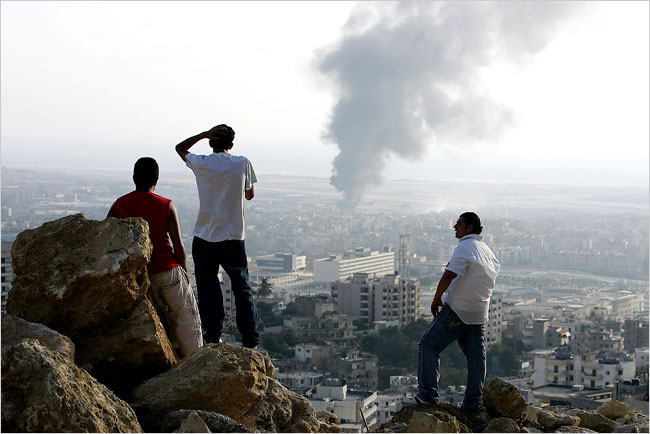
Lebanese men watched the Beirut airport burn after an Israeli airstrike.
Middle East Crisis

Israel Vows to Rout Hezbollah
Pierre Bou Karam/Associated Press
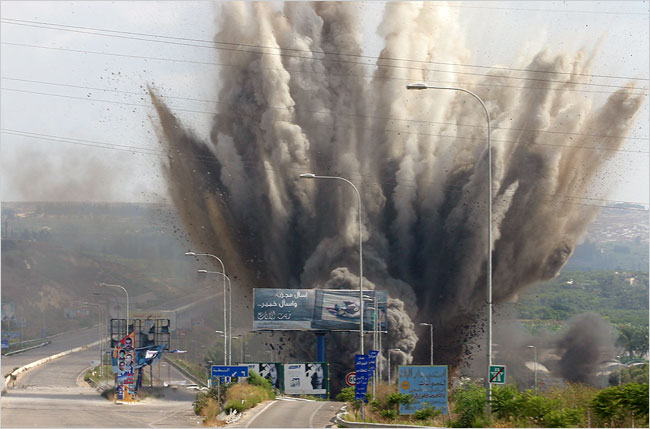
A Lebanese soldier stood next to a crater produced by an Israeli airstrike in Beirut Friday. Hezbollah fired more than 100 rockets into Israel.
By STEVEN ERLANGER
Published: July 15, 2006
JERUSALEM, Saturday, July 15 — The face-off between Israel and the Lebanese group Hezbollah escalated sharply on Friday as Israeli jets hit its Beirut headquarters and southern strongholds and Israeli news reports said a Hezbollah drone aircraft packed with explosives struck an Israeli naval vessel, causing severe damage.
The Israeli military later reported four sailors were missing. Leaders of the two sides threatened a still more intense war as a barrage of more than 100 Hezbollah rockets flew into Israel, which said it would destroy the power of Hezbollah and drive it from Israel’s border.
Smoke billowed across Beirut’s southern skyline as the capital found itself the new front line of the conflict. With Beirut under siege and the Lebanese government largely out of sight, many Lebanese grew resigned to a crisis that was largely in the hands of foreign powers.
Israeli officials said a defeat of Hezbollah, a radical Shiite militia with strong ties to Syria and Iran, would send an important message to the region and would help Israel in its efforts to undermine the power of Hamas in the Palestinian Authority. They argued it would also help the weak Lebanese government assert control over the entire country.
Thursday, July 13, 2006
Email from Shape Magazine
Nick hi
I'd happily see a transcript of your interview although we don't do many stories of this nature but hey, if it knocks my socks off why not!
Kind regardsToni--
Toni Younghusband
Editor: Shape(021) 408-3867
I'd happily see a transcript of your interview although we don't do many stories of this nature but hey, if it knocks my socks off why not!
Kind regardsToni--
Toni Younghusband
Editor: Shape(021) 408-3867
Big Screen
I watched the first mountain stage of the Tour de France yesterday at Hannes' place (just 300m down the road from where I stay). It's amazing watching it on his 2x1.5m big screen. He has a projector, and the image is so large and sharp it sometimes feels like you're in a helicopter (or cinema) or sitting in the car watching the cyclists moving by an open window. It's that real. Going there again tonight.
This morning I got up early and went to do a spinning class at 8pm. Some of Bloem's stud wives seem to favour the after-the-morning-rush class, because they were there, bursting with silicon and free time. After the class they have a leisurely cup of coffee, and then I guess it's grocery shopping and fridge packing and waiting for hubby to return home.
At 10am I test drove a white golf Chico. 136 000km and a 2001 model. Not bad, R46 900. Doesn't grab me, but maybe I need to be a bit more desperate. Still haven't heard from Heartland, otherwise I might have been capable of breaking into the R50 000 bracket.
Today I have a heck of a lot of marking to do. Andrea also emailed me and wants thumbnails of each partner I had on the fietstoer. That ought to take some time.
Reality Check
Staying sane in a mad world
All the accoutrements of modern society: SUVs, chocolate cellphones, big screen TVs, cargo pants, Jennifer Lopez , junk food, junk mail, reality soaps and 24 hours news – does any of this matter. Does this stuff deepen our lives? I doubt it. It all amounts to stuff, stuff we pursue, stuff we lust after and after a momentary kick, it’s over, and none of it means anything.
What’s an average life these days? Liberty and simple happiness until the age of 6 (usually earlier) when education (work) begins. It doesn’t end for another 18 to 20 years. Some may possibly take a single year off traveling, followed by 40 more years of work (with two week holidays per year). Those 40 years are spent chasing deadlines, rushing around on errands while accumulating debts, and material possessions there is no time to use. In this period of work one might decide to share one’s good fortune by getting married and having children, but there’s a 50% chance of being divorced after a decade.
The infrastructure of this existence involves living in a boxlike structure besides many other boxlike structures that are connected by long black macadam ribbons to faraway multistory boxlike structures. You move back and forth from box to box in a box on wheels (these boxes, called cars, get smaller every year). You pump tons of garbage into your body each day, including vitamin pills, caffeine, alcohol, fast food grease, rotten cows milk (cheese) and black water with about 8 tablespoons of teeth rotting (and mood altering) refined sugar. This diet of artery and cancer inducing goo might be supplemented by mood altering antidepressants, recreational drugs, diet pills, muscle building steroids, growth hormones or some combination of appearance enhancing surgery (stomach stapling, hair transplants, plastic surgery, and liposuction).
Meanwhile the sense of becoming increasingly disconnected grows. We spend more and more time speaking into small silver digital boxes or staring at square digital screens, and all the while we’re encouraged to connect. Connect. Connect at high speed at such and such a cost. Connect to everything through some or other multitasking device.
Do you know how to connect? Go and speak to someone face to face. Touch them directly, hold their hands, look into their eyes, listen to what they are saying, or just read their emotions from their facial expressions and body languages.
Connect to yourself by getting rid of all the stuff, turn off all the noise, get away, go to a place that is beyond everything made by man. Go to a high mountain or a remote desert, go to Antarctica to get away from the artificial light of cities. Leave the emptiness of the world behind you and fill yourself up with the sun and the moon, the sky and the soil and the wild creatures of the world. Once we were wild. In the desert (or mountain or forest or beach) find your wild self. That’s all you need. Connect to what really matters and when you return to Mad World, remember who you are, and what you’re made of.
This morning I got up early and went to do a spinning class at 8pm. Some of Bloem's stud wives seem to favour the after-the-morning-rush class, because they were there, bursting with silicon and free time. After the class they have a leisurely cup of coffee, and then I guess it's grocery shopping and fridge packing and waiting for hubby to return home.
At 10am I test drove a white golf Chico. 136 000km and a 2001 model. Not bad, R46 900. Doesn't grab me, but maybe I need to be a bit more desperate. Still haven't heard from Heartland, otherwise I might have been capable of breaking into the R50 000 bracket.
Today I have a heck of a lot of marking to do. Andrea also emailed me and wants thumbnails of each partner I had on the fietstoer. That ought to take some time.
Reality Check
Staying sane in a mad world
All the accoutrements of modern society: SUVs, chocolate cellphones, big screen TVs, cargo pants, Jennifer Lopez , junk food, junk mail, reality soaps and 24 hours news – does any of this matter. Does this stuff deepen our lives? I doubt it. It all amounts to stuff, stuff we pursue, stuff we lust after and after a momentary kick, it’s over, and none of it means anything.
What’s an average life these days? Liberty and simple happiness until the age of 6 (usually earlier) when education (work) begins. It doesn’t end for another 18 to 20 years. Some may possibly take a single year off traveling, followed by 40 more years of work (with two week holidays per year). Those 40 years are spent chasing deadlines, rushing around on errands while accumulating debts, and material possessions there is no time to use. In this period of work one might decide to share one’s good fortune by getting married and having children, but there’s a 50% chance of being divorced after a decade.
The infrastructure of this existence involves living in a boxlike structure besides many other boxlike structures that are connected by long black macadam ribbons to faraway multistory boxlike structures. You move back and forth from box to box in a box on wheels (these boxes, called cars, get smaller every year). You pump tons of garbage into your body each day, including vitamin pills, caffeine, alcohol, fast food grease, rotten cows milk (cheese) and black water with about 8 tablespoons of teeth rotting (and mood altering) refined sugar. This diet of artery and cancer inducing goo might be supplemented by mood altering antidepressants, recreational drugs, diet pills, muscle building steroids, growth hormones or some combination of appearance enhancing surgery (stomach stapling, hair transplants, plastic surgery, and liposuction).
Meanwhile the sense of becoming increasingly disconnected grows. We spend more and more time speaking into small silver digital boxes or staring at square digital screens, and all the while we’re encouraged to connect. Connect. Connect at high speed at such and such a cost. Connect to everything through some or other multitasking device.
Do you know how to connect? Go and speak to someone face to face. Touch them directly, hold their hands, look into their eyes, listen to what they are saying, or just read their emotions from their facial expressions and body languages.
Connect to yourself by getting rid of all the stuff, turn off all the noise, get away, go to a place that is beyond everything made by man. Go to a high mountain or a remote desert, go to Antarctica to get away from the artificial light of cities. Leave the emptiness of the world behind you and fill yourself up with the sun and the moon, the sky and the soil and the wild creatures of the world. Once we were wild. In the desert (or mountain or forest or beach) find your wild self. That’s all you need. Connect to what really matters and when you return to Mad World, remember who you are, and what you’re made of.
Magazine Wars
It’s good for us
I was in Woolworths yesterday and noticed, again, Wegbreek and Getaway (with identical covers) right beside the media24 owned publications, Weg and go! (also with identical covers). All four magazines have stories about Namibia. It’s a war, all right, and the winners are the readers and subscribers out there.
At the moment Weg (formerly calling themselves Wegbreek until Getaway sat up and howled: “Foul!”) seems to be winning the war. Weg has not only outsold Getaway, but was voted (at the annual ADawards) the best magazine in South Africa. Weg’s editor, Bun Booyens received the award for best editor for 2006.
My father has bought one or the other magazine depending on content. He is currently in Botswana (has traveled recently to Madagascar, Greece and the USA), and often buys travel and wildlife magazines for their informative and useful articles and insights. After buying Getaway for many years he has switched to Weg, even though it is an Afrikaans magazine and he is English speaking.
Weg’s success may be because Afrikaners travel more than other South Africans (who possibly prefer to stay in 5 star hotels). Weg suits its audience because when Afrikaners travel it often involves camping or really roughing it in the bush.
The articles are aimed more at the common man, the writing is practical, accessible and interesting. Booyen’s style and format is visually fresh, with many simple blocks of informative text, eye-catching landscapes or creature pictures, snippets, and chunk sized articles (a style pioneered I think by FHM, the Men’s magazine with the highest circulation figures in South Africa).
While Weg is colorful, it’s not pretentious, and that’s the style the real outdoor types appreciate. It’s not about staying in ritzy hotels. Yet it is a high quality magazine, and one that can be read and reread on the coffee table over the course of a month. It’s also got a more tasteful selection of advertising. Getaway seems to have become overwhelmed with advertising, where the whole second half of the magazine is given over to page after page of advertising. If Weg does that it is far less intrusive.
Now that Weg is available in English, my father has switched to go! The first issue came out this month. My money is on Weg and go! to win the magazine wars.
Meanwhile, Ster Kinekor and Nu Metro are slashing prices to steal away customers. When I went to watch Superman Returns with my girlfriend at a Nu Metro cinema, my shadow rubbed hands in glee when the ticket price came to only R12 (R6 each). I’m not sure why, but Ster Kinekor (at least in my area) always seems to sell better popcorn and have ice, and that’s reason enough (for me) to not go to Nu Metro more often than I have to. I hope Nu Metro is taking notes.
SABC3 and eTV have the news in the same time slot (7pm) theoretically to compete directly against each other. By doing the same with other programming (including reality shows, soapies etc) the television watcher just gets a better selection to choose from.
The same company makes Sprite Zero and Coke Light for the weight conscious customer. For me these two products present quite a tough choice. I used to hate Coke Light, but recently the taste (and number of calories) has been improved. Ice teas (especially Lipton’s raspberry flavour) and the array of flavoured waters have totally opened up the non-soda pop market. Once upon the time the fridges in shops were filled with just Coke, Fanta and Spar Letta, now there is a lot more to choose from.
Last and best of all, Telkom will soon have to clean up its act when the second operator enters the market. It will be partially financed by an Indian company (Tata). I think all Telkom customers should abandon Telkom as soon as they can just to punish them for at least a decade of abusing their customer base. Once they’ve repented we might consider coming back.
Yes, it’s good to see an increasingly competitive environment in this country, simply because competition is always going to be good for us.
I was in Woolworths yesterday and noticed, again, Wegbreek and Getaway (with identical covers) right beside the media24 owned publications, Weg and go! (also with identical covers). All four magazines have stories about Namibia. It’s a war, all right, and the winners are the readers and subscribers out there.
At the moment Weg (formerly calling themselves Wegbreek until Getaway sat up and howled: “Foul!”) seems to be winning the war. Weg has not only outsold Getaway, but was voted (at the annual ADawards) the best magazine in South Africa. Weg’s editor, Bun Booyens received the award for best editor for 2006.
My father has bought one or the other magazine depending on content. He is currently in Botswana (has traveled recently to Madagascar, Greece and the USA), and often buys travel and wildlife magazines for their informative and useful articles and insights. After buying Getaway for many years he has switched to Weg, even though it is an Afrikaans magazine and he is English speaking.
Weg’s success may be because Afrikaners travel more than other South Africans (who possibly prefer to stay in 5 star hotels). Weg suits its audience because when Afrikaners travel it often involves camping or really roughing it in the bush.
The articles are aimed more at the common man, the writing is practical, accessible and interesting. Booyen’s style and format is visually fresh, with many simple blocks of informative text, eye-catching landscapes or creature pictures, snippets, and chunk sized articles (a style pioneered I think by FHM, the Men’s magazine with the highest circulation figures in South Africa).
While Weg is colorful, it’s not pretentious, and that’s the style the real outdoor types appreciate. It’s not about staying in ritzy hotels. Yet it is a high quality magazine, and one that can be read and reread on the coffee table over the course of a month. It’s also got a more tasteful selection of advertising. Getaway seems to have become overwhelmed with advertising, where the whole second half of the magazine is given over to page after page of advertising. If Weg does that it is far less intrusive.
Now that Weg is available in English, my father has switched to go! The first issue came out this month. My money is on Weg and go! to win the magazine wars.
Meanwhile, Ster Kinekor and Nu Metro are slashing prices to steal away customers. When I went to watch Superman Returns with my girlfriend at a Nu Metro cinema, my shadow rubbed hands in glee when the ticket price came to only R12 (R6 each). I’m not sure why, but Ster Kinekor (at least in my area) always seems to sell better popcorn and have ice, and that’s reason enough (for me) to not go to Nu Metro more often than I have to. I hope Nu Metro is taking notes.
SABC3 and eTV have the news in the same time slot (7pm) theoretically to compete directly against each other. By doing the same with other programming (including reality shows, soapies etc) the television watcher just gets a better selection to choose from.
The same company makes Sprite Zero and Coke Light for the weight conscious customer. For me these two products present quite a tough choice. I used to hate Coke Light, but recently the taste (and number of calories) has been improved. Ice teas (especially Lipton’s raspberry flavour) and the array of flavoured waters have totally opened up the non-soda pop market. Once upon the time the fridges in shops were filled with just Coke, Fanta and Spar Letta, now there is a lot more to choose from.
Last and best of all, Telkom will soon have to clean up its act when the second operator enters the market. It will be partially financed by an Indian company (Tata). I think all Telkom customers should abandon Telkom as soon as they can just to punish them for at least a decade of abusing their customer base. Once they’ve repented we might consider coming back.
Yes, it’s good to see an increasingly competitive environment in this country, simply because competition is always going to be good for us.
Do antidepressants work?
Living a lie is unsustainable
What works best to beat the blues? That depends on how chronic the depression is and a host of other factors. Depression doesn’t just happen; it’s the result of ingrained habits, habitual thinking and an addiction to thinking paths and patterns.
One could begin by saying, ‘If you’re suicidal, antidepressants are a must.’ That’s too broad a stroke. Since a large proportion of suicides happen as people are coming off antidepressants, it’s good to develop the fortitude to not become dependent on a chemical crutch in the first place. So what to do?
First of all, understanding depression is all important. Using antidepressants is just symptomatic treatment. You feel bad, you’re unhappy and debilitated, and your coping strategy is to swallow pills? How does medicating a mindset (that doesn’t work) change your circumstances, and even more important, your mindset? In short, it doesn’t, and it probably never will.
My definition of depression is living incongruently over the long term. That means being untrue to yourself (your spirit) for the majority of your day, your week, your year, your life. In time, the spirit rejects this chosen lifestyle (yes, you chose it), and starts to impose sanctions until you stop, or do something else. The mad part is that people tend to want to insist on continuing with their destructive behavior and unhealthy habits, and want to ignore or repress or chemically extinguish their depression.
Depression manifests as a result of doing things every day that aren’t good for you. This may be spending long hours in a job you hate, or being trapped in a marriage with a partner you’ve given up on (or who has given up on you), or just being completely divorced from any sense of one’s own being, being disconnected from what’s real and true. This resistance to reality is a source of constant pain. It can be changed either by accepting the present, changing the present or changing oneself. All require some kind of internal paradigm shift, a coming to terms with oneself in terms of reality.
If that sounds convoluted, here’s an even simpler explanation of depression, and it goes to the cause of this mental malaise. Depression is the inability to function (or be aware of) the present moment. Depression arises by being constantly burdened by the burdens of the past, or the perceived pressures of the future. It’s in the reality of the Now (and also the only reality) that the key lies to salvation. It’s in the Now that we need to be in order to not be depressed. Now is all we have, and all we will ever have. But being in the Now also requires us to face those things we’ve being trying to escape from (and escapism takes many forms, from listening to music, watching TV and movies, to reading, to sex, to shopping, to sleeping).
Constantly chewing on thoughts that have no final answer (especially playing back unsolved mental dramas from the past) and depriving ourselves of meaningful answers and things to do (solutions in the present) is a highway to hell.
Depression in fact is a healthy response. The body slows down and needs to stop functioning. It’s not unlike a physical ailment. The mind’s habitual thoughts slowly poison the body, and the body responds by becoming paralyzed and resistant. Our mental resistance to reality is mirrored by a physical resistance to participate in that reality. It cannot thrive on poison and starts running out of energy (or inspiration). Depression is another way of our bodies saying to our minds, “Please stop.” Stop and listen to your self.
It’s important to respond to the message of depression. It might be enough to simply accept that you’re taking strain and continue on the same track. Probably, some change will be required, and herein lies the secret. If you have depression and you make no significant structural changes to your lifestyle (or your mindstyle), expect depression to continue. If you’re blue and you make no changes to yourself, how can you expect to feel differently?
The question then arises, ‘What must I change?’
Actually, the answer is simple. Depression and laziness are often interchangeable. Laziness is perhaps the precursor to depression, but without doubt, depressed people come across as very lazy, especially when they are advanced cases. How to spot a depressed person? Someone who sleeps a lot, who can’t get things done, who’s irritable, who blames, who procrastinates and importantly, who never exercises. Depressed people are often overweight. They’re full of excuses, and are professional time wasters. Change (by facing) your laziness.
So, ‘Where to start?’ Start by doing what you know you must do. Do what you fear the most. The focus must be on what you can do. Not on what to think, or say, or feel, but what to do. Acting healthy leads to being healthy. Smile, even if you don’t want to, and see how your feelings and thoughts change. How it works is thoughts lead to feelings which lead to actions. But it also works in the reverse order, and if your thoughts and feelings are out of sync, it’s very difficult to start there. You’ve been focused on thinking, and now balance needs to be restored. Focus on your body, and spirit.
Stop wasting time. Start by exercising. The easiest is to run. Yes you will hate every step of it in the beginning. You will hate to even expose your face to the streets, but go out and take it from there. After a week you will start to enjoy it. Or swim, or do some other physical activity. Get into the habit of exercising. Start modestly. What’s happening now is chemicals are being activated in your brain that need to be (serotonin, dopamine and endorphins). Not only that, you’re learning to put yourself in a painful place, and manage that process. And the bonus for all this suffering is a wonderful sense of control, an improved appearance, and over time (probably a lot), an improved sense of self. Exercise is a great way to spend time in the now, alone, with yourself. Get to know who you are again. Knowing what you don’t want or don’t like is halfway to knowing what you do want, what you do like and who you want to be.
Once you’re in the habit of exercising, start to focus on your spirit. Without thinking, breathe, and feel who you are. Do this whenever you have a moment. Experience your being. Now build your spirit. Read something that enriches you. Go for a walk in a forest, commune with nature, connect with your self.
Any person who exercises (knows the benefits) and will scoff at the idea of using antidepressants. In the same way, people who use antidepressants will aggressively defend themselves, reminding you of all the painful things in their lives, and reasons why medication is helping them to live. Be patient. If you’re using antidepressants, fine, use them; just remember that using them alone is changing nothing. It’s simply lessening the burden. The onus to change remains. Try using antidepressants and exercising. Perhaps one day you’ll find a way to your self. Believe you will and your will will find a way.
What works best to beat the blues? That depends on how chronic the depression is and a host of other factors. Depression doesn’t just happen; it’s the result of ingrained habits, habitual thinking and an addiction to thinking paths and patterns.
One could begin by saying, ‘If you’re suicidal, antidepressants are a must.’ That’s too broad a stroke. Since a large proportion of suicides happen as people are coming off antidepressants, it’s good to develop the fortitude to not become dependent on a chemical crutch in the first place. So what to do?
First of all, understanding depression is all important. Using antidepressants is just symptomatic treatment. You feel bad, you’re unhappy and debilitated, and your coping strategy is to swallow pills? How does medicating a mindset (that doesn’t work) change your circumstances, and even more important, your mindset? In short, it doesn’t, and it probably never will.
My definition of depression is living incongruently over the long term. That means being untrue to yourself (your spirit) for the majority of your day, your week, your year, your life. In time, the spirit rejects this chosen lifestyle (yes, you chose it), and starts to impose sanctions until you stop, or do something else. The mad part is that people tend to want to insist on continuing with their destructive behavior and unhealthy habits, and want to ignore or repress or chemically extinguish their depression.
Depression manifests as a result of doing things every day that aren’t good for you. This may be spending long hours in a job you hate, or being trapped in a marriage with a partner you’ve given up on (or who has given up on you), or just being completely divorced from any sense of one’s own being, being disconnected from what’s real and true. This resistance to reality is a source of constant pain. It can be changed either by accepting the present, changing the present or changing oneself. All require some kind of internal paradigm shift, a coming to terms with oneself in terms of reality.
If that sounds convoluted, here’s an even simpler explanation of depression, and it goes to the cause of this mental malaise. Depression is the inability to function (or be aware of) the present moment. Depression arises by being constantly burdened by the burdens of the past, or the perceived pressures of the future. It’s in the reality of the Now (and also the only reality) that the key lies to salvation. It’s in the Now that we need to be in order to not be depressed. Now is all we have, and all we will ever have. But being in the Now also requires us to face those things we’ve being trying to escape from (and escapism takes many forms, from listening to music, watching TV and movies, to reading, to sex, to shopping, to sleeping).
Constantly chewing on thoughts that have no final answer (especially playing back unsolved mental dramas from the past) and depriving ourselves of meaningful answers and things to do (solutions in the present) is a highway to hell.
Depression in fact is a healthy response. The body slows down and needs to stop functioning. It’s not unlike a physical ailment. The mind’s habitual thoughts slowly poison the body, and the body responds by becoming paralyzed and resistant. Our mental resistance to reality is mirrored by a physical resistance to participate in that reality. It cannot thrive on poison and starts running out of energy (or inspiration). Depression is another way of our bodies saying to our minds, “Please stop.” Stop and listen to your self.
It’s important to respond to the message of depression. It might be enough to simply accept that you’re taking strain and continue on the same track. Probably, some change will be required, and herein lies the secret. If you have depression and you make no significant structural changes to your lifestyle (or your mindstyle), expect depression to continue. If you’re blue and you make no changes to yourself, how can you expect to feel differently?
The question then arises, ‘What must I change?’
Actually, the answer is simple. Depression and laziness are often interchangeable. Laziness is perhaps the precursor to depression, but without doubt, depressed people come across as very lazy, especially when they are advanced cases. How to spot a depressed person? Someone who sleeps a lot, who can’t get things done, who’s irritable, who blames, who procrastinates and importantly, who never exercises. Depressed people are often overweight. They’re full of excuses, and are professional time wasters. Change (by facing) your laziness.
So, ‘Where to start?’ Start by doing what you know you must do. Do what you fear the most. The focus must be on what you can do. Not on what to think, or say, or feel, but what to do. Acting healthy leads to being healthy. Smile, even if you don’t want to, and see how your feelings and thoughts change. How it works is thoughts lead to feelings which lead to actions. But it also works in the reverse order, and if your thoughts and feelings are out of sync, it’s very difficult to start there. You’ve been focused on thinking, and now balance needs to be restored. Focus on your body, and spirit.
Stop wasting time. Start by exercising. The easiest is to run. Yes you will hate every step of it in the beginning. You will hate to even expose your face to the streets, but go out and take it from there. After a week you will start to enjoy it. Or swim, or do some other physical activity. Get into the habit of exercising. Start modestly. What’s happening now is chemicals are being activated in your brain that need to be (serotonin, dopamine and endorphins). Not only that, you’re learning to put yourself in a painful place, and manage that process. And the bonus for all this suffering is a wonderful sense of control, an improved appearance, and over time (probably a lot), an improved sense of self. Exercise is a great way to spend time in the now, alone, with yourself. Get to know who you are again. Knowing what you don’t want or don’t like is halfway to knowing what you do want, what you do like and who you want to be.
Once you’re in the habit of exercising, start to focus on your spirit. Without thinking, breathe, and feel who you are. Do this whenever you have a moment. Experience your being. Now build your spirit. Read something that enriches you. Go for a walk in a forest, commune with nature, connect with your self.
Any person who exercises (knows the benefits) and will scoff at the idea of using antidepressants. In the same way, people who use antidepressants will aggressively defend themselves, reminding you of all the painful things in their lives, and reasons why medication is helping them to live. Be patient. If you’re using antidepressants, fine, use them; just remember that using them alone is changing nothing. It’s simply lessening the burden. The onus to change remains. Try using antidepressants and exercising. Perhaps one day you’ll find a way to your self. Believe you will and your will will find a way.
Tuesday, July 11, 2006
Monday, July 10, 2006
get GOing
I recieved a call today from Andreis Weiss (editor of go! magazine, the sister publication of Weg!, one of South Africa's most successful publications, and the most successful publication in its class in this country).
She tells me they are going to publish my 'Tour de Free State' story in the next go! and will probably translate it for weg! I sms'ed Lee (headhoncho of the Tour) and he said "excellent". Hope they like the story.
At the same time I am stepping up a gear with Heartland (who owe me almost R8000). Because Quentin told me they are moving to new offices soon (and a travel agency is taking over their office space), some alarm bells rang. Quentin says that, and the editor tells me the auditor's report shows the magazine is in deep financial trouble. So before they pull off a disappearing act I'm going to take them to the CCMA or sue for what they owe me. I want to buy a car now, and I'm going to need that R8 000.
Ran 6 laps with Barendine today at 1pm.
50 minutes. Good fat burner.
Am going interview Ina tonight (who did the Eco Primal Quest).
www.ecoprimalquest.com
She tells me they are going to publish my 'Tour de Free State' story in the next go! and will probably translate it for weg! I sms'ed Lee (headhoncho of the Tour) and he said "excellent". Hope they like the story.
At the same time I am stepping up a gear with Heartland (who owe me almost R8000). Because Quentin told me they are moving to new offices soon (and a travel agency is taking over their office space), some alarm bells rang. Quentin says that, and the editor tells me the auditor's report shows the magazine is in deep financial trouble. So before they pull off a disappearing act I'm going to take them to the CCMA or sue for what they owe me. I want to buy a car now, and I'm going to need that R8 000.
Ran 6 laps with Barendine today at 1pm.
50 minutes. Good fat burner.
Am going interview Ina tonight (who did the Eco Primal Quest).
www.ecoprimalquest.com
Kunstler: The Long Emergency Zone
Now that I have written a book titled The Long Emergency, there is a new wave of disappointment gathering that life as we know it has not come to an immediate end, and I am being reproached for suggesting that we have some problems. Of course, that was never the point, as a reflection on the book's title ought to suggest. One funny element of this is that the reproach reached a crescendo the very week that crude oil prices reached record levels above $75 a barrel.
So this might just be a good point to step back and ask where are we now at mid-year, 2006. In January, I predicted that the US economy would get into a lot of trouble, specifically that the Dow would melt down to around 4000 and that we would see carnage on the real estate scene. When you figure in inflation, the Dow has just gone sideways for six months. What is propping it up? Last week I referred to Doug Noland's theory that investments in alt.fuels and technology are starting a new boom. I doubt this can work as a prop to support the huge losses in previous misinvestments. For instance, sooner or later General Motors will go up in a vapor for its failure to sell cars, pure and simple.
In any case, we are faced with the essential problem of ever-increasing prices for far less net energy. That is a recipe, perhaps, for an American peristroika, but not for continuing to benefit from the old arrangements. And so far, America at all levels, in leadership and the public, resists the sort restructuring we require. For example, we are still systematically starving and dismantling the railroad system instead of rebuilding it. There is still plenty of time left in 2006 for the stock market to start reflecting the true character of our phony-baloney economy -- namely that it is based on consuming goods and resources without producing things of value.
It is my observation that the housing market is tanking broadly and steeply around the nation. In my own town, a mini "hot market," there have never been so many "for sale" signs planted in so many yards (and remaining there month after month). Some even have "price reduced" shingles added to them. But there remains mutual reinforcement between the sellers and their realtor agents to keep a happy face on the situation (to avoid panic selling).
Since house prices here, in a tourist town, are falling when the tourist season has hardly gotten underway, I have to surmise that the local market is in deep shit. A few months from now when the tourists depart, and the last golden leaves flutter down from the maples, I expect we'll see psychological capitulation among the sellers and their realtor cheerleaders.
The energy picture, as alluded to above, is certainly cause for concern. Oil prices are creeping up relentlessly into territory that will, at least, stall the consumption orgy among the WalMart shoppers. We are one hurricane or one geopolitical incident away from an energy trauma. The natural gas supply situation is another storm lurking on the far horizon.
So, here at high noon of 2006, I'll stand pat with what I have said more than once: we have already entered the zone of The Long Emergency.
So this might just be a good point to step back and ask where are we now at mid-year, 2006. In January, I predicted that the US economy would get into a lot of trouble, specifically that the Dow would melt down to around 4000 and that we would see carnage on the real estate scene. When you figure in inflation, the Dow has just gone sideways for six months. What is propping it up? Last week I referred to Doug Noland's theory that investments in alt.fuels and technology are starting a new boom. I doubt this can work as a prop to support the huge losses in previous misinvestments. For instance, sooner or later General Motors will go up in a vapor for its failure to sell cars, pure and simple.
In any case, we are faced with the essential problem of ever-increasing prices for far less net energy. That is a recipe, perhaps, for an American peristroika, but not for continuing to benefit from the old arrangements. And so far, America at all levels, in leadership and the public, resists the sort restructuring we require. For example, we are still systematically starving and dismantling the railroad system instead of rebuilding it. There is still plenty of time left in 2006 for the stock market to start reflecting the true character of our phony-baloney economy -- namely that it is based on consuming goods and resources without producing things of value.
It is my observation that the housing market is tanking broadly and steeply around the nation. In my own town, a mini "hot market," there have never been so many "for sale" signs planted in so many yards (and remaining there month after month). Some even have "price reduced" shingles added to them. But there remains mutual reinforcement between the sellers and their realtor agents to keep a happy face on the situation (to avoid panic selling).
Since house prices here, in a tourist town, are falling when the tourist season has hardly gotten underway, I have to surmise that the local market is in deep shit. A few months from now when the tourists depart, and the last golden leaves flutter down from the maples, I expect we'll see psychological capitulation among the sellers and their realtor cheerleaders.
The energy picture, as alluded to above, is certainly cause for concern. Oil prices are creeping up relentlessly into territory that will, at least, stall the consumption orgy among the WalMart shoppers. We are one hurricane or one geopolitical incident away from an energy trauma. The natural gas supply situation is another storm lurking on the far horizon.
So, here at high noon of 2006, I'll stand pat with what I have said more than once: we have already entered the zone of The Long Emergency.
Reality Check

The world is about to change... Picture courtesy www.topleftpizel.com
I took Fransa out for a birthday dinner and she woke up the next day with a stomach bug that sent her into hospital by the end of the day. Thanks guys. I bumped into one of the waittresses on my way to CNA (to buy a newspaper) and told her to spread the word to the cooks (one of whom must have spoiled the broth). Throw out the Swiss Caseroles and burn them!
It's a bizarre feeling...sometimes...driving around. We are so used to a car-based society that life without it just wouldn't work.
Today we seem to be at a turnaround point in various respects. The middle class (mostly black) are defaulting on credit card payments and loans (including house and vehicle repayments) on an increasingly massive scale.
The world is poised to fall into inflation. And with demand for fuel showing no signs of abating (India and China are just getting their engine's started) we're poised to see oil shoot up above $100 a barrel. Yes, we've said it before. I'm saying it again.
Barry Ronge wrote today about people in South Africa who complain about crime. Some people call them whingers. He says, "Whinge as much as you can. Whinge until someone listens, until things change."
The same is true of the energy situation.
But even in this context, I need to function. I've found the strain of not having a car very difficult. Renting is expensive. Borrowing seems to go against the grain of girlfriends and family members who decry: "Get your own." That may seem fair. In tomorrow's world, there will be a psychology of sharing, because there won't be enough for everyone, and there never will be. Well, perhaps not never. But for long enough for it to feel that way.
Bruyneel Missing Armstrong
Bruyneel discovers limits after bad day at the Tour
AFPJuly 8, 2006
RENNES, France (AFP) - American team Discovery Channel failed in their bid to dominate the general classification after the crucial seventh stage time trial of the Tour de France.
In the absence of the now-retired Lance Armstrong, fellow American George Hincapie was expected to step up to the mark ahead of his attempt to succeed the seven-time winner.
Hincapie had shown time trialling promise by finishing fourth in the 43km time trial at the Dauphine Libere last month - a result which left his team manager Johan Bruyneel hoping to place a few of his riders near the top of the general classification.
However, in a longer 52km course that was dogged by a headwind in the afternoon, the big New Yorker could only manage 24th from the 170 riders taking part, finishing at 2min 42sec behind new race leader Serguei Gonchar of T-Mobile.
The 36-year-old caused a minor upset, overpowering the favourites Floyd Landis, David Zabriskie and Australian Michael Rogers to become the first Ukrainian to pull on the race's famous yellow jersey.
T-Mobile now have four riders in the race's top ten - Gonchar, Rogers, Patrik Sinkewitz and Andreas Kloden, who finished runner-up in the Tour in 2004.
It gives the German team, who suspended their 1997 winner Jan Ullrich before the race because he is implicated in an ongoing blood doping scandal in Spain, plenty of options before key stages in the Pyrenees from Wednesday.
Discovery Channel will be forced to attack Gonchar, Rogers and Kloden if they want to take the race lead before the Alps, where three days of climbing over some of the race's legendary peaks is set to decide the destination of the yellow jersey.
Former two-time Tour of Italy winner Paolo Savoldelli is the American team's best placed rider in the general classification in 13th place at 2:10 behind Gonchar.
Hincapie is 17th at 2:30 while another Ukrainian, Yaroslav Popovych is 23rd at 3:27.
Discovery manager Bruyneel, who led the team's successful seven-year reign when Armstrong was in command, admitted that Ullrich's absence had kept their yellow jersey hopes alive.
"It's lucky Jan Ullrich isn't here. Otherwise the Tour would be over," he said.
AFPJuly 8, 2006
RENNES, France (AFP) - American team Discovery Channel failed in their bid to dominate the general classification after the crucial seventh stage time trial of the Tour de France.
In the absence of the now-retired Lance Armstrong, fellow American George Hincapie was expected to step up to the mark ahead of his attempt to succeed the seven-time winner.
Hincapie had shown time trialling promise by finishing fourth in the 43km time trial at the Dauphine Libere last month - a result which left his team manager Johan Bruyneel hoping to place a few of his riders near the top of the general classification.
However, in a longer 52km course that was dogged by a headwind in the afternoon, the big New Yorker could only manage 24th from the 170 riders taking part, finishing at 2min 42sec behind new race leader Serguei Gonchar of T-Mobile.
The 36-year-old caused a minor upset, overpowering the favourites Floyd Landis, David Zabriskie and Australian Michael Rogers to become the first Ukrainian to pull on the race's famous yellow jersey.
T-Mobile now have four riders in the race's top ten - Gonchar, Rogers, Patrik Sinkewitz and Andreas Kloden, who finished runner-up in the Tour in 2004.
It gives the German team, who suspended their 1997 winner Jan Ullrich before the race because he is implicated in an ongoing blood doping scandal in Spain, plenty of options before key stages in the Pyrenees from Wednesday.
Discovery Channel will be forced to attack Gonchar, Rogers and Kloden if they want to take the race lead before the Alps, where three days of climbing over some of the race's legendary peaks is set to decide the destination of the yellow jersey.
Former two-time Tour of Italy winner Paolo Savoldelli is the American team's best placed rider in the general classification in 13th place at 2:10 behind Gonchar.
Hincapie is 17th at 2:30 while another Ukrainian, Yaroslav Popovych is 23rd at 3:27.
Discovery manager Bruyneel, who led the team's successful seven-year reign when Armstrong was in command, admitted that Ullrich's absence had kept their yellow jersey hopes alive.
"It's lucky Jan Ullrich isn't here. Otherwise the Tour would be over," he said.
Saturday, July 08, 2006
Tour de Free State
Ficksburg to God’s Window
60 Cyclists, 1000km (almost) and An Undiscovered Country
Diary entry:
19:57, Friday
…atmosphere somewhat reserved…in the hinge period between work and holidays…still casting off the cobwebs…
Day 1
The moment of truth is that spark that happens when it is cold and dark
Let there be light. It’s Saturday, just past 5am in Ficksburg, and I am hoisting a mattress into the huge belly of a truck – the first of at least sixty. Deep in the darkness and the chill, inside the sandstone church hall, people young and old (but mostly young) clip on helmets and wheel their bicycles out. Some bicycles are sleek Tour de France type machines. Others look like they come from the farm. A steady stream spills down the steps bringing sleeping bags or dragging mattresses. I’m working with a team of packers (the pakspan) until everything is loaded. It soon is but I’m the last to go back inside and gobble down some breakfast. When I emerge it’s still dark, and our leader Lee is giving us instructions. We say a short prayer. We’re cycling to Bethlehem today – all 60 of us. It’s 93.8km. I look into the murk. Let there be light.
And there is light. Each of us has to take care of someone on the road. I’m partnered with Ize-Marie, ex headgirl of Oranje, a Human Movement Science student at the University of the Free State. She works part time at the same gym where my girlfriend works. She’s a personal trainer there, and she looks strong. From the first pedal turn she’s struggling with the gears. It’s not her bike, she says, “I borrowed it from a friend.” From the vantage point of my lightweight Cannondale I try to make sense of her gearing problem, then recommend she shifts the lever upward with her thumb. It works. We pick up speed and start to pass the others. Light starts to flood the fields around us, turning the mists silver and the sandstone cliffs gold.
It’s into this misty farmland, filled with light, that more than 60 cyclists fade away. We’re the Sendingfietstoer – a group of mostly Free State university students – on a 1000km mission to God’s Window. Half of us – the girls – will be expected to cycle 500km. The guys will cycle all of it if they can, and help out the girls en route. There’s no such thing as going off on your own when the girls are riding. Or you can, but you risk being given ridiculous outfits to wear the next day (like the green Padvark uniform, or the ridiculous Mnr As or Mej Speek blouse). Who gets to wear them is decided at a vote at the end of each day.
Ize is doing pretty well for someone who has never cycled before. For me it’s inconceivable to attempt something like this on a borrowed bike, and with no training, but at least a third do so. I am a well trained cyclist on a machine built for long distance. I’m quite fit, but well aware these next few days are going to hurt a lot. Lee has told us the mountains get harder and harder the closer we get to our destination. Yes, so far Ize is doing a good job. Together we’ve moved up to the front third of the pack. She’s riding a really heavy black Diamond Back. It’s basically a chunk of steel. When we approach a hill she immediately sinks back and then I ride alongside her, put my hand on her back, and dragging her up the hill with me. She works hard with me, against the force of gravity. Then the fun bit: we fly down the other side. I glance back to the valleys and the farms and notice the silver ‘mist’ is actually gray smoke from this angle.
We cycle through fields of cosmos, stopping occasionally beside the Barlow World sponsored vehicles driven by our support crew. We scoff down a banana or chew on toffees then pedal out another 10 or 20 kilometres. There’s a beautiful sense of living the day: believing in ourselves and each other, whilst increasingly beautiful countryside – an undiscovered country – stretches out further and further along the secondary roads we’re on. The first day has been gold and blue with barely a whisper of wind.
Day 2
After resting in Bethlehem on Sunday, we travel by bus (with our bicycles in the truck) to Clarens. Monday morning early we’re off again, this time through Golden Gate. We’re doing two stages today. One, the climbing stage, is through the mountains, and the next is just for the manne, from Kestell to Warden.
There’s stillness today. It’s a hollow, echoey sort of stillness that you only find in the mountains. Godlight is streaming between clouds and rock, and we cyclists are heading right through this panoramic spectacle. I have the same feeling of joy and awe I had yesterday. It’s another beautiful day and what better place is there to spend it, to enjoy the great outdoors than right here?
God’s own country, Golden Gate, wheels around us. The great cliffs open the sun soaked fields of the Lord to us. My partner today is Marisan. She’s more talkative than Ize, and I’m enjoying her enthusiasm. She’s riding a lightweight yellow Giant racing bike, but the gears don’t work at all, so she’s stuck on a single gear. That’s bad news for climbing in the mountains. Fortunately for us both, it’s stuck in a high gear, so when the going gets tough, her face reddens, and my arm goes over her back and we strain to make it over the shoulders of mountains. Sometimes she gets off to walk. I don’t really mind, the scenery needs time to absorb.
On one occasion, while I am pushing her up a hill, I give her one last shove (which makes me slow down to almost 0km/h. At that moment I turn suddenly across the road – to recover my balance and my strength, and to regain momentum. And as I’m halfway across the road, a green bakkies flies out of nowhere and hoots at me. The driver is so close I can see the color of his eyes. My toes and fingertips are stinging from fright. I’m still thinking about that close miss when we arrive at the beautiful sandstone church at Kestell. Ize and I share a pillow in the shade while the others come in one by one, and find us and our bicycles lounging on the lawn beside the church.
After Kestell the guys race each other. I come in 4th, not far behind a 50 year old guy called Andre who, from behind, looks like a lightie, and climbs like a demon. Warden is one of those towns you might miss if you’re yawning as you pass by it. Once again it has a beautiful sandstone church. It’s one of the biggest sandstone buildings in South Africa (after the Union Buildings).
We have to walk along a country road to a building where we can shower. It’s this sort of thing that makes the Tour magical. I’m still on a high from what’s happened today. There’s a quiet excitement about getting to the middle of nowhere on your own steam, and not knowing what’s going to happen tomorrow.
Day 3
I’m Padvark today, so I have to wear a heavy green apron. My maneuver in Golden Gate yesterday that almost got me killed earned me a unanimous vote from the other riders, especially Schabbord. Thanks guys. Today we’re cycling to Vrede. My partner is a very petite medical student – Nadia, who’s riding a red lightweight Mountain bike. She looks even lighter than her aluminum steed. Thankfully it’s a very flat stage. We start off in a perfect rhythm. Six of us ride in the stillness of the morning, and the only sound is the clockwork whirr of clean chains spinning wheels. At the first rest point Ize, wearing pink, decides to quit for the day – her knee is hurting. We see a lot of cows mooing in fields full of white and pink cosmos. Once again it’s just a pleasure to be pedaling through such pretty scenes. Often I want to get off my bike and snap pictures, but another part of me just wants to enjoy it, and wants to see what’s over the next hill. Besides I’m also enjoying talking to Nadia. She’s an interesting combination of being physically delicate, but having a sharp tongue and a determined head on her shoulders.
Over the next hill is a field filled with big bales of rolled grass. It’s scenes like this that make me realize the Free State has a lot of its own charm, its very own brand of beauty. It’s not a province to be sniffed at, not even by Cape Townians. It has a pleasant appeal – it’s got the whole country life/country feeling package: Quietude, farmers fields, flowers and mountain backdrops. Oh it’s not stupendous. It’s soft, and subtle. It’s gentle and soothing on the stressed soul. The morning mists are phenomenal. The sunshine is warm and rich. I’m surprised there aren’t a bunch of artists sitting in fields with their canvasses and easels.
In Vrede there’s a luxurious lawn surrounding the church. We lie there while the cyclists trickle in. I’ve had fun riding with Nadia because we’ve raced Andre and his partner, Michelle. The last 200metres is a sprint down Vrede’s main street that nearly ends in carnage when a local on a postman-type bicycle suddenly turns left. How Willie, on my left, avoids smashing right into this guy I really don’t know.
After lunch (delicious bobotie) the guys motor towards Standerton. I work with two other guys to reel in Kallie – a 40 year old guy riding a very cool silver bike with double (4 spoked) Spinergy’s. I drop both the guys I am working with in the last few kilometers. Kallie tells me he’s been waiting one or two minutes – he says we closed the gap quickly in the last few kilometers. But I wonder, When am I going to win a stage?
Day 4
We may run the race for ourselves, but it is significant that we do it in front of spectators – Grete Waits (1986)
It’s tradition that the manne take one stage off on the Tour, and so we decide to sit out on this one. From Volksrust it’s not much more than 30km (we have all driven from Standerton to Volksrust by bus, in order to avoid a dangerous minibus infested stretch of road). The girls are on their own now. The back markers must help each other. Meanwhile I’m snoozing in the bus where it’s parked alongside the church in Wakkerstroom. When the girls arrive I emerge and gasp. The church looks like something from Olde England. All the churches have been impressive, but this one, in Wakkerstroom, is magnificent. Perhaps it’s the way the tall, sharp steeple punctures the blue balloon above it. Or it’s the soft mountain scenery behind it.
The food they serve us at the hall is delicious, but I separate the noodles and leave all the meat behind. Not cycling in the morning, not pushing someone up a hill has left my legs feeling fresh and ready for this afternoon.
Immediately, at the start of the stage, we start to climb. In fact, we climb for about 20km. Although I am not about to set a cracking pace, the group is moving very slowly, and to stay with them on the downhills I find I have to brake. So I allow myself to drift off the front. Schabbord and I work together until we drop down from the highest point. I’m not sure if it is nerves, but I take wing on my way down and find he’s falling further and further away. Now I start to fly. It’s a long, long downhill and I am shouting and whooping with excitement and sheer happiness. It’s almost like skiing down a mountain, just faster. And I have the roads all to myself.
I hop over potholes – one as big as a grave hole – and shoot over the crest of a hill just as a herd of cattle are being shooed on to it. As I flip over the next hill I look back and see at least one cyclist stuck behind a brown blob of bulls.
And then something takes my breath away. Here I am, speeding along on my own, swooping along the saddle of an escarpment. On my right the land falls dramatically away and then launches up in a giant green wave. Slotted into the sharp downward slope are telephone lines, and for some reason they appear green and see-through, like fishing line. I look at the big mountain rising on my right out of the huge space under me. Hovering between the mountain and me are two birds. Two small birds sitting quietly on a telephone line, but for some reason the line is invisible. These birds seem to be perched in space. And here I am, on my own, moving into and out of their world. I feel the size of the world in that moment. And the great beauty of it. With the sun shining on my back, I watch my shadow, and my front wheel’s shadow windmilling beside me. I make it spin faster and faster. After a gut wrenching final uphill in killer heat, I reach Piet Retief first. When the others arrive they’re covered in a lather of perspiration.
Day 5
There’s something very old school about Piet Retief. There’s a feeling that the last outpost of the AWB still lives out here, in some parts of suburbia. That was my impression anyway. The next day Charlene and I cycle together to the halfway mark. Big celebrations. 500km done. 500km to go. We pose for photos, smile for the video camera, eat ice cream and glug down globs of Ultramel.
The short stretch from the halfway mark to the little dusty town called Amsterdam kills my legs. There’s a short, stiff uphill and Charlene needs all my help getting up. She wants to walk but I just need her to vasbyt a bit longer. We make it, but it feels like getting over the hill has tied my leg muscles into tight knots.
After lunch the guys head out towards Ermelo. Soon a core group forms. Willie, Andre, Ben and me. My legs still feel tight and sore from that damned hill after the halfway mark. At various points each of us either falls behind or flies on ahead. Ben’s chain falls off, Willie weakens, and I catch a Coke truck which rockets me out of sight – until they catch me again about 10km later. The road is like a ribbon, twisting and swooping constantly. The sun cooks us, even though we’ve plastered ourselves with sunblock. I can almost hear my skin sizzling in the heat. After being split and diced by sun and road, we arrive at Ermelo together. I spot the red flag of our support crew and kick into a sprint. Andre has been the strongest climber the whole way, but he doesn’t see the flag. Second stage win!
Meanwhile, one of the trucks has had its gearbox explode – literally shatter to pieces on a downhill a few kilometers outside Ermelo. That means the whole Tour is in jeopardy. Lee tells us not to worry, they will make a plan.
The next morning we hear a truck is on its way (but needs to go through a roadworthy test first), so we won’t be able to cycle (to Belfast). We need all the vehicles we have to make two trips. One to transport ourselves, the other to move bikes and mattresses and everything else.
Day 6
No one is complaining about the unscheduled rest day yesterday, because today is a 3 stage monster. The last stage today ends in the monstrous Long Tom Pass. My partner today is one of the strongest girls, Christie. An extrovert. She’s riding a light blue, lightweight racer, and there’s no holding us back as we speed off in the mists ahead of the whole peloton. I’m glad. I don’t want to total my legs before Long Tom. We arrive in Dullstroom first, and immediately head to a coffee shop for something hot to drink and pancakes. Delicious. Dullstroom is Mpumulanga’s equivalent of Clarens (in the Free State). On weekends it’s buzzing.
From there we cycle to Lydenburg. Now the countryside is turning green, we’re seeing a lot more forest, waterfalls, and instead of koppies or Golden Gates, green mounds fall over each other. There’s less and less straight flat road, more and more curvier, bouncy, up-and-down road.
Lydenburg is another lovely dorp, a quaint weekend getaway. The people here are also nice. When we arrive a marathon is just wrapping up.
After lunch we’re warned not to ride this next stage if we’re not feeling strong. It’s an ominous start, and even more ominous, is the wind that beats us as we start to head up Long Tom Pass. The Pass is named over the cannons used in a battle on the hillside of the Pass. But the Long part is certainly right. I look down at my bike, wondering if the brake blocks are locking against my rims. I look down again and again unable to believe I have no extra gears. The climb is agonizing. Legs grind slowly to form a single circle, then another, for an hour, and so it goes on and on and on. A few times I swing down, making a small circle just to give my legs a reprieve. I climb with Andre and Barendine into the cool mists. Around us the Pass becomes increasingly bare. We reach the highest point, 2150m, and then slip beneath the veil of cloud, racing down, careful on the dewy roads to turn without falling. The downside takes a long time, but the views are spectacular. In the last kilometer a massive yellow truck pulls out in front of me, and I have to dive to the opposite side of the road to miss it. In the end only about 12 of us finish Long Tom.
Day 7
…our reward for this physical commitment is a spiritual experience…
Sabie is a lush, woody piece of South Africa. It has forests and waterfalls, and feels like another country. Indonesia or Malaysia perhaps. Because of a misunderstanding, about 70 of us spend the night in one house. It belongs to the owner of a Backpacker’s who made an error with the booking. So he’s got his whole family (except for his horse) living somewhere else for the weekend, and we’re ruling his roost: swimming in his pool, jumping on his trampoline, putting his toilet and geyser through the ultimate test.
The cycle to God’s Window takes us via Graskop. Graskop is quaint. It’s really a gateway to plenty of nearby tourist attractions. Petro is my partner today – a slim, curly haired medical student riding a hefty blue Trek Mountain Bike. After a nice chat and a cup of coffee we cycle out of Graskop towards God’s Window. The scenery becomes breathtaking. We can’t seem to go very far without climbing, and here the air is thinner, so the effort literally takes our breath away. But we’re blessed, once again, with beautiful weather, and slowly but surely the colorful flotilla of us moves like an amoeba up the mountain.
There’s a last-day nostalgia that makes the muscle ache almost pleasant. Because it’s the final few kilometers we all ride together. We chat, we crack jokes, and we help those who are struggling up the steep climbs. We arrive at God’s Window tired and sore, and spend a long time just staring out at the clouds below us. We’ve come a long way. Our road, on bicycles over mist covered mountains, has taken us through valleys and farms we would otherwise have missed. It’s an Undiscovered Country all right; fine and fair and filled with light.
The 1000km Sendingfietstoer is held every year in early April. SA Truck Bodies sponsors the Tour each year with a bus and truck. This year additional support vehicles were provided by Barlow World. Monies raised (including the price for a slot) go to missionary work in Africa. For enquiries call Sally at 083 294 4946.
60 Cyclists, 1000km (almost) and An Undiscovered Country
Diary entry:
19:57, Friday
…atmosphere somewhat reserved…in the hinge period between work and holidays…still casting off the cobwebs…
Day 1
The moment of truth is that spark that happens when it is cold and dark
Let there be light. It’s Saturday, just past 5am in Ficksburg, and I am hoisting a mattress into the huge belly of a truck – the first of at least sixty. Deep in the darkness and the chill, inside the sandstone church hall, people young and old (but mostly young) clip on helmets and wheel their bicycles out. Some bicycles are sleek Tour de France type machines. Others look like they come from the farm. A steady stream spills down the steps bringing sleeping bags or dragging mattresses. I’m working with a team of packers (the pakspan) until everything is loaded. It soon is but I’m the last to go back inside and gobble down some breakfast. When I emerge it’s still dark, and our leader Lee is giving us instructions. We say a short prayer. We’re cycling to Bethlehem today – all 60 of us. It’s 93.8km. I look into the murk. Let there be light.
And there is light. Each of us has to take care of someone on the road. I’m partnered with Ize-Marie, ex headgirl of Oranje, a Human Movement Science student at the University of the Free State. She works part time at the same gym where my girlfriend works. She’s a personal trainer there, and she looks strong. From the first pedal turn she’s struggling with the gears. It’s not her bike, she says, “I borrowed it from a friend.” From the vantage point of my lightweight Cannondale I try to make sense of her gearing problem, then recommend she shifts the lever upward with her thumb. It works. We pick up speed and start to pass the others. Light starts to flood the fields around us, turning the mists silver and the sandstone cliffs gold.
It’s into this misty farmland, filled with light, that more than 60 cyclists fade away. We’re the Sendingfietstoer – a group of mostly Free State university students – on a 1000km mission to God’s Window. Half of us – the girls – will be expected to cycle 500km. The guys will cycle all of it if they can, and help out the girls en route. There’s no such thing as going off on your own when the girls are riding. Or you can, but you risk being given ridiculous outfits to wear the next day (like the green Padvark uniform, or the ridiculous Mnr As or Mej Speek blouse). Who gets to wear them is decided at a vote at the end of each day.
Ize is doing pretty well for someone who has never cycled before. For me it’s inconceivable to attempt something like this on a borrowed bike, and with no training, but at least a third do so. I am a well trained cyclist on a machine built for long distance. I’m quite fit, but well aware these next few days are going to hurt a lot. Lee has told us the mountains get harder and harder the closer we get to our destination. Yes, so far Ize is doing a good job. Together we’ve moved up to the front third of the pack. She’s riding a really heavy black Diamond Back. It’s basically a chunk of steel. When we approach a hill she immediately sinks back and then I ride alongside her, put my hand on her back, and dragging her up the hill with me. She works hard with me, against the force of gravity. Then the fun bit: we fly down the other side. I glance back to the valleys and the farms and notice the silver ‘mist’ is actually gray smoke from this angle.
We cycle through fields of cosmos, stopping occasionally beside the Barlow World sponsored vehicles driven by our support crew. We scoff down a banana or chew on toffees then pedal out another 10 or 20 kilometres. There’s a beautiful sense of living the day: believing in ourselves and each other, whilst increasingly beautiful countryside – an undiscovered country – stretches out further and further along the secondary roads we’re on. The first day has been gold and blue with barely a whisper of wind.
Day 2
After resting in Bethlehem on Sunday, we travel by bus (with our bicycles in the truck) to Clarens. Monday morning early we’re off again, this time through Golden Gate. We’re doing two stages today. One, the climbing stage, is through the mountains, and the next is just for the manne, from Kestell to Warden.
There’s stillness today. It’s a hollow, echoey sort of stillness that you only find in the mountains. Godlight is streaming between clouds and rock, and we cyclists are heading right through this panoramic spectacle. I have the same feeling of joy and awe I had yesterday. It’s another beautiful day and what better place is there to spend it, to enjoy the great outdoors than right here?
God’s own country, Golden Gate, wheels around us. The great cliffs open the sun soaked fields of the Lord to us. My partner today is Marisan. She’s more talkative than Ize, and I’m enjoying her enthusiasm. She’s riding a lightweight yellow Giant racing bike, but the gears don’t work at all, so she’s stuck on a single gear. That’s bad news for climbing in the mountains. Fortunately for us both, it’s stuck in a high gear, so when the going gets tough, her face reddens, and my arm goes over her back and we strain to make it over the shoulders of mountains. Sometimes she gets off to walk. I don’t really mind, the scenery needs time to absorb.
On one occasion, while I am pushing her up a hill, I give her one last shove (which makes me slow down to almost 0km/h. At that moment I turn suddenly across the road – to recover my balance and my strength, and to regain momentum. And as I’m halfway across the road, a green bakkies flies out of nowhere and hoots at me. The driver is so close I can see the color of his eyes. My toes and fingertips are stinging from fright. I’m still thinking about that close miss when we arrive at the beautiful sandstone church at Kestell. Ize and I share a pillow in the shade while the others come in one by one, and find us and our bicycles lounging on the lawn beside the church.
After Kestell the guys race each other. I come in 4th, not far behind a 50 year old guy called Andre who, from behind, looks like a lightie, and climbs like a demon. Warden is one of those towns you might miss if you’re yawning as you pass by it. Once again it has a beautiful sandstone church. It’s one of the biggest sandstone buildings in South Africa (after the Union Buildings).
We have to walk along a country road to a building where we can shower. It’s this sort of thing that makes the Tour magical. I’m still on a high from what’s happened today. There’s a quiet excitement about getting to the middle of nowhere on your own steam, and not knowing what’s going to happen tomorrow.
Day 3
I’m Padvark today, so I have to wear a heavy green apron. My maneuver in Golden Gate yesterday that almost got me killed earned me a unanimous vote from the other riders, especially Schabbord. Thanks guys. Today we’re cycling to Vrede. My partner is a very petite medical student – Nadia, who’s riding a red lightweight Mountain bike. She looks even lighter than her aluminum steed. Thankfully it’s a very flat stage. We start off in a perfect rhythm. Six of us ride in the stillness of the morning, and the only sound is the clockwork whirr of clean chains spinning wheels. At the first rest point Ize, wearing pink, decides to quit for the day – her knee is hurting. We see a lot of cows mooing in fields full of white and pink cosmos. Once again it’s just a pleasure to be pedaling through such pretty scenes. Often I want to get off my bike and snap pictures, but another part of me just wants to enjoy it, and wants to see what’s over the next hill. Besides I’m also enjoying talking to Nadia. She’s an interesting combination of being physically delicate, but having a sharp tongue and a determined head on her shoulders.
Over the next hill is a field filled with big bales of rolled grass. It’s scenes like this that make me realize the Free State has a lot of its own charm, its very own brand of beauty. It’s not a province to be sniffed at, not even by Cape Townians. It has a pleasant appeal – it’s got the whole country life/country feeling package: Quietude, farmers fields, flowers and mountain backdrops. Oh it’s not stupendous. It’s soft, and subtle. It’s gentle and soothing on the stressed soul. The morning mists are phenomenal. The sunshine is warm and rich. I’m surprised there aren’t a bunch of artists sitting in fields with their canvasses and easels.
In Vrede there’s a luxurious lawn surrounding the church. We lie there while the cyclists trickle in. I’ve had fun riding with Nadia because we’ve raced Andre and his partner, Michelle. The last 200metres is a sprint down Vrede’s main street that nearly ends in carnage when a local on a postman-type bicycle suddenly turns left. How Willie, on my left, avoids smashing right into this guy I really don’t know.
After lunch (delicious bobotie) the guys motor towards Standerton. I work with two other guys to reel in Kallie – a 40 year old guy riding a very cool silver bike with double (4 spoked) Spinergy’s. I drop both the guys I am working with in the last few kilometers. Kallie tells me he’s been waiting one or two minutes – he says we closed the gap quickly in the last few kilometers. But I wonder, When am I going to win a stage?
Day 4
We may run the race for ourselves, but it is significant that we do it in front of spectators – Grete Waits (1986)
It’s tradition that the manne take one stage off on the Tour, and so we decide to sit out on this one. From Volksrust it’s not much more than 30km (we have all driven from Standerton to Volksrust by bus, in order to avoid a dangerous minibus infested stretch of road). The girls are on their own now. The back markers must help each other. Meanwhile I’m snoozing in the bus where it’s parked alongside the church in Wakkerstroom. When the girls arrive I emerge and gasp. The church looks like something from Olde England. All the churches have been impressive, but this one, in Wakkerstroom, is magnificent. Perhaps it’s the way the tall, sharp steeple punctures the blue balloon above it. Or it’s the soft mountain scenery behind it.
The food they serve us at the hall is delicious, but I separate the noodles and leave all the meat behind. Not cycling in the morning, not pushing someone up a hill has left my legs feeling fresh and ready for this afternoon.
Immediately, at the start of the stage, we start to climb. In fact, we climb for about 20km. Although I am not about to set a cracking pace, the group is moving very slowly, and to stay with them on the downhills I find I have to brake. So I allow myself to drift off the front. Schabbord and I work together until we drop down from the highest point. I’m not sure if it is nerves, but I take wing on my way down and find he’s falling further and further away. Now I start to fly. It’s a long, long downhill and I am shouting and whooping with excitement and sheer happiness. It’s almost like skiing down a mountain, just faster. And I have the roads all to myself.
I hop over potholes – one as big as a grave hole – and shoot over the crest of a hill just as a herd of cattle are being shooed on to it. As I flip over the next hill I look back and see at least one cyclist stuck behind a brown blob of bulls.
And then something takes my breath away. Here I am, speeding along on my own, swooping along the saddle of an escarpment. On my right the land falls dramatically away and then launches up in a giant green wave. Slotted into the sharp downward slope are telephone lines, and for some reason they appear green and see-through, like fishing line. I look at the big mountain rising on my right out of the huge space under me. Hovering between the mountain and me are two birds. Two small birds sitting quietly on a telephone line, but for some reason the line is invisible. These birds seem to be perched in space. And here I am, on my own, moving into and out of their world. I feel the size of the world in that moment. And the great beauty of it. With the sun shining on my back, I watch my shadow, and my front wheel’s shadow windmilling beside me. I make it spin faster and faster. After a gut wrenching final uphill in killer heat, I reach Piet Retief first. When the others arrive they’re covered in a lather of perspiration.
Day 5
There’s something very old school about Piet Retief. There’s a feeling that the last outpost of the AWB still lives out here, in some parts of suburbia. That was my impression anyway. The next day Charlene and I cycle together to the halfway mark. Big celebrations. 500km done. 500km to go. We pose for photos, smile for the video camera, eat ice cream and glug down globs of Ultramel.
The short stretch from the halfway mark to the little dusty town called Amsterdam kills my legs. There’s a short, stiff uphill and Charlene needs all my help getting up. She wants to walk but I just need her to vasbyt a bit longer. We make it, but it feels like getting over the hill has tied my leg muscles into tight knots.
After lunch the guys head out towards Ermelo. Soon a core group forms. Willie, Andre, Ben and me. My legs still feel tight and sore from that damned hill after the halfway mark. At various points each of us either falls behind or flies on ahead. Ben’s chain falls off, Willie weakens, and I catch a Coke truck which rockets me out of sight – until they catch me again about 10km later. The road is like a ribbon, twisting and swooping constantly. The sun cooks us, even though we’ve plastered ourselves with sunblock. I can almost hear my skin sizzling in the heat. After being split and diced by sun and road, we arrive at Ermelo together. I spot the red flag of our support crew and kick into a sprint. Andre has been the strongest climber the whole way, but he doesn’t see the flag. Second stage win!
Meanwhile, one of the trucks has had its gearbox explode – literally shatter to pieces on a downhill a few kilometers outside Ermelo. That means the whole Tour is in jeopardy. Lee tells us not to worry, they will make a plan.
The next morning we hear a truck is on its way (but needs to go through a roadworthy test first), so we won’t be able to cycle (to Belfast). We need all the vehicles we have to make two trips. One to transport ourselves, the other to move bikes and mattresses and everything else.
Day 6
No one is complaining about the unscheduled rest day yesterday, because today is a 3 stage monster. The last stage today ends in the monstrous Long Tom Pass. My partner today is one of the strongest girls, Christie. An extrovert. She’s riding a light blue, lightweight racer, and there’s no holding us back as we speed off in the mists ahead of the whole peloton. I’m glad. I don’t want to total my legs before Long Tom. We arrive in Dullstroom first, and immediately head to a coffee shop for something hot to drink and pancakes. Delicious. Dullstroom is Mpumulanga’s equivalent of Clarens (in the Free State). On weekends it’s buzzing.
From there we cycle to Lydenburg. Now the countryside is turning green, we’re seeing a lot more forest, waterfalls, and instead of koppies or Golden Gates, green mounds fall over each other. There’s less and less straight flat road, more and more curvier, bouncy, up-and-down road.
Lydenburg is another lovely dorp, a quaint weekend getaway. The people here are also nice. When we arrive a marathon is just wrapping up.
After lunch we’re warned not to ride this next stage if we’re not feeling strong. It’s an ominous start, and even more ominous, is the wind that beats us as we start to head up Long Tom Pass. The Pass is named over the cannons used in a battle on the hillside of the Pass. But the Long part is certainly right. I look down at my bike, wondering if the brake blocks are locking against my rims. I look down again and again unable to believe I have no extra gears. The climb is agonizing. Legs grind slowly to form a single circle, then another, for an hour, and so it goes on and on and on. A few times I swing down, making a small circle just to give my legs a reprieve. I climb with Andre and Barendine into the cool mists. Around us the Pass becomes increasingly bare. We reach the highest point, 2150m, and then slip beneath the veil of cloud, racing down, careful on the dewy roads to turn without falling. The downside takes a long time, but the views are spectacular. In the last kilometer a massive yellow truck pulls out in front of me, and I have to dive to the opposite side of the road to miss it. In the end only about 12 of us finish Long Tom.
Day 7
…our reward for this physical commitment is a spiritual experience…
Sabie is a lush, woody piece of South Africa. It has forests and waterfalls, and feels like another country. Indonesia or Malaysia perhaps. Because of a misunderstanding, about 70 of us spend the night in one house. It belongs to the owner of a Backpacker’s who made an error with the booking. So he’s got his whole family (except for his horse) living somewhere else for the weekend, and we’re ruling his roost: swimming in his pool, jumping on his trampoline, putting his toilet and geyser through the ultimate test.
The cycle to God’s Window takes us via Graskop. Graskop is quaint. It’s really a gateway to plenty of nearby tourist attractions. Petro is my partner today – a slim, curly haired medical student riding a hefty blue Trek Mountain Bike. After a nice chat and a cup of coffee we cycle out of Graskop towards God’s Window. The scenery becomes breathtaking. We can’t seem to go very far without climbing, and here the air is thinner, so the effort literally takes our breath away. But we’re blessed, once again, with beautiful weather, and slowly but surely the colorful flotilla of us moves like an amoeba up the mountain.
There’s a last-day nostalgia that makes the muscle ache almost pleasant. Because it’s the final few kilometers we all ride together. We chat, we crack jokes, and we help those who are struggling up the steep climbs. We arrive at God’s Window tired and sore, and spend a long time just staring out at the clouds below us. We’ve come a long way. Our road, on bicycles over mist covered mountains, has taken us through valleys and farms we would otherwise have missed. It’s an Undiscovered Country all right; fine and fair and filled with light.
The 1000km Sendingfietstoer is held every year in early April. SA Truck Bodies sponsors the Tour each year with a bus and truck. This year additional support vehicles were provided by Barlow World. Monies raised (including the price for a slot) go to missionary work in Africa. For enquiries call Sally at 083 294 4946.
Comment: The Jesus Mysteries
It's difficult to talk about this subject without offending people. Once upon a time I took offence, having an inbox for everything that supported my beliefs (on Christianity) and a junk folder for everything else. It's taken a while to develop a more rational, and inclusive belief system.
At university this year I studied the classical play Antigone. This is another story that has been written and copied over and over again. Today we see this 'refreshing of old material' in music, where new cover versions are done of old songs, as well as movies that express classic texts in new and interesting ways. Some make changes that they feel are topical (like the modern Hamlet, set in New York), others try to stick to what they believe is the original version as closely as possible (Passion of the Christ).
What shocked me is the extent to which writers borrowed from popular mythology in the classical period when the Greeks had their great Empire. This is a period that predates Christianity by a few thousand years. As a matter of course, the most popular plays were rehashed, modified, repeated, over and over again. Some would call that plagiarism. Others, just 'retelling'. Much of Greek mythology can be applied to Christianity.
A DVD that explores the issue of the pagan links to Christianity is called The God Who Wasn't There. Newsweek wrote an article on it (you can order it at www.thegodmovie.com). In it they also mention Osirus and Dionysus, as well as a score for various heroes stories (from Apollo, to Robin Hood, to Oedipus). There are 22 traits of the mythical hero (what the author calls The Hero of Tradition). Jesus gets 19, Osirus gets 22. These traits include:
- being of royal blood
- being the son of a God
- being rejected by his people/unable to rule on Earth
- entering a city on a donkey
- dying on a hill
- rising from the dead
- after three days
There are more. When one looks at the number of ancient texts that coincide with these (and many more) plot devices, it's difficult to see the story of Jesus Christ either as original, or special or even to believe they ever happened to begin with.
Recent books have pointed out that the gospel was actually voted into existence, including particular aspects of it. Some folklore has been removed, but much has remained (the walking on water, the devices used above).
The most obvious pagan rituals that were designed into Christianity were December 25 and Sunday (as a holy day). This made Christianity more acceptable to the masses. As a result of those changes, we have Judaism (more ritualised, and with the Sabbath still on Saturday) and its more acceptable (and more palatable to the public)descendant, Christianity.
Some people ask, when one modifies one's belief: "You're just being convenient about your beliefs. You believe what suits you." The irony is, that's what all the religions are - suitable beliefs, some more suitable than others. How much they have to do with actual history (and reality) is debatable. Millions of intelligent people subscribe to them because much of what religion comprises involves morally right living (which makes sense).
What doesn't make sense is the exclusive nature of religions. Where there is only one way, one right, one answer. This exclusivity is what leads to a sort of contract between the follower the system. On a mass scale it leads to war and domination, and human history is filled with examples of it. President Bush has gone to war by labelling countries as an axis of 'evil'. What is 'evil' really depends on your beliefs. Those fighting him describe Bush and his forces as 'crusading armies'. Aren't they? Of course, I don't really believe the war in Iraq is about good versus evil - no one does. But the war started under that pretext. Most do. This is what is so dangerous.
What is important to remember, even when we suggest (or believe) that Christ never existed, is that belief in him can do a lot of good. Of course, in history it's been used time and again to go to war. But it has to be remembered that some people have a quiet faith that enhances their existence. While I no longer believe that serves me (believing in something I'm certain is historically untrue), I do believe that Faith in a Higher Being does serve one. Giving this Higher Being a name can be useful, but often we get stuck on the details, this symbol or that symbol.
I believe there is a Higher Existence, and we should aspire to it. The Now, is a good way to start to become aware of the present magic of the universe. Now, this moment is all we have. It's an expanding creation, and it is awesome.
As soon as we give things names, we limit their power. We ought to have the discipline and open mindedness to see things the way they are, not how we want them to be.
At university this year I studied the classical play Antigone. This is another story that has been written and copied over and over again. Today we see this 'refreshing of old material' in music, where new cover versions are done of old songs, as well as movies that express classic texts in new and interesting ways. Some make changes that they feel are topical (like the modern Hamlet, set in New York), others try to stick to what they believe is the original version as closely as possible (Passion of the Christ).
What shocked me is the extent to which writers borrowed from popular mythology in the classical period when the Greeks had their great Empire. This is a period that predates Christianity by a few thousand years. As a matter of course, the most popular plays were rehashed, modified, repeated, over and over again. Some would call that plagiarism. Others, just 'retelling'. Much of Greek mythology can be applied to Christianity.
A DVD that explores the issue of the pagan links to Christianity is called The God Who Wasn't There. Newsweek wrote an article on it (you can order it at www.thegodmovie.com). In it they also mention Osirus and Dionysus, as well as a score for various heroes stories (from Apollo, to Robin Hood, to Oedipus). There are 22 traits of the mythical hero (what the author calls The Hero of Tradition). Jesus gets 19, Osirus gets 22. These traits include:
- being of royal blood
- being the son of a God
- being rejected by his people/unable to rule on Earth
- entering a city on a donkey
- dying on a hill
- rising from the dead
- after three days
There are more. When one looks at the number of ancient texts that coincide with these (and many more) plot devices, it's difficult to see the story of Jesus Christ either as original, or special or even to believe they ever happened to begin with.
Recent books have pointed out that the gospel was actually voted into existence, including particular aspects of it. Some folklore has been removed, but much has remained (the walking on water, the devices used above).
The most obvious pagan rituals that were designed into Christianity were December 25 and Sunday (as a holy day). This made Christianity more acceptable to the masses. As a result of those changes, we have Judaism (more ritualised, and with the Sabbath still on Saturday) and its more acceptable (and more palatable to the public)descendant, Christianity.
Some people ask, when one modifies one's belief: "You're just being convenient about your beliefs. You believe what suits you." The irony is, that's what all the religions are - suitable beliefs, some more suitable than others. How much they have to do with actual history (and reality) is debatable. Millions of intelligent people subscribe to them because much of what religion comprises involves morally right living (which makes sense).
What doesn't make sense is the exclusive nature of religions. Where there is only one way, one right, one answer. This exclusivity is what leads to a sort of contract between the follower the system. On a mass scale it leads to war and domination, and human history is filled with examples of it. President Bush has gone to war by labelling countries as an axis of 'evil'. What is 'evil' really depends on your beliefs. Those fighting him describe Bush and his forces as 'crusading armies'. Aren't they? Of course, I don't really believe the war in Iraq is about good versus evil - no one does. But the war started under that pretext. Most do. This is what is so dangerous.
What is important to remember, even when we suggest (or believe) that Christ never existed, is that belief in him can do a lot of good. Of course, in history it's been used time and again to go to war. But it has to be remembered that some people have a quiet faith that enhances their existence. While I no longer believe that serves me (believing in something I'm certain is historically untrue), I do believe that Faith in a Higher Being does serve one. Giving this Higher Being a name can be useful, but often we get stuck on the details, this symbol or that symbol.
I believe there is a Higher Existence, and we should aspire to it. The Now, is a good way to start to become aware of the present magic of the universe. Now, this moment is all we have. It's an expanding creation, and it is awesome.
As soon as we give things names, we limit their power. We ought to have the discipline and open mindedness to see things the way they are, not how we want them to be.
Subscribe to:
Posts (Atom)