
Tuesday, May 31, 2005


Monday, May 30, 2005
Get ready for the interesting half of the year 2005
May 30, 2005
It's a measure of our country's desperation that many hopes among US government officials are pinned to the just-completed 1000-mile oil pipeline between Baku on the Caspian Sea and the Turkish port of Ceyhan on the Mediterranean. The idea is to get oil from Kazakhstan on the far eastern side of the Caspian sea through several other former Soviet states, bypassing a shorter, older route through the Black Sea, and creating an alternative to the ongoing horror show of the Persian Gulf.
The main problem is the idea that the American economy, and the easy-motoring lifestyle that holds it hostage, will now depend on a 42-inch wide oil pipe running through nations fraught with Muslim-Christian conflict on top of post-Soviet gangster politics. The good news is that the $4 billion pipe is buried underground so it will not be vulnerable to the small arms so abundant in that part of the world: shoulder-launched missiles, rocket propelled grenades, or .50 caliber bullets. The bad news is that it is only a few feet underground and can still be blown up by five pounds of Semtech strapped to a donkey. Also, the pipeline traverses some of the most rugged terrain in Asia Minor and presents many opportunities for mischief.
Another problem: Kazakhstan is right next door to China. China needs foreign oil as desperately as the US does. Nothing prevents China from commandeering Kazakhstan's oil, by means ranging from legal contracts to Chinese soldiers on-the-ground. That logically raises the question as to whether America would entertain a land war with China over landlocked Kazakhstan, 12,000 miles away from here. What would you say our prospects would be in such a venture? The Russians might have some interests there, too, not necessarily identical to ours. World War Three anyone?
Finally, the wish back in the 1990s that Central Asian oil would bail the west out of dependence on the Persian Gulf nations has faded with exploration which now indicates the region has far less oil than the 300-billion barrels originally hoped for (more like 16 to 40 billion now), and that it mostly consists of low quality "sour" crude, heavy on sulfur and more expensive to refine.
But such is the nature of strategic thinking in Washington these days that it all comes down to a 42 two inch pipeline for us now. You have to wonder, for instance, why we couldn't take that $4 billion and refurbish at least part of the US passenger railroad system -- as compared to the roughly $290 billion slated for this year's federal highway construction and maintenance bill.
Get ready for the interesting half of the year 2005. The summer vacation motoring season is officially underway with the Memorial Day weekend. Oil prices are back up near $52 a barrel after falling to $46 for a few weeks in May. Americans are not going to drive fewer miles this year. Just look at how we've arranged things on the landscape. Most have to drive all over the place whether they like it or not. By the fall, motorists (i.e. American citizens -- a.k.a. "consumers") are going to be very disappointed with the way things are going, and they are going to start blaming the people responsible for our strategic thinking.
from:
www.kunstler.com
It's a measure of our country's desperation that many hopes among US government officials are pinned to the just-completed 1000-mile oil pipeline between Baku on the Caspian Sea and the Turkish port of Ceyhan on the Mediterranean. The idea is to get oil from Kazakhstan on the far eastern side of the Caspian sea through several other former Soviet states, bypassing a shorter, older route through the Black Sea, and creating an alternative to the ongoing horror show of the Persian Gulf.
The main problem is the idea that the American economy, and the easy-motoring lifestyle that holds it hostage, will now depend on a 42-inch wide oil pipe running through nations fraught with Muslim-Christian conflict on top of post-Soviet gangster politics. The good news is that the $4 billion pipe is buried underground so it will not be vulnerable to the small arms so abundant in that part of the world: shoulder-launched missiles, rocket propelled grenades, or .50 caliber bullets. The bad news is that it is only a few feet underground and can still be blown up by five pounds of Semtech strapped to a donkey. Also, the pipeline traverses some of the most rugged terrain in Asia Minor and presents many opportunities for mischief.
Another problem: Kazakhstan is right next door to China. China needs foreign oil as desperately as the US does. Nothing prevents China from commandeering Kazakhstan's oil, by means ranging from legal contracts to Chinese soldiers on-the-ground. That logically raises the question as to whether America would entertain a land war with China over landlocked Kazakhstan, 12,000 miles away from here. What would you say our prospects would be in such a venture? The Russians might have some interests there, too, not necessarily identical to ours. World War Three anyone?
Finally, the wish back in the 1990s that Central Asian oil would bail the west out of dependence on the Persian Gulf nations has faded with exploration which now indicates the region has far less oil than the 300-billion barrels originally hoped for (more like 16 to 40 billion now), and that it mostly consists of low quality "sour" crude, heavy on sulfur and more expensive to refine.
But such is the nature of strategic thinking in Washington these days that it all comes down to a 42 two inch pipeline for us now. You have to wonder, for instance, why we couldn't take that $4 billion and refurbish at least part of the US passenger railroad system -- as compared to the roughly $290 billion slated for this year's federal highway construction and maintenance bill.
Get ready for the interesting half of the year 2005. The summer vacation motoring season is officially underway with the Memorial Day weekend. Oil prices are back up near $52 a barrel after falling to $46 for a few weeks in May. Americans are not going to drive fewer miles this year. Just look at how we've arranged things on the landscape. Most have to drive all over the place whether they like it or not. By the fall, motorists (i.e. American citizens -- a.k.a. "consumers") are going to be very disappointed with the way things are going, and they are going to start blaming the people responsible for our strategic thinking.
from:
www.kunstler.com
Week 49, Day 1
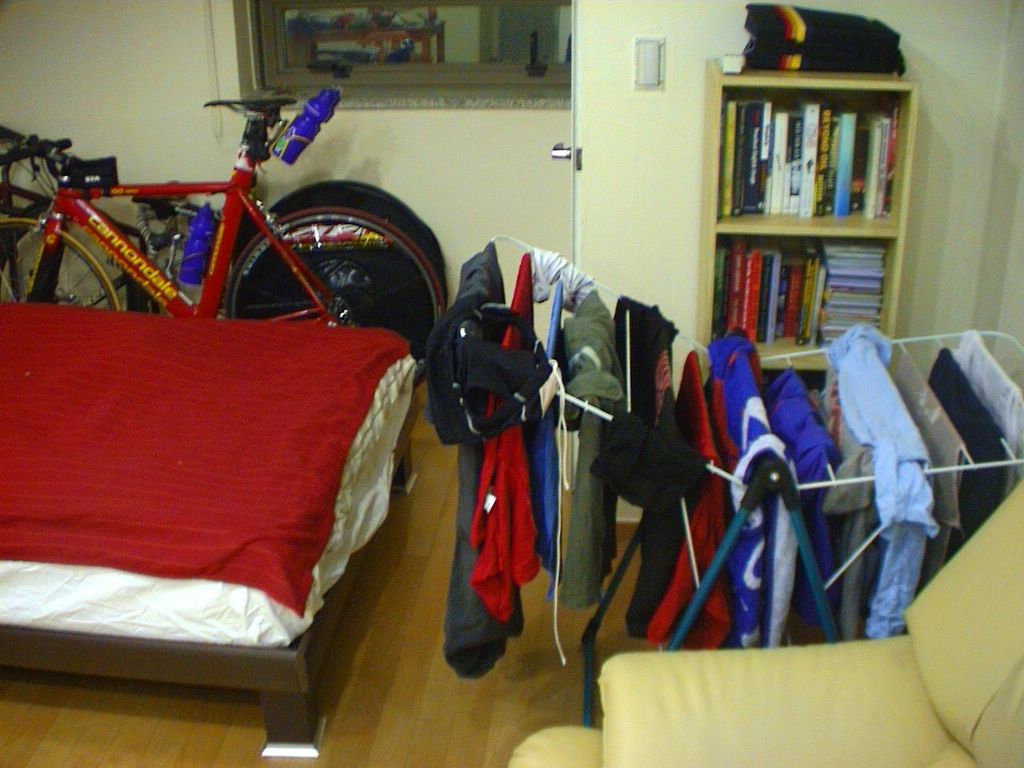
A lot of sneezing today, sniffing, coughing and chills. Feel a bit crappy, but would like to go for a cycle tomorrow. Call it impatience, maybe it is a bit rash, but if I am getting sick, might as well get into the thick of it, and get it over with.
It was sticky in class again. Gawd, June and July...I think I'm gonna melt, or turn into an ooze. Some classes have aircon, but not all, and not the staff room.
I'm feeling more settled in. I mean, I arrived back from work at 8pm, bought some icecream and small batteries for my TV's remote control, and then hung up my washing.
Someone in South Africa mentioned to me that my blog is becoming boring. Is it? I'd like to maintain the focus on oil and health issues (particularly related to flu). I agree though that focussing only on this isn't healthy, so I'd like to offset this gloomy reporting with some more uplifting stuff.
Right now I'm thinking of focussing a bit on Jean d-Arc. I read exhaustively on this subject when I studied advertising in Cape Town in 2000. Fascinating. It gave me a new respect for the Roman Catholic Church, and I was really inspired to see how faith can move mountains, in Jeanne's case, whole armies, an entire country. There are so few people like this these days, who truly live out their faith, for their community instead of themselves. Mandela is a living example. Maybe Oprah Winfrey is too, but I'd say one of the qualities of saintliness, is selflessness. Oprah's selfless, but she's also one of America's richest women. You can't blame rich people for becoming comfortable and accustomed to their wealth, but I think we respect people more who aren't changed by it. Ted Turner represents that, or seems to, to some extent.
While unpacking I found a sketch that Glen did (an ex- student). I marvelled at how beautiful the watercolors are. I originally asked her to do some demo illustrations for a short story I wrote called, 'My Friend Frank'. I can't believe, after seeing these beautiful pictures, I didn't get her to finish the job (and obviously reward her for her effort.
I'll have to ask the teachers at Kang's if she is still there, and see if I can get this children's story done with her help.
Tomorrow...cycling at 5am...

Scary Stuff in Europe
French "No" stings leaders of France, Europe
PARIS (Reuters) - France and Europe licked their wounds on Monday after French voters dealt what politicians across the continent said may have been a knockout blow to the European Union constitution.
Defeated in one of the biggest referendum turnouts for years, President Jacques Chirac hinted he could replace Prime Minister Jean-Pierre Raffarin, who told reporters after meeting Chirac to expect unspecified political developments by Tuesday.
Many voters -- and turnout was 69.7 percent -- used the vote to punish the government over France's economy and high unemployment. Chirac, 72, ignored calls from some members of the "No" camp that he step down.
EU leaders insisted the treaty -- intended to make EU decision-making easier -- was alive and member states should go on ratifying. But few doubted the result would hamper its chances elsewhere in the 25-nation bloc, notably in Wednesday's vote in the Netherlands.
The constitution requires the backing of all member states to go into force.
"There is a risk of contagion," European Commission President Jose Manuel Durao Barroso told French LCI Television after results of Sunday's vote showed a resounding 54.87 percent of French voters voted "No".
SERIOUS PROBLEM
"It's a very serious problem. We can't talk about business as usual," he said, adding EU leaders would discuss the crisis in confidence at a June 16 summit in Brussels.
The bigger-than-expected victory for the "No" camp drove the euro down a third of a percent to $1.2528 (86 pence) in early trading. The charter, intended to ensure the smooth working of the enlarged bloc, requires the approval of all member states and investors now fear a bout of political uncertainty.
Luxembourg Prime Minister and current EU presidency-holder Jean-Claude Juncker said the result could harm the July referendum in his tiny, pro-Europe state and warned of consequences for the European economy.
"It cannot be positive for the economy of Europe," Juncker said on French RTL radio.
Juncker said the result could hit the standing of EU founder member France in the bloc, a concern echoed in much of the French press. "A masochist masterpiece" was the way the Paris daily Liberation described the vote against the treaty.
"The French know from experience that their country is doing badly. Unfortunately, it is doing even worse this morning."
The heavy defeat leaves Chirac something of a lame duck two years before presidential and parliamentary elections and was seen reducing the chances of a repeat vote on the treaty.
The Netherlands holds its own referendum on the EU constitution on Wednesday and Dutch ministers urged voters on Sunday to ignore the result in France. A Dutch "No" vote, as opinion polls forecast, would sting the EU even more.
Juncker said nearly half the 454 million EU citizens in nine states had already backed the charter and added: "The European process does not come to a halt today."
CHIRAC PROMISES CHANGES
As a large crowd of flag-waving treaty opponents celebrated victory on Sunday night in Place de la Bastille in Paris, a major landmark of the 1789 French Revolution, Chirac dropped his heaviest hint so far that he planned to remove Raffarin.
"I intend to respond ... by giving a new and strong impetus to the action of the government," Chirac said in a televised address soon after the result was announced.
Many voters resent what they see as France's declining role in the Union, especially with the expansion to 25 members last year, and say the treaty enshrines economic policies that have failed to stop the loss of jobs to low-wage economies.
British Prime Minister Tony Blair said the EU needed time for reflection. He said there was no decision as yet on whether Britain would hold a referendum as planned next year.
"The referendum result is a blow for the constitutional process, but not the end of it," German Chancellor Gerhard Schroeder said. "It is also not the end of the German-French partnership in and for Europe."
Nine countries have approved the treaty, including Germany which alongside France drove creation of the post-World War Two economic alliance that developed into the European Union.
PARIS (Reuters) - France and Europe licked their wounds on Monday after French voters dealt what politicians across the continent said may have been a knockout blow to the European Union constitution.
Defeated in one of the biggest referendum turnouts for years, President Jacques Chirac hinted he could replace Prime Minister Jean-Pierre Raffarin, who told reporters after meeting Chirac to expect unspecified political developments by Tuesday.
Many voters -- and turnout was 69.7 percent -- used the vote to punish the government over France's economy and high unemployment. Chirac, 72, ignored calls from some members of the "No" camp that he step down.
EU leaders insisted the treaty -- intended to make EU decision-making easier -- was alive and member states should go on ratifying. But few doubted the result would hamper its chances elsewhere in the 25-nation bloc, notably in Wednesday's vote in the Netherlands.
The constitution requires the backing of all member states to go into force.
"There is a risk of contagion," European Commission President Jose Manuel Durao Barroso told French LCI Television after results of Sunday's vote showed a resounding 54.87 percent of French voters voted "No".
SERIOUS PROBLEM
"It's a very serious problem. We can't talk about business as usual," he said, adding EU leaders would discuss the crisis in confidence at a June 16 summit in Brussels.
The bigger-than-expected victory for the "No" camp drove the euro down a third of a percent to $1.2528 (86 pence) in early trading. The charter, intended to ensure the smooth working of the enlarged bloc, requires the approval of all member states and investors now fear a bout of political uncertainty.
Luxembourg Prime Minister and current EU presidency-holder Jean-Claude Juncker said the result could harm the July referendum in his tiny, pro-Europe state and warned of consequences for the European economy.
"It cannot be positive for the economy of Europe," Juncker said on French RTL radio.
Juncker said the result could hit the standing of EU founder member France in the bloc, a concern echoed in much of the French press. "A masochist masterpiece" was the way the Paris daily Liberation described the vote against the treaty.
"The French know from experience that their country is doing badly. Unfortunately, it is doing even worse this morning."
The heavy defeat leaves Chirac something of a lame duck two years before presidential and parliamentary elections and was seen reducing the chances of a repeat vote on the treaty.
The Netherlands holds its own referendum on the EU constitution on Wednesday and Dutch ministers urged voters on Sunday to ignore the result in France. A Dutch "No" vote, as opinion polls forecast, would sting the EU even more.
Juncker said nearly half the 454 million EU citizens in nine states had already backed the charter and added: "The European process does not come to a halt today."
CHIRAC PROMISES CHANGES
As a large crowd of flag-waving treaty opponents celebrated victory on Sunday night in Place de la Bastille in Paris, a major landmark of the 1789 French Revolution, Chirac dropped his heaviest hint so far that he planned to remove Raffarin.
"I intend to respond ... by giving a new and strong impetus to the action of the government," Chirac said in a televised address soon after the result was announced.
Many voters resent what they see as France's declining role in the Union, especially with the expansion to 25 members last year, and say the treaty enshrines economic policies that have failed to stop the loss of jobs to low-wage economies.
British Prime Minister Tony Blair said the EU needed time for reflection. He said there was no decision as yet on whether Britain would hold a referendum as planned next year.
"The referendum result is a blow for the constitutional process, but not the end of it," German Chancellor Gerhard Schroeder said. "It is also not the end of the German-French partnership in and for Europe."
Nine countries have approved the treaty, including Germany which alongside France drove creation of the post-World War Two economic alliance that developed into the European Union.
Joan died 574 years ago today.
Washington - Today is Monday, May 30, the 150th day of 2005. There are 215 days left in the year.
1431 - After being handed over by the church, who judged her a heretic, Saint Joan of Arc (Jeanne d'Arc is the better to pronounce her name) is burned at the stake in Rouen, France, by the English and their French collaborators.
1431 - After being handed over by the church, who judged her a heretic, Saint Joan of Arc (Jeanne d'Arc is the better to pronounce her name) is burned at the stake in Rouen, France, by the English and their French collaborators.
Summer Housewarming, Friday 3rd
I'd like to get some of my friends and colleagues together this Friday. Those who regularly read this blog, if you're in the neighborhood of Ilsan, and would like to drop by, send me an email (nicolasvdl@yahoo.com) and I'll provide directions, otherwise I will email or call people directly.
Come to my place around 10pm, and try to dress in a sort of surf/beach style. That means tong shoes, and shorts. Bring your own booze and I'll provide some snacks.
Come to my place around 10pm, and try to dress in a sort of surf/beach style. That means tong shoes, and shorts. Bring your own booze and I'll provide some snacks.

M&M & Typhoons
Went swimming with Lonnie at M&M today. Was interesting, and different, but didn't really work for swimming training. The pool is only 20m (instead of 25m at OSC and Sung Ho), and has only 3 lanes. This would still be OK, except I could only use one lane, and only for 40 minutes before they took all the lanes out and started aquarobics.
I'll possibly go late in the evening, or slightly earlier, but a 20m pool is still a bit small for me.
I'm feeling a bit sick, AGAIN. Throat is feeling sore and irritated, and phelgm is another shade of yellow. Yergh.
The sky is really polluted today, very hazy, so I am looking forward to the typhoon season - it starts tomorrow. Nothing like a typhoon to swing around and vacuum all the gunk out of the atmosphere.
I'll possibly go late in the evening, or slightly earlier, but a 20m pool is still a bit small for me.
I'm feeling a bit sick, AGAIN. Throat is feeling sore and irritated, and phelgm is another shade of yellow. Yergh.
The sky is really polluted today, very hazy, so I am looking forward to the typhoon season - it starts tomorrow. Nothing like a typhoon to swing around and vacuum all the gunk out of the atmosphere.
End of road for oil joyride looms as production peaks
May 30, 2005
Could the petroleum joyride - cheap, abundant oil that has sent the global economy whizzing along with the pedal to the metal and the air-conditioner blasting for decades - be coming to an end?
Some industry observers think so. They predict that this year, maybe next - almost certainly by the end of the decade - global oil production, having grown exuberantly for more than a century, will peak and begin to decline.
And then it really will be all downhill. The price of oil will increase drastically. Major oil-consuming countries will experience crippling inflation, unemployment and economic instability.
Princeton University geologist Kenneth Deffeyes predicts ``a permanent state of oil shortage.''
According to these experts, it will take a decade or more before conservation measures and new technologies can bridge the gap between supply and demand, and even then the situation will be touch and go.
None of this will affect vacation plans this summer - Americans can expect another season of beach weekends and road trips to Graceland relatively unimpeded by the cost of getting there. Though gas prices are up, they are expected to remain below US$2.50 a gallon (HK$5.15 a liter).
Accounting for inflation, that is pretty comparable to what motorists paid for most of the 20th century; it only feels expensive because gasoline was unusually cheap from 1986 to 2003.
And there are many who doubt the doomsday scenario will ever come true.
Most industry analysts think production will continue growing for at least another 30 years. By then, substitute energy sources will be available to ease the transition into a post-petroleum age.
``This is just silly,'' said Michael Lynch, president of Strategic Energy and Economic Research in Winchester, Massachusetts. ``It's not like industrial civilization is going to come crashing down.''
Where you stand on ``peak oil,'' as parties to the debate call it, depends on which forces you consider dominant in controlling the oil markets. People who consider economic forces most important believe prices are high now mostly because of demand from China and other rapidly growing economies.
But eventually, high prices should encourage consumers to use less and producers to pump more.
But Deffeyes and many other geologists counter that when it comes to oil, Mother Nature trumps Adam Smith.
The way they see it, Saudi Arabia, Russia, Norway and other major producers are already pumping as fast as they can. The only way to increase production capacity is to discover more oil. Yet there just is not much left out there to be discovered.
``The economists all think that if you show up at the cashier's cage with enough currency, God will put more oil in the ground,'' said Deffeyes.
There will be warning signs before oil production peaks, the bearers of bad news contend. Prices will rise dramatically and become increasingly volatile.
With little or no excess production capacity, minor supply disruptions - political instability in Venezuela, hurricanes in the Gulf of Mexico or labor unrest in Nigeria, for example - will send the oil markets into a tizzy.
So will periodic admissions by oil companies and petroleum-rich nations that they have been overestimating their reserves.
Oil producers will grow flush with cash. And because the price of oil ultimately affects the cost of just about everything else in the economy, inflation will follow.
Anybody who has been paying close attention to the news lately may feel a bit queasy at this stage. Could US$5-a-gallon gas be right around the corner?
``The world has never seen anything like this before and so we just really don't know,'' said Science Applications International energy analyst Robert Hirsch in Santa Monica, California.
Still, he added, ``there's a number of really competent professionals that are very pessimistic.''
But there also many experts who see no reason global oil production has to peak at all. It could plateau and then gradually fall as the economy converts to other forms of energy.
``Even in 30 to 40 years there's still going to be huge amounts of oil in the Middle East,'' said Daniel Sperling, director of the Institute of Transportation Studies at the University of California, Davis.
A few years ago, geologists began applying geologist M King Hubbert's methods to the entire world's oil production. Their analyses indicated that oil production would peak some time during the first decade of this century.
ASSOCIATED PRESS
Copyright 2005, The Standard, Sing Tao Newspaper Group and Global China Group. All rights reserved. No content may be redistributed or republished, either electronically or in print, without express written consent of The Standard.
Could the petroleum joyride - cheap, abundant oil that has sent the global economy whizzing along with the pedal to the metal and the air-conditioner blasting for decades - be coming to an end?
Some industry observers think so. They predict that this year, maybe next - almost certainly by the end of the decade - global oil production, having grown exuberantly for more than a century, will peak and begin to decline.
And then it really will be all downhill. The price of oil will increase drastically. Major oil-consuming countries will experience crippling inflation, unemployment and economic instability.
Princeton University geologist Kenneth Deffeyes predicts ``a permanent state of oil shortage.''
According to these experts, it will take a decade or more before conservation measures and new technologies can bridge the gap between supply and demand, and even then the situation will be touch and go.
None of this will affect vacation plans this summer - Americans can expect another season of beach weekends and road trips to Graceland relatively unimpeded by the cost of getting there. Though gas prices are up, they are expected to remain below US$2.50 a gallon (HK$5.15 a liter).
Accounting for inflation, that is pretty comparable to what motorists paid for most of the 20th century; it only feels expensive because gasoline was unusually cheap from 1986 to 2003.
And there are many who doubt the doomsday scenario will ever come true.
Most industry analysts think production will continue growing for at least another 30 years. By then, substitute energy sources will be available to ease the transition into a post-petroleum age.
``This is just silly,'' said Michael Lynch, president of Strategic Energy and Economic Research in Winchester, Massachusetts. ``It's not like industrial civilization is going to come crashing down.''
Where you stand on ``peak oil,'' as parties to the debate call it, depends on which forces you consider dominant in controlling the oil markets. People who consider economic forces most important believe prices are high now mostly because of demand from China and other rapidly growing economies.
But eventually, high prices should encourage consumers to use less and producers to pump more.
But Deffeyes and many other geologists counter that when it comes to oil, Mother Nature trumps Adam Smith.
The way they see it, Saudi Arabia, Russia, Norway and other major producers are already pumping as fast as they can. The only way to increase production capacity is to discover more oil. Yet there just is not much left out there to be discovered.
``The economists all think that if you show up at the cashier's cage with enough currency, God will put more oil in the ground,'' said Deffeyes.
There will be warning signs before oil production peaks, the bearers of bad news contend. Prices will rise dramatically and become increasingly volatile.
With little or no excess production capacity, minor supply disruptions - political instability in Venezuela, hurricanes in the Gulf of Mexico or labor unrest in Nigeria, for example - will send the oil markets into a tizzy.
So will periodic admissions by oil companies and petroleum-rich nations that they have been overestimating their reserves.
Oil producers will grow flush with cash. And because the price of oil ultimately affects the cost of just about everything else in the economy, inflation will follow.
Anybody who has been paying close attention to the news lately may feel a bit queasy at this stage. Could US$5-a-gallon gas be right around the corner?
``The world has never seen anything like this before and so we just really don't know,'' said Science Applications International energy analyst Robert Hirsch in Santa Monica, California.
Still, he added, ``there's a number of really competent professionals that are very pessimistic.''
But there also many experts who see no reason global oil production has to peak at all. It could plateau and then gradually fall as the economy converts to other forms of energy.
``Even in 30 to 40 years there's still going to be huge amounts of oil in the Middle East,'' said Daniel Sperling, director of the Institute of Transportation Studies at the University of California, Davis.
A few years ago, geologists began applying geologist M King Hubbert's methods to the entire world's oil production. Their analyses indicated that oil production would peak some time during the first decade of this century.
ASSOCIATED PRESS
Copyright 2005, The Standard, Sing Tao Newspaper Group and Global China Group. All rights reserved. No content may be redistributed or republished, either electronically or in print, without express written consent of The Standard.
Sunday, May 29, 2005
Grocery Store Romance
I didn't cycle to Imjingak today. Feeling tired and...not 100% well. Headaches, slight chills. I am feeling pretty impatient and disappointed at how difficult it has been to get back into a training pattern.
Will rest and try to join the group on their next ride on Tuesday.
I called Lonnie to arrange a swim tomorrow morning at M&M. He says it's not really that busy in the mornings.
Went to Allalie to help her exchange TV's, and then to Carrefour for some groceries. A funny thing happened at the grocery store. Near the fruit section we ran into Elena. I stood around while Corneli and her chatted, and eventually lay on the handle of the trolley because the conversation just never swung to me. A few minutes later, unstairs, we bumped into Chris, and exactly the reverse happened. He and I spoke about a book he was reading (on the origins of the 2nd World War) and he barely said a word to Corneli. I guess it's unwritten Grocery Shopping etiquette. If you're a couple shopping, or have the semblance of a couple, then it is forbidden for a stranger to engage with a member of the opposite sex in conversation.
The sky today is very polluted. I believe there was a half marathon today. I'm sorry I missed it. Lately I'm feeling like I'm not quite in the loop.
Last week, on the spur of the moment, I wrote a song, and emailed it to a friend of mine who has been doing a bit of songwriting and composing lately, and even performed at a bar recently. He liked the song and asked if he could use it. I'ver asked him to record it and send me a .wav or .wmp file so I can hear it. It has a sort of U2/Bono feel to it.
I'm already looking forward to next weekend...
Will rest and try to join the group on their next ride on Tuesday.
I called Lonnie to arrange a swim tomorrow morning at M&M. He says it's not really that busy in the mornings.
Went to Allalie to help her exchange TV's, and then to Carrefour for some groceries. A funny thing happened at the grocery store. Near the fruit section we ran into Elena. I stood around while Corneli and her chatted, and eventually lay on the handle of the trolley because the conversation just never swung to me. A few minutes later, unstairs, we bumped into Chris, and exactly the reverse happened. He and I spoke about a book he was reading (on the origins of the 2nd World War) and he barely said a word to Corneli. I guess it's unwritten Grocery Shopping etiquette. If you're a couple shopping, or have the semblance of a couple, then it is forbidden for a stranger to engage with a member of the opposite sex in conversation.
The sky today is very polluted. I believe there was a half marathon today. I'm sorry I missed it. Lately I'm feeling like I'm not quite in the loop.
Last week, on the spur of the moment, I wrote a song, and emailed it to a friend of mine who has been doing a bit of songwriting and composing lately, and even performed at a bar recently. He liked the song and asked if he could use it. I'ver asked him to record it and send me a .wav or .wmp file so I can hear it. It has a sort of U2/Bono feel to it.
I'm already looking forward to next weekend...

What is the Answer?
In terms of energy, it is easy to shoot down almost all the alternatives.
Despite Bush's speech in Virginia, Ethanol/biomass is not the answer, simply because huge amounts of land (in America, 10 x the size of Iowa) are required, and you also need energy to grow these crops and maintain these crops, and none of these crops can be used for food.
The answer is nuclear. Wired magazine describes it like this: It's the power to light a city in a lump the size of a soda can. It is expensive to start up, one plant costs $2 billion. Solar is extremely expensive, but Nuclear is about as cost-competitive as all the others, from coal, to wind, to biomass, once up and running. Nuclear requires a fraction of the land needed by wind and solar generators. To meet energy requirements in the States (and reducing carbon emissions by 15%), they will have to build five times the number of nuclear power plants. To do this in terms of Wind, they'd have to increase wind generators three hundred fold, and Solar, six thousand fold (source: Wired magazine). Here it is again:
Nuclear: 5x
Wind: 300x
Solar: 6000x
Nuclear power has come a long way, and is now safer and better. Few realise that coal produces more radioactive waste, a 100 times more radioactive pollutants and tons of other noxious stuff, into the atmosphere, than an equivalent nuclear reactor does.
Nuclear will also make hydrogen possible, if not plausible. As luck would have it, nuclear reactors do two things really really well: they generate electricity and very high temperatures. This is exactly what bis needed to produce hydrogen most efficently. Even so, Hydrogen is a difficult one to call. If you have huge amounts of energy to synthesise hydrogen, and you don't mind the extra cost, you still have to deal with a very tricky element that is corrosive, hard to store, and volatile. The real problem is that hydrogen is so light it has to be pressurised, and beyond that, it has to be stored in reinforced containers that are heavy and difficult to produce. So here you have this superlight substance that you transport in very heavy containers, and you have to pressurise it to get a decent amount of the stuff.
Still, the combination of Nuclear for electricity, and Hydrogen for fuel, seems to be the way to go. And it has to be pursued in that order: Nuclear first, and Hydrogen second.
Despite Bush's speech in Virginia, Ethanol/biomass is not the answer, simply because huge amounts of land (in America, 10 x the size of Iowa) are required, and you also need energy to grow these crops and maintain these crops, and none of these crops can be used for food.
The answer is nuclear. Wired magazine describes it like this: It's the power to light a city in a lump the size of a soda can. It is expensive to start up, one plant costs $2 billion. Solar is extremely expensive, but Nuclear is about as cost-competitive as all the others, from coal, to wind, to biomass, once up and running. Nuclear requires a fraction of the land needed by wind and solar generators. To meet energy requirements in the States (and reducing carbon emissions by 15%), they will have to build five times the number of nuclear power plants. To do this in terms of Wind, they'd have to increase wind generators three hundred fold, and Solar, six thousand fold (source: Wired magazine). Here it is again:
Nuclear: 5x
Wind: 300x
Solar: 6000x
Nuclear power has come a long way, and is now safer and better. Few realise that coal produces more radioactive waste, a 100 times more radioactive pollutants and tons of other noxious stuff, into the atmosphere, than an equivalent nuclear reactor does.
Nuclear will also make hydrogen possible, if not plausible. As luck would have it, nuclear reactors do two things really really well: they generate electricity and very high temperatures. This is exactly what bis needed to produce hydrogen most efficently. Even so, Hydrogen is a difficult one to call. If you have huge amounts of energy to synthesise hydrogen, and you don't mind the extra cost, you still have to deal with a very tricky element that is corrosive, hard to store, and volatile. The real problem is that hydrogen is so light it has to be pressurised, and beyond that, it has to be stored in reinforced containers that are heavy and difficult to produce. So here you have this superlight substance that you transport in very heavy containers, and you have to pressurise it to get a decent amount of the stuff.
Still, the combination of Nuclear for electricity, and Hydrogen for fuel, seems to be the way to go. And it has to be pursued in that order: Nuclear first, and Hydrogen second.

Phony Real

Howard Hughes is an interesting subject. It's an odd combination of brilliance and madness, reality and phoniness, passion and perfection beside hypochondria and dysfunction. It seems to me that anyone can make a fortune (and lose a fortune), but not everyone has that extraordinary level of energy (or attention span) to pull off coup after coup after coup. A lot of millionaires, billionaires are driven by the same thing athletes and sportsmen are. Compulsion.
I've trained for a number of races, and every moment you're aware that your competitors are out there, using the available time to get stronger, fitter and faster. And you have to ask yourself, how can I do better with my time? Maybe the answer is to never rest, or seems to be. Often, that workhorse ethic, is part and parcel of success. Another thing is in forgetting and ignoring the risk, the downside. The adventure of it is what's important.
The love of aircraft is something I had too. I flew my share of kites (including a three eyed beast that went hundreds of metres up, and some even use for shark fishing), made my model aeroplanes. I went to the Air Force where the dream of flying fizzled. It seemed phony, the world around the airplanes, and the life in the armed forces was filled with such drudgery and retardedness, I couldn't wait to be rid of it. I was offered a contract to become a pilot (one of only two other candidates, subsequent to writing some math based aptitude tests) and I considered it. They were offering me a house, but they also wanted me to stay put, in this...environment...and the Air Force represented the 13th year of bondage (after 12 years of school) and I wanted to be free.
I can't say I like flying much anymore. Not on commercial aircraft, as a long haul passenger anyway. What could be a more boring way to fly than to wait hours for a plane, wait hours in a plane, seated....the only reward being the fleeting glimpse of a city, seen from the sky, as you disembark, and the magic appearance of a new destination from the sky.
My brother and I were lucky enough to fly in military and other helicopters when we were kids. That's still an abiding ambition, to pilot a helicopter. The area around Cape Town is notorious for its fires, as the dry season and windy season coincide. The seeds of many of the indigenous plants actually need to be smoked and/or burned in order to germinate.
There is a private company that operates Mi8's (helicopters)out of Cape Town with buckets slung underneath. Tragically one was lost, along with all 3 on board, in 1998 due to a tail-rotor strike while lifting an air conditioning unit onto the roof of a building in Town.
I've written at least 3 novels/works in progress featuring helicopters. One involves a shipwrecked Mi-26 (the world's largest helicopter) in the kalahari desert, which sets off an existential quest for the filling of the great wild, and empty heart of man. Another was a self-indulgent love story, which opens with a metaphorical resurrection (shipwrecked this time on a small boat, floating out to see, and airlifted/resurrected to safety)of the heartbroken protagonist. The third involved a pilot who inadvertently scoops up a shallow diver and tosses him, flippers and all, into a raging forest fire on the slopes of Table Mountain in Cape Town.
A documentary of aviation explanes how these superaeroplanes (like Hughes' Spruce Goose, and even the Concorde to some extent) were superceded by smaller jets capable of using smaller runways. The latest airbus will probably be a casualty of oil, unless it can transport more people more cheaply. All this is reminiscent of the cheaper GSM phones wiping out a possible market for satellite phones, despite the technology being more sophisticated.
Back to Hughes, as he is depicted in the Aviator. Kate Blanchett is a work of artistic intelligence in motion, and her appearances in The Aviator are all interesting. DiCaprio is a good actor, but I can't help seeing him in every movie as a boyish character surrounded by older women.
The Aviator is an interesting movie, but it bares little resemblance to the real Howard Hughes, and only hints at the darker dealings he was involved with. Perhaps wisely, Scorcese has focussed on the flying aspect. That is possibly Hughes' defining magic, and what gave him some nobility and vision within all the corruption
that surrounded his life. The thing that Hollywood does, is it weaves a beautiful story of excess and love and passion, with all the rewards but not all the consequences.
We like to believe that life is like this, but if we really think it is, then we're phonies in a phony-real world.
The value in movies based on fact is that we once again remember people who have passed, how their era shaped them and made them, and that, into what is now. There is tremendous insight in hindsight, to go beyond just the glitz to exactly what they achieved and did that did not, and does still, endure today. What we see can help us be whoever we've made up our minds to be, or remind us in our forgetfulness, of all that we have forgotten to do.

The Aviator
(Director Martin Scorsese)
Reviewed by James Howard Kunstler
A peculiar story about a bizarre person, Howard Hughes, but rather grandly put together against the background of Hollywood in the early-to-mid 20th century -- an era that now seems as remote and enchanted as the medieval period.
Hughes's parents die when he is barely out of his teens, leaving him a fortune and an oil drilling equipment company that runs like a cash register. Rich young Howard, though, is magnetically drawn to the new movie industry in Los Angeles, with its air of risk, and adventure, and sex-on-demand.
Scorsese's evocation of the early Hollywood scene is the best thing about the movie -- the big set-pieces in the fabled Coconut Grove nightclub, the behavior of the slick young men and women who would become the stars of Hollywood's "Golden Age," all that glamorous fluff.
Leonardo DiCaprio is consistently interesting to watch. Whatever his public persona may be, the young feller can put across plausible behavior on screen, even with such an implausible character as Hughes for material.
The other big splash in the movie is Cate Blanchette doing a dead-on imitation of Katherine Hepburn, one of Hughes's more serious paramours. Blanchette doesn't really look anything like Hepburn, but she gets the weird, grating voice just right and the imperious manner.
The best scene in the movie, for my money, is the one in which Hepburn takes Hughes home to meet her family in Connecticut -- a clan of self-conscious and excrutiatingly phony rich bohemians, especially Katherine's censorious "socialist" mother who Howard neatly tells off. It seems to me that the movie ran about fifteen minutes too long, but it was all-in-all a competent and admirable job.


Remarks by President Bush on Energy (May 15)
Virginia BioDiesel Refinery
West Point, Virginia
...it is important for our country to understand we need an affordable, reliable supply of energy. And that starts with pursuing policies to make prices reasonable at the pump. Today's gasoline prices and diesel prices are making it harder for our families to meet their budgets. These prices are making it more expensive for farmers to produce their crop, more difficult for businesses to create jobs.
Americans are concerned about high prices at the pump, and they're really concerned as they start making their travel plans, and I understand that. I wish I could just wave a magic wand and lower the price at the pump; I'd do that. That's not how it works. You see, the high prices we face today have been decades in the making. Four years ago I laid out a comprehensive energy strategy to address our energy challenges. Yet Congress hasn't passed energy legislation. For the sake of the American consumers, it is time to confront our problems now, and not pass them on to future Congresses and future generations.
The increase in the price of crude oil is largely responsible for the higher gas prices and diesel prices that you're paying at the pump. For many years, most of the crude oil refined into gasoline in America came from home, came from domestic oil fields. In 1985, 75 percent of the crude oil used in U.S. refineries came from American sources; only about 25 percent came from abroad. Over the past few decades we've seen a dramatic change in our energy equation. American gasoline consumption has increased by about a third, while our crude production has dropped and oil imports have risen dramatically.
The result today -- the result is that today only 35 percent -- only 35 percent -- of the crude oil used in U.S. refineries comes from here at home; 65 percent comes from foreign countries, like Saudi Arabia and Mexico and Canada and Venezuela. You see, we're growing more dependent on foreign oil. Because we haven't had an energy strategy, we're becoming more dependent on countries outside our borders to provide us with the energy needed to refine gasoline. To compound the problem, countries with rapidly growing economies, like India and China, are competing for more of the world oil supply. And that drives up the price of oil, and that makes prices at the pump even higher for American families and businesses and farmers.
Our dependence on foreign oil is like a foreign tax on the American Dream, and that tax is growing every year. My administration is doing all we can to help ease the problem in the short run. We're encouraging oil-producing countries to maximize their production so that more crude oil is on the market, which will help take the pressure off price. We'll make sure that consumers here at home are treated fairly, there's not going to be any price- gouging here in America. But to solve the problem in the long run, we must address the root causes of high gasoline prices. We need to take four steps toward one vital goal, and that is to make America less dependent on foreign sources of oil. (Applause.)
We must be better conservers. We must produce and refine more crude oil here in America. We must help countries like India and China to reduce their demand for crude oil. And we've got to develop new fuels like biodiesel and ethanol as alternatives to diesel and gasoline. (Applause.)
Americans have been waiting long enough for a strategy. It is time to deliver an effective, common-sense energy strategy for the 21st strategy. And that's what I want to talk to you about today. The first step toward making America less dependent on foreign oil is to improve fuel conservation and efficiency. My administration is leading research into new technologies that reduce gas consumption while maintaining performance, such as lightweight auto parts and more efficient batteries.
We're raising fuel economy standards for sport utility vehicles and vans and pickup trucks, starting with model year 2005. When these reasonable increases in mileage standards take full effect, they will save American drivers about 340,000 barrels of gasoline a day. That's more gas than you consume every day in the entire state of Virginia.
To improve fuel efficiency, we're also taking advantage of more efficient engine technologies. Hybrid vehicles are powered by a combination of internal combustion engine and an electric motor. Hybrid cars and trucks can travel twice as far on a gallon of fuel as gasoline-only vehicles. And they produce lower emissions.
To help more consumers conserve gas and protect the environment, my budget next year proposes that every American who purchases a hybrid vehicle receive a tax credit of up to $4,000. (Applause.)
Diesel engine technology has also progressed dramatically in the past few decades. Many Americans remember the diesel cars of the 1970s -- they made a lot of noise and they spewed a lot of black smoke. Advances in technology and new rules issued by my administration have allowed us to leave those days of diesel behind. Our clean diesel rules will reduce air pollution from diesel engines by about 90 percent, and reduce the sulfur content of diesel fuel by more than 95 percent.
Today I saw a diesel-powered truck that can get up to 30 percent better fuel economy than gasoline-powered vehicles, without the harmful emissions of past diesels. I mean, the fellow got in the truck and cranked it up, and another man got on the ladder, and he put the white handkerchief by the emissions port, and the white handkerchief remained white. In other words, technology is changing the world. Our engines are becoming cleaner.
Consumers around the world are taking advantage of clean diesel technology. About half of newly registered passenger cars in Western Europe are now equipped with diesel engines. Yet in America, fewer than 1 percent of the cars on the road use diesel. According to the Department of Energy, if diesel vehicles made up 20 percent of our fleet in 15 years, we would save 350,000 barrels of oil a day. That's about a quarter of what we import every day from Venezuela.
To help more Americans benefit from a new generation of diesel technology, I have proposed making owners of clean diesel vehicles eligible for the same tax credit as owners of hybrid vehicles. America leads the world in technology. We need to use that technology to lead the world in fuel efficiency. (Applause.)
The second step toward making America less dependent on foreign oil is to produce and refine more crude oil here at home, in environmentally sensitive ways. By far the most promising site for oil in America is the Arctic National Wildlife Refuge in Alaska. I want you all to hear the facts about what we're talking about. Technology now makes it possible to reach the oil reserves in ANWR by drilling on just 2,000 acres of the 19 million acres. Technology has advanced to the point where you can take a small portion -- 2,000 acres -- of this vast track of land and explore for oil in an environmentally sensitive way.
As a matter of fact, developing this tiny area could yield up to about a million barrels of oil a day. And thanks to technology, we can reach that oil with almost no impact on land or wildlife. To make this country less dependent on foreign -- foreign oil, Congress needs to authorize pro-growth, pro-job, pro-environment exploration of ANWR. (Applause.)
As we produce more of our own oil, we need to improve our ability to refine it into gasoline. There has not been a single new refinery built in America since 1976. Here in Virginia, you have only one oil refinery, the Yorktown refinery. And that was built in the 1950s. To meet our growing demand for gasoline, America now imports more than a million barrels of fully refined gasoline every day. That means about one of every nine gallons of gas you get in your pump is refined in a foreign country. To help secure our gasoline supply and lower prices at the pump, we need to encourage existing refineries like Yorktown to expand their capacity. So the Environmental Protection Agency is simplifying rules and regulations for refinery expansion. And they will do so and maintain strict environmental safeguards at the same time.
We also need to build new refineries. So I've directed federal agencies to work with states to encourage the construction of new refineries on closed military facilities, and to simplify the permitting process for these new refineries. By promoting reasonable regulations, we can refine more gasoline for more American consumers. And that means we're less dependent on foreign sources of energy.
The third step toward making America less dependent on foreign oil is to ensure that other nations use technology to reduce their own demand for crude oil. It's in our interest -- it's in our economic interest and our national interest to help countries like India and China become more efficient users of oil, because that would help take the pressure off global oil supply, take the pressure off prices here at home. At the G8 meeting in July, I'm going to ask other world leaders to join America in helping developing countries find practical ways to use clean energy technology, to be more efficient about how they use energy. You see, when the global demand for oil is lower, Americans will be better off at the gas pump.
The final step toward making America less dependent on foreign oil is to develop new alternatives to gasoline and diesel. Here at Virginia BioDiesel, you are using Virginia soybean oil to produce a clean-burning fuel. Other biodiesel refiners are making fuel from waste products like recycled cooking grease. Biodiesel can be used in any vehicle that runs on regular diesel, and delivers critical environmental and economic benefits.
Biodiesel burns more completely and produces less air pollution than gasoline or regular diesel. Biodiesel also reduces engine wear, and produces almost no sulfur emissions, which makes it a good choice for cities and states working to meet strict air quality standards. And every time we use home grown biodiesel, we support American farmers, not foreign oil producers. (Applause.)
More Americans are realizing the benefits of biodiesel every year. In 1999, biodiesel producers sold about 500,000 gallons of fuel for the year. Last year, biodiesel sales totaled 30 million gallons. That's a sixtyfold increase in five years. (Applause.) More than 500 operators of major vehicle fleets now use biodiesel, including the Department of Defense and the National Park Service and James Madison University. The County of Arlington, Virginia, has converted its fleet of school buses to biodiesel. And Harrisonburg is using biodiesel in its city transit buses.
In the past three years, more than 300 public fueling stations have started offering biodiesel. You're beginning to see a new industry evolve. (Applause.) And as more Americans choose biodiesel over petroleum fuel, they can be proud in knowing they're helping to make this country less dependent on foreign oil. (Applause.)
Another important alternative fuel is ethanol. Ethanol comes from corn, and it can be mixed with gasoline to produce a clean, efficient fuel. In low concentrations, ethanol can be used in any vehicle. And with minor modifications, vehicles can run on fuel blend that includes 85 percent ethanol and only 15 percent gasoline.
Like biodiesel, ethanol helps communities to meet clean air standards, farmers to find new markets for their products, and America to replace foreign crude oil with a renewable source grown right here in the nation's heartland. (Applause.) Together, ethanol and biodiesel present a tremendous opportunity to diversify our supply of fuel for cars and buses and trucks and heavy-duty vehicles.
A recent study by Oak Ridge National Laboratory projected that biofuels, such as ethanol and biodiesel, could provide about a fifth of America's transportation fuel within 25 years. And that would be good for our kids and our grandkids. (Applause.) So there are some things we can do to bring that prospect closer to reality. We have extended federal tax credits for ethanol through 2007, and last year I signed into law a 50-cent-per-gallon tax credit for producers of biodiesel. (Applause.)
There's ways government can help. Congress needs to get me a bill that continues to help diversify away from crude oil. (Applause.) My administration supports a flexible, cost-effective renewable fuel standard. Its proposal would require fuel producers to include a certain percentage of ethanol and biodiesel in their fuel. And to expand the potential of ethanol and biodiesel even more, I proposed $84 million in my 2006 budget for ongoing research. (Applause.) I think it makes sense. I think it's a good use of taxpayers' money to continue to stay on the leading edge of change. And in this case, by staying on the leading edge of change, we become less dependent on foreign sources of oil. (Applause.)
My administration is also supporting another of America's most promising alternative fuels -- hydrogen. When hydrogen is used in a fuel cell, it can power a car that requires no gas and emit pure water instead of exhaust fumes. We've already dedicated $1.2 billion to hydrogen fuel cell research. I've asked Congress for an additional $500 million over five years to get hydrogen cars into the dealership lot. With a bold investment now, we can replace a hydrocarbon economy with a hydrogen economy, and make possible for today's children to take their driver's test in a completely pollution-free car. (Applause.)
As we make America less dependent on foreign oil, we're pursuing a comprehensive strategy to address other energy challenges facing our nation. Along with high gas prices, many families and small businesses are confronting rising electricity bills. Summer air-conditioning costs are going to make it even more expensive for our homes and office buildings. To help consumers save on their power bills, we'll continue expanding efforts to conserve electricity. We're funding research into energy-efficient technologies for our homes, such as highly-efficient windows and appliances.
To ensure the electricity is delivered efficiently, Congress must make reliability standards for electric utilities mandatory, not optional. (Applause.) We've got modern interstate grids for our phone lines and highways. It is time to put practical law in place so we can have modern electricity grids, as well. (Applause.) All this modernization of our electricity grid is contained in the electricity title in the energy bill I submitted to the United States Congress.
To power our growing economy, we also need to generate more electricity. Electricity comes from three principal sources -- coal and natural gas and nuclear power. To ensure that electricity is affordable and reliable, America must improve our use of all three. Coal is our nation's most abundant energy resource, and it provides about half of your electricity here in Virginia. As a matter of fact, we got coal reserves that will last us for 250 more years. But coal presents an environmental challenge. We know that. So I've asked Congress to provide more than $2 billion over 10 years for a coal research initiative, a program that will promote new technologies to remove virtually all pollutants from coal-fired power plants.
My Clear Skies Initiative will also result in tens of billions of dollars in clean coal investments by private companies. It will help communities across the state meet stricter air quality standards. To help Virginia clean your air and keep your coal, Congress needs to get the Clear Skills bill to my desk this year. (Applause.)
Improving our electricity supply also means making better use of natural gas. It's an important power source for our farmers and manufacturers and homeowners. We need to increase environmentally responsible production of natural gas from federal lands. To further increase our natural gas supply, Congress needs to make clear federal authority to choose sites for new receiving terminals for liquified natural gas. In other words, we're getting a lot of natural gas from overseas that gets liquified, and we got to be able to de-liquify it so we can get it into your homes. And we need more terminals, and Congress needs to give us the authority to site those terminals in order to get you more natural gas. (Applause.)
I don't know if you realize this, but here in Virginia, you get about a third of your electricity from nuclear energy. Yet America has not ordered a nuclear power plant since the 1970s. France, by contrast, has built 58 plants in the same period. And today, France gets more than 78 percent of its electricity from nuclear power. In order to make sure you get electricity at reasonable prices, and in order to make sure our air remains clean, it is time for us to start building some nuclear power plants in America. (Applause.)
Technology has made it so I can say to you I am confident we can build safe nuclear power plants for you. Last month I directed the Department of Energy to work with Congress to reduce uncertainty in the nuclear power plant licensing process. We're also working to provide other incentives to encourage new plant construction, such as federal insurance to protect the builders of the first four new plants against lawsuits and bureaucratic obstacles and other delays beyond their control. A secure energy future for this country must include safe and clean nuclear power.
Many of the initiatives I've discussed today -- and I recognize this is a comprehensive plan, but that's what we need in America; we need a comprehensive plan. And many of these initiatives are contained in the energy bill before the Congress. I want to thank the House for passing the energy bill last month. And now it's time for the United States Senate to act. (Applause.) You don't have to worry about George Allen. He'll take the lead. (Applause.)
For the past four years, Americans have seen the cost of delaying a national energy policy. You've seen firsthand what it means when the nation's capital gets locked down with too much politics and not enough action on behalf of the American people. You've seen it through rising power bills; you've seen it through blackouts and high prices at the pump. Four years of debate is enough. It is time for the House and the Senate to come together and to get a good energy bill to my desk by August, and I'll sign it into law. (Applause.)
I've set big goals for our nation's energy policy, and I am confident our nation can meet those goals. Americans have a long history of overcoming problems through determination and through technology. Not long ago the prospect of running a car on fuel made from soybean oil seemed pretty unlikely. I imagine 30 years ago a politician saying, vote for me and I'll see to it that your car can run on soybean oil, wouldn't get very far. (Laughter.) Here we are, standing in front of a refinery that makes it. (Applause.)
West Point, Virginia
...it is important for our country to understand we need an affordable, reliable supply of energy. And that starts with pursuing policies to make prices reasonable at the pump. Today's gasoline prices and diesel prices are making it harder for our families to meet their budgets. These prices are making it more expensive for farmers to produce their crop, more difficult for businesses to create jobs.
Americans are concerned about high prices at the pump, and they're really concerned as they start making their travel plans, and I understand that. I wish I could just wave a magic wand and lower the price at the pump; I'd do that. That's not how it works. You see, the high prices we face today have been decades in the making. Four years ago I laid out a comprehensive energy strategy to address our energy challenges. Yet Congress hasn't passed energy legislation. For the sake of the American consumers, it is time to confront our problems now, and not pass them on to future Congresses and future generations.
The increase in the price of crude oil is largely responsible for the higher gas prices and diesel prices that you're paying at the pump. For many years, most of the crude oil refined into gasoline in America came from home, came from domestic oil fields. In 1985, 75 percent of the crude oil used in U.S. refineries came from American sources; only about 25 percent came from abroad. Over the past few decades we've seen a dramatic change in our energy equation. American gasoline consumption has increased by about a third, while our crude production has dropped and oil imports have risen dramatically.
The result today -- the result is that today only 35 percent -- only 35 percent -- of the crude oil used in U.S. refineries comes from here at home; 65 percent comes from foreign countries, like Saudi Arabia and Mexico and Canada and Venezuela. You see, we're growing more dependent on foreign oil. Because we haven't had an energy strategy, we're becoming more dependent on countries outside our borders to provide us with the energy needed to refine gasoline. To compound the problem, countries with rapidly growing economies, like India and China, are competing for more of the world oil supply. And that drives up the price of oil, and that makes prices at the pump even higher for American families and businesses and farmers.
Our dependence on foreign oil is like a foreign tax on the American Dream, and that tax is growing every year. My administration is doing all we can to help ease the problem in the short run. We're encouraging oil-producing countries to maximize their production so that more crude oil is on the market, which will help take the pressure off price. We'll make sure that consumers here at home are treated fairly, there's not going to be any price- gouging here in America. But to solve the problem in the long run, we must address the root causes of high gasoline prices. We need to take four steps toward one vital goal, and that is to make America less dependent on foreign sources of oil. (Applause.)
We must be better conservers. We must produce and refine more crude oil here in America. We must help countries like India and China to reduce their demand for crude oil. And we've got to develop new fuels like biodiesel and ethanol as alternatives to diesel and gasoline. (Applause.)
Americans have been waiting long enough for a strategy. It is time to deliver an effective, common-sense energy strategy for the 21st strategy. And that's what I want to talk to you about today. The first step toward making America less dependent on foreign oil is to improve fuel conservation and efficiency. My administration is leading research into new technologies that reduce gas consumption while maintaining performance, such as lightweight auto parts and more efficient batteries.
We're raising fuel economy standards for sport utility vehicles and vans and pickup trucks, starting with model year 2005. When these reasonable increases in mileage standards take full effect, they will save American drivers about 340,000 barrels of gasoline a day. That's more gas than you consume every day in the entire state of Virginia.
To improve fuel efficiency, we're also taking advantage of more efficient engine technologies. Hybrid vehicles are powered by a combination of internal combustion engine and an electric motor. Hybrid cars and trucks can travel twice as far on a gallon of fuel as gasoline-only vehicles. And they produce lower emissions.
To help more consumers conserve gas and protect the environment, my budget next year proposes that every American who purchases a hybrid vehicle receive a tax credit of up to $4,000. (Applause.)
Diesel engine technology has also progressed dramatically in the past few decades. Many Americans remember the diesel cars of the 1970s -- they made a lot of noise and they spewed a lot of black smoke. Advances in technology and new rules issued by my administration have allowed us to leave those days of diesel behind. Our clean diesel rules will reduce air pollution from diesel engines by about 90 percent, and reduce the sulfur content of diesel fuel by more than 95 percent.
Today I saw a diesel-powered truck that can get up to 30 percent better fuel economy than gasoline-powered vehicles, without the harmful emissions of past diesels. I mean, the fellow got in the truck and cranked it up, and another man got on the ladder, and he put the white handkerchief by the emissions port, and the white handkerchief remained white. In other words, technology is changing the world. Our engines are becoming cleaner.
Consumers around the world are taking advantage of clean diesel technology. About half of newly registered passenger cars in Western Europe are now equipped with diesel engines. Yet in America, fewer than 1 percent of the cars on the road use diesel. According to the Department of Energy, if diesel vehicles made up 20 percent of our fleet in 15 years, we would save 350,000 barrels of oil a day. That's about a quarter of what we import every day from Venezuela.
To help more Americans benefit from a new generation of diesel technology, I have proposed making owners of clean diesel vehicles eligible for the same tax credit as owners of hybrid vehicles. America leads the world in technology. We need to use that technology to lead the world in fuel efficiency. (Applause.)
The second step toward making America less dependent on foreign oil is to produce and refine more crude oil here at home, in environmentally sensitive ways. By far the most promising site for oil in America is the Arctic National Wildlife Refuge in Alaska. I want you all to hear the facts about what we're talking about. Technology now makes it possible to reach the oil reserves in ANWR by drilling on just 2,000 acres of the 19 million acres. Technology has advanced to the point where you can take a small portion -- 2,000 acres -- of this vast track of land and explore for oil in an environmentally sensitive way.
As a matter of fact, developing this tiny area could yield up to about a million barrels of oil a day. And thanks to technology, we can reach that oil with almost no impact on land or wildlife. To make this country less dependent on foreign -- foreign oil, Congress needs to authorize pro-growth, pro-job, pro-environment exploration of ANWR. (Applause.)
As we produce more of our own oil, we need to improve our ability to refine it into gasoline. There has not been a single new refinery built in America since 1976. Here in Virginia, you have only one oil refinery, the Yorktown refinery. And that was built in the 1950s. To meet our growing demand for gasoline, America now imports more than a million barrels of fully refined gasoline every day. That means about one of every nine gallons of gas you get in your pump is refined in a foreign country. To help secure our gasoline supply and lower prices at the pump, we need to encourage existing refineries like Yorktown to expand their capacity. So the Environmental Protection Agency is simplifying rules and regulations for refinery expansion. And they will do so and maintain strict environmental safeguards at the same time.
We also need to build new refineries. So I've directed federal agencies to work with states to encourage the construction of new refineries on closed military facilities, and to simplify the permitting process for these new refineries. By promoting reasonable regulations, we can refine more gasoline for more American consumers. And that means we're less dependent on foreign sources of energy.
The third step toward making America less dependent on foreign oil is to ensure that other nations use technology to reduce their own demand for crude oil. It's in our interest -- it's in our economic interest and our national interest to help countries like India and China become more efficient users of oil, because that would help take the pressure off global oil supply, take the pressure off prices here at home. At the G8 meeting in July, I'm going to ask other world leaders to join America in helping developing countries find practical ways to use clean energy technology, to be more efficient about how they use energy. You see, when the global demand for oil is lower, Americans will be better off at the gas pump.
The final step toward making America less dependent on foreign oil is to develop new alternatives to gasoline and diesel. Here at Virginia BioDiesel, you are using Virginia soybean oil to produce a clean-burning fuel. Other biodiesel refiners are making fuel from waste products like recycled cooking grease. Biodiesel can be used in any vehicle that runs on regular diesel, and delivers critical environmental and economic benefits.
Biodiesel burns more completely and produces less air pollution than gasoline or regular diesel. Biodiesel also reduces engine wear, and produces almost no sulfur emissions, which makes it a good choice for cities and states working to meet strict air quality standards. And every time we use home grown biodiesel, we support American farmers, not foreign oil producers. (Applause.)
More Americans are realizing the benefits of biodiesel every year. In 1999, biodiesel producers sold about 500,000 gallons of fuel for the year. Last year, biodiesel sales totaled 30 million gallons. That's a sixtyfold increase in five years. (Applause.) More than 500 operators of major vehicle fleets now use biodiesel, including the Department of Defense and the National Park Service and James Madison University. The County of Arlington, Virginia, has converted its fleet of school buses to biodiesel. And Harrisonburg is using biodiesel in its city transit buses.
In the past three years, more than 300 public fueling stations have started offering biodiesel. You're beginning to see a new industry evolve. (Applause.) And as more Americans choose biodiesel over petroleum fuel, they can be proud in knowing they're helping to make this country less dependent on foreign oil. (Applause.)
Another important alternative fuel is ethanol. Ethanol comes from corn, and it can be mixed with gasoline to produce a clean, efficient fuel. In low concentrations, ethanol can be used in any vehicle. And with minor modifications, vehicles can run on fuel blend that includes 85 percent ethanol and only 15 percent gasoline.
Like biodiesel, ethanol helps communities to meet clean air standards, farmers to find new markets for their products, and America to replace foreign crude oil with a renewable source grown right here in the nation's heartland. (Applause.) Together, ethanol and biodiesel present a tremendous opportunity to diversify our supply of fuel for cars and buses and trucks and heavy-duty vehicles.
A recent study by Oak Ridge National Laboratory projected that biofuels, such as ethanol and biodiesel, could provide about a fifth of America's transportation fuel within 25 years. And that would be good for our kids and our grandkids. (Applause.) So there are some things we can do to bring that prospect closer to reality. We have extended federal tax credits for ethanol through 2007, and last year I signed into law a 50-cent-per-gallon tax credit for producers of biodiesel. (Applause.)
There's ways government can help. Congress needs to get me a bill that continues to help diversify away from crude oil. (Applause.) My administration supports a flexible, cost-effective renewable fuel standard. Its proposal would require fuel producers to include a certain percentage of ethanol and biodiesel in their fuel. And to expand the potential of ethanol and biodiesel even more, I proposed $84 million in my 2006 budget for ongoing research. (Applause.) I think it makes sense. I think it's a good use of taxpayers' money to continue to stay on the leading edge of change. And in this case, by staying on the leading edge of change, we become less dependent on foreign sources of oil. (Applause.)
My administration is also supporting another of America's most promising alternative fuels -- hydrogen. When hydrogen is used in a fuel cell, it can power a car that requires no gas and emit pure water instead of exhaust fumes. We've already dedicated $1.2 billion to hydrogen fuel cell research. I've asked Congress for an additional $500 million over five years to get hydrogen cars into the dealership lot. With a bold investment now, we can replace a hydrocarbon economy with a hydrogen economy, and make possible for today's children to take their driver's test in a completely pollution-free car. (Applause.)
As we make America less dependent on foreign oil, we're pursuing a comprehensive strategy to address other energy challenges facing our nation. Along with high gas prices, many families and small businesses are confronting rising electricity bills. Summer air-conditioning costs are going to make it even more expensive for our homes and office buildings. To help consumers save on their power bills, we'll continue expanding efforts to conserve electricity. We're funding research into energy-efficient technologies for our homes, such as highly-efficient windows and appliances.
To ensure the electricity is delivered efficiently, Congress must make reliability standards for electric utilities mandatory, not optional. (Applause.) We've got modern interstate grids for our phone lines and highways. It is time to put practical law in place so we can have modern electricity grids, as well. (Applause.) All this modernization of our electricity grid is contained in the electricity title in the energy bill I submitted to the United States Congress.
To power our growing economy, we also need to generate more electricity. Electricity comes from three principal sources -- coal and natural gas and nuclear power. To ensure that electricity is affordable and reliable, America must improve our use of all three. Coal is our nation's most abundant energy resource, and it provides about half of your electricity here in Virginia. As a matter of fact, we got coal reserves that will last us for 250 more years. But coal presents an environmental challenge. We know that. So I've asked Congress to provide more than $2 billion over 10 years for a coal research initiative, a program that will promote new technologies to remove virtually all pollutants from coal-fired power plants.
My Clear Skies Initiative will also result in tens of billions of dollars in clean coal investments by private companies. It will help communities across the state meet stricter air quality standards. To help Virginia clean your air and keep your coal, Congress needs to get the Clear Skills bill to my desk this year. (Applause.)
Improving our electricity supply also means making better use of natural gas. It's an important power source for our farmers and manufacturers and homeowners. We need to increase environmentally responsible production of natural gas from federal lands. To further increase our natural gas supply, Congress needs to make clear federal authority to choose sites for new receiving terminals for liquified natural gas. In other words, we're getting a lot of natural gas from overseas that gets liquified, and we got to be able to de-liquify it so we can get it into your homes. And we need more terminals, and Congress needs to give us the authority to site those terminals in order to get you more natural gas. (Applause.)
I don't know if you realize this, but here in Virginia, you get about a third of your electricity from nuclear energy. Yet America has not ordered a nuclear power plant since the 1970s. France, by contrast, has built 58 plants in the same period. And today, France gets more than 78 percent of its electricity from nuclear power. In order to make sure you get electricity at reasonable prices, and in order to make sure our air remains clean, it is time for us to start building some nuclear power plants in America. (Applause.)
Technology has made it so I can say to you I am confident we can build safe nuclear power plants for you. Last month I directed the Department of Energy to work with Congress to reduce uncertainty in the nuclear power plant licensing process. We're also working to provide other incentives to encourage new plant construction, such as federal insurance to protect the builders of the first four new plants against lawsuits and bureaucratic obstacles and other delays beyond their control. A secure energy future for this country must include safe and clean nuclear power.
Many of the initiatives I've discussed today -- and I recognize this is a comprehensive plan, but that's what we need in America; we need a comprehensive plan. And many of these initiatives are contained in the energy bill before the Congress. I want to thank the House for passing the energy bill last month. And now it's time for the United States Senate to act. (Applause.) You don't have to worry about George Allen. He'll take the lead. (Applause.)
For the past four years, Americans have seen the cost of delaying a national energy policy. You've seen firsthand what it means when the nation's capital gets locked down with too much politics and not enough action on behalf of the American people. You've seen it through rising power bills; you've seen it through blackouts and high prices at the pump. Four years of debate is enough. It is time for the House and the Senate to come together and to get a good energy bill to my desk by August, and I'll sign it into law. (Applause.)
I've set big goals for our nation's energy policy, and I am confident our nation can meet those goals. Americans have a long history of overcoming problems through determination and through technology. Not long ago the prospect of running a car on fuel made from soybean oil seemed pretty unlikely. I imagine 30 years ago a politician saying, vote for me and I'll see to it that your car can run on soybean oil, wouldn't get very far. (Laughter.) Here we are, standing in front of a refinery that makes it. (Applause.)
Subscribe to:
Posts (Atom)