Monday, November 07, 2005

534 Difficult Day


Harry and I have been having a torrid time. Harry got sent to detention (for almost killing Malvoy), and had to serve time on the same Saturday as the Quidditch Championship game. Ron's broken up with his girlfriend, and so have Dean and Ginny.

The strain today was difficult to endure. The students were unusually rude and defiant, and although I was firm but calm, I felt like I was in a very long and difficult exam.

On the way to work, after having read about H5N1 in China (in a school), and knowing what we do about what is happening in the world, it is hard not to feel as though this world, now more than ever, desperately needs saving. We don't seem (most of us) capable of saving ourselves. So what we need is a Saviour, a hero.


There were no heroes in sight at the Post Office today. There was a strapping Korean guy with big muscles (but apparentyly no brain), a young girl who may have started working there this week), and just stood around going 'Chahshimanjoh - please weait" and an old woman who muttered and ran around in circles and didin't seem to have a clue what she was doing. Quite an interesting post office crew that.
Even after paying them and giving them an exact copy of the details of the last package (almost a carbon copy) they struggled for so long to put my package on the system that I eventually had to leave to go to work, with no receipt, with everyone still fumbling through books and gawking at computers. I arrived at work with about 3 minutes to spare.
Corneli said they called her and so apparently it was shipped off today. I will pick up the receipt tomorrow I expect.

I'm not going to go through the details at work. Actually, I am.

The Power of Negative thinking is this: we can see how things are...not make them worse than they are, just see things the way they are...

Suffice it to say the children were very unruly today. I took the diskman that I bought from Karlee (for about W40 000) and thought I'd give it, as a reward, to one of the best students. Katarina who was my first candidate, unusually, came in eating takpoki, so I gave her W1000 instead (as a reward for filling up her sticker paper).
Julia and Jeeny came in 15 minutes late, which they've been doing for 2 or 3 weeks now. I took them to the director today and after the class was over he was still lounging on the phone while they stood idly by.
A while later I asked if he understood the problem, and then I impressed upon him that "These students come to school sometimes 15 or 20 minutes late. Their parents are paying for English class, but they're not even in the class."
I sent one or two other students to the director, which is unusual for me, as I usually just put up with it all. Perhaps I've been 'putting up with' far more than I should have. Perhaps I've needed to complain more. In the last class the director actually hit Terry and Peter with a plastic thing that looked like the end of a vacuum cleaner. He'd watched my class on the monitor and saw that they weren't there for the first 5 minutes, and when they sprinted from the hallway to my class (from the opposite end to where the director was sitting) he saw them.

There were PLENTY of other problems today...the kids were just listless and lazy and wanting to speak Korean and insisting on doing their own thing.
I also spoke to Sharon and saw she wasn't following me, and after students interrupted us she looked down and continued her work. I stopped her, and said, "You know, you didn't understand what I said, but then you didn't ask me...you didn't find out what's wrong. Your job is to help me, as my supervisor, your job is to listen and understand my problem with students, or with material. I know your English isn't perfect, but you need to try to listen to teachers sometimes too. You ask me to do something and I do it, but if I ask you something you don't listen. Can you please listen to me if I'm talking to you?"

I wasn't in a foul mood today, I felt drained and my body was kind've trembling from taking two Tylenols in about 6 hours. It was just a tremendous strain to keep things going while kids seemed to be trying their best to taunt me. One kid that I'm really fond of - his name is Dain - wrote "Teacher is shit, teacher is very very very shit." No big deal, and they're just having a laugh...I mean me and him get along well... unless you hear that shouted at you for 10 minutes while you're trying to get other students to write something, and trying to listen carefully to them read what they're writing. Dain made the mistake of laughing at a kid who misunderstood me, and this kid took it upon himself to grab Dain's paper (where he'd written in Korean 'Teacher is shit') and take it to the Director. I let him, curious to see what would happen. The director came to the class after a few minutes and said a few words to Dain. When he looked at me I just smiled and shrugged like I didn't know what was going on.


At the end of the day, I still have my Diskman. I'm thinking maybe I should take it with me in the plane and give it to David, my friend Allan's son, who I've said I might give my Notebook to as well.

The Power of positive thinking: this is the power to transform the present into a more positive world, and ourselves, into perveyors of a more positive truth.

Harry's team won the Championship even without him captaining the side, and he was so happy that he kissed Ginny in front of everyone, even Ron. Ron, Ginny's brother (and Harry's best mate) fortunately gave him a well, if you must nod.

My good news is I didn't have any of those terrible hour-long coughing fits at school, and despite some deplorable behaviour I didn't come unstuck despite being physically predisposed to tiredness and irritation. There's some reward also in seeing the director scrambling after his own students...which shows to what extent he is not interested or attentive to the goings on at his own school (unless someone tells him). I'm sure some of the impressions of today will stay with him when I'm no longer here, because I feel it communicated a stronger sense that he is totally unaware of the real situation in many of the classes, and parents would be horrified if they knew how little he does to enforce discipline, maintain order and encourage meaningful education, and a meaningful application of their children's time and attentions.
And I feel like my health is improving. And I sent another box off.

I've called Brian this evening. He is going to Yongsan tomorrow and will pick up two things I need for my computer. That helps me immensely. I bought cereal and a tin of beans on the way home. I didn't have enough money for more because the Post Office charged me for insurance...so the box came to W35 000, but they didn't understand that I didn't want insurance, so I had very little money left for groceries. Corneli has been kind enough to pick up some groceries for me, as she's just called to say she is going to Carrefour anyway.

It'll be my turn for a kiss in just a few days ;-)

Riots Worsen in French Cities

10 Officers Shot
By CRAIG S. SMITH
Published: November 7, 2005

PARIS, Monday, Nov. 7 - Rioters fired shotguns at the police in a working-class suburb of Paris on Sunday, wounding 10 officers as the country's fast-spreading urban unrest escalated dangerously. Just hours earlier, President Jacques Chirac called an emergency meeting of top security officials and promised increased police pressure to confront the violence.

"The republic is completely determined to be stronger than those who want to sow violence or fear," Mr. Chirac said at a news conference in the courtyard of Élysée Palace after meeting with his internal security council. "The last word must be from the law."

A firefighter examined the wreckage of a textile warehouse Sunday in Aubervilliers, a Paris suburb. The building was set ablaze on Friday.

But the violence, which has become one of the most serious challenges to governmental authority here in nearly 40 years, showed no sign of abating, and Sunday was the first day that police officers had been wounded by gunfire in the unrest. More than 3,300 vehicles have been destroyed, along with dozens of public buildings and private businesses, since the violence began.

"This is just the beginning," said Moussa Diallo, 22, a tall, unemployed French-African man in Clichy-sous-Bois, the working-class Parisian suburb where the violence started Oct. 27. "It's not going to end until there are two policemen dead."

Top 100 Public Intellectuals

Name Occupation Country
Chinua Achebe Novelist Nigeria
Jean Baudrillard Sociologist, cultural critic France
Gary Becker Economist United States
Pope Benedict XVI Religious leader Germany, Vatican
Jagdish Bhagwati Economist India, United States
Fernando Henrique Cardoso Sociologist, former president Brazil
Noam Chomsky Linguist, author, activist United States
J.M. Coetzee Novelist South Africa
Gordon Conway Agricultural ecologist Britain
Robert Cooper Diplomat, writer Britain
Richard Dawkins Biologist, polemicist Britain
Hernando de Soto Economist Peru
Pavol Demes Political analyst Slovakia
Daniel Dennett Philosopher United States
Kemal Dervis Economist Turkey
Jared Diamond Biologist, physiologist, historian United States
Freeman Dyson Physicist United States
Shirin Ebadi Lawyer, human rights activist Iran
Umberto Eco Medievalist, novelist Italy
Paul Ekman Psychologist United States
Fan Gang Economist China
Niall Ferguson Historian Britain
Alain Finkielkraut Essayist, philosopher France
Thomas Friedman Journalist, author United States
Francis Fukuyama Political scientist, author United States
Gao Xingjian Novelist, playwright China
Howard Gardner Psychologist United States
Timothy Garton Ash Historian Britain
Henry Louis Gates Jr. Scholar, cultural critic United States
Clifford Geertz Anthropologist United States
Neil Gershenfeld Physicist, computer scientist United States
Anthony Giddens Sociologist Britain
Germaine Greer Writer, academic Australia, Britain
Jürgen Habermas Philosopher Germany
Ha Jin Novelist China
Václav Havel Playwright, statesman Czech Republic
Ayaan Hirsi Ali Politician Somalia, Netherlands
Christopher Hitchens Polemicist United States, Britain
Eric Hobsbawm Historian Britain
Robert Hughes Art critic Australia
Samuel Huntington Political scientist United States
Michael Ignatieff Writer, human rights theorist Canada
Shintaro Ishihara Politician, author Japan
Robert Kagan Author, political commentator United States
Daniel Kahneman Psychologist Israel, United States
Sergei Karaganov Foreign-policy analyst Russia
Paul Kennedy Historian Britain, United States
Gilles Kepel Scholar of Islam France
Naomi Klein Journalist, author Canada
Rem Koolhaas Architect Netherlands
Enrique Krauze Historian Mexico
Julia Kristeva Philosopher France
Paul Krugman Economist, columnist United States
Hans Küng Theologian Switzerland
Jaron Lanier Virtual reality pioneer United States
Lawrence Lessig Legal scholar United States
Bernard Lewis Historian Britain, United States
Bjørn Lomborg Environmentalist Denmark
James Lovelock Scientist Britain
Kishore Mahbubani Author, diplomat Singapore
Ali Mazrui Political scientist Kenya
Sunita Narain Environmentalist India
Antonio Negri Philosopher, activist Italy
Martha Nussbaum Philosopher United States
Sari Nusseibeh Diplomat, philosopher Palestine
Kenichi Ohmae Management theorist Japan
Amos Oz Novelist Israel
Camille Paglia Social critic, author United States
Orhan Pamuk Novelist Turkey
Steven Pinker Experimental psychologist Canada, United States
Richard Posner Judge, scholar, author United States
Pramoedya Ananta Toer Writer, dissident Indonesia
Yusuf al-Qaradawi Cleric Egypt, Qatar
Robert Putnam Political scientist United States
Tariq Ramadan Scholar of Islam Switzerland
Martin Rees Astrophysicist Britain
Richard Rorty Philosopher United States
Salman Rushdie Novelist, political commentator Britain, India
Jeffrey Sachs Economist United States
Elaine Scarry Literary theorist United States
Amartya Sen Economist India
Peter Singer Philosopher Australia
Ali al-Sistani Cleric Iran, Iraq
Peter Sloterdijk Philosopher Germany
Abdolkarim Soroush Religious theorist Iran
Wole Soyinka Playwright, activist Nigeria
Lawrence Summers Economist, academic United States
Mario Vargas Llosa Novelist, politician Peru
Harold Varmus Medical scientist United States
Craig Venter Biologist, businessman United States
Michael Walzer Political theorist United States
Florence Wambugu Plant Pathologist Kenya
Wang Jisi Foreign-policy analyst China
Steven Weinberg Physicist United States
E.O. Wilson Biologist United States
James Q. Wilson Criminologist United States
Paul Wolfowitz Policymaker, academic United States
Fareed Zakaria Journalist, author United States
Zheng Bijian Political scientist China
Slavoj Zizek Sociologist, philosopher Slovenia

Site of ancient church unveiled

Mosaic covered with fish, an ancient Christian symbol

Sunday, November 6, 2005; Posted: 9:15 p.m. EST (02:15 GMT)

MEGIDDO PRISON, Israel (AP) -- Israeli prisoner Ramil Razilo was removing rubble from the planned site of a new prison ward when his shovel uncovered the edge of an elaborate mosaic, unveiling what Israeli archaeologists said Sunday may be the Holy Land's oldest church.

The discovery of the church in the northern Israeli town of Megiddo, near the biblical Armageddon, was hailed by experts as an important discovery that could reveal details about the development of the early church in the region.

Archaeologists said the church dated from the third century, decades before Constantine legalized Christianity across the Byzantine Empire.

"What's clear today is that it's the oldest archaeological remains of a church in Israel, maybe even in the entire region. Whether in the entire world, it's still too early to say," said Yotam Tepper, the excavation's head archaeologist.

Israeli officials were giddy about the discovery, with Prime Minister Ariel Sharon calling the church "an amazing story."

Vatican officials also hailed the find.

"A discovery of this kind will make Israel more interesting to all Christians, for the church all over the world," said Archbishop Pietro Sambi, the Vatican envoy to Jerusalem.

"If it's true that the church and the beautiful mosaics are from the third century, it would be one of the most ancient churches in the Middle East," he said.

(For the link to the original CNN article, click on the title of this post).

0.45 512

Had a terrible sleep despite being tired. Couldn't stop coughing for an hour at about 5am.

China, which has yet to record any human bird flu cases, mobilised its massive military to try to stamp out the H5N1 virus in poultry after thousands of birds started dropping dead in a village east of Beijing.

The signs are there that bird flu is beginning to travel through the human population. http://www.miami.com/mld/miamiherald/
living/health/13098996.htm

What makes the above case extremely alarming is that it occured at a school, and official say they 'cannot rule out the possibility of human transmission'. There are new cases reported in China (3 I believe) and 5 more people have died in Indonesia (follow link below).
http://www.heraldsun.news.com.au/common/
story_page/0,5478,17157626%255E663,00.html.


These reports may seem negligible, but it's analogous to people who call TV networks to complain about an offensive remark. Usually these few cases are symptomatic of a much wider infection that is harder to identify.

There seems like so much to do in this week.
Fortunately the flu has gone from a sore throat to a cough, so I seem to be getting healthier. The body ache is gone.
Going to send another box off today. Time seems to be running out in more ways than one.

Sunday, November 06, 2005

Are You A Consumer?


We're told we're consumers, and we think of ourselves as consumers. Sometimes we refer to ourselves as customers, and we insist that the customer (aka consumer) is always right. In fact, the consumer is more often wrong, because of the way we consume, and because all we do is consume.

A consumer is not just somebody who buys goods or services. It is somebody or something that consumes something, by eating it, drinking it, or using it up. And in an ecological community or food chain, a consumer is an organism that feeds on other organisms, or on material derived from them.

Consumers consume, and producers produce. What happens if the number of consumers becomes far greater than either the amount of resources producers are able to put at their disposal, or there are simply not enough resources, or both? Well, it's a good question, and we're about to find out the answer.

Capitalism puts a lot of power into the hands of individuals, and we like that power. With that power we can do great things, and terrible things, and because so many of us have machines, and money, and own so many things, and because we continue to want even more, our collective power is even greater, and growing...and our collective impact is simply turning the Earth into a giant sponge, which we squeeze until there is not a drop of life-giving juice left. All that is left is ourselves, on a soapy dirty sponge.

And then we (entire populations of consumers)are faced with a difficult problem: where can we get something to eat now that we've wrecked, ruined, hollowed out, polluted or depleted our resources?

Well, try to answer that question right now. Imagine that your local supermarket suddenly vanished, and the shop around the corner. Imagine all those places gone. Imagine the fast food restaurants gone. Now, where would get some food for yourself? Where is the nearest orchard or vegetable field? Do you know?

Yes it is possible (I hope) to avoid a SHUTDOWN scenario. How we do it is we cut down on our consumption. We buy what we NEED, not what we want, or feel like. If we don't choose to become conservers, we will be finally forced to become survivors...and many of us will not even have that choice.

Business Unusual: A Practical Example

On Saturday I went to an electronics market with a friend, and after finding a gift (an unnecessary purchase) we headed to an ATM. While standing there (and I swear thisn part is true) an extremely obese white girl waddled over to the cash machine and made 3 huge withdrawals. She stuffed some of the wads into the bulging back pocket of her enormous jeans and then barrelled through the aisles for some, I'm guessing, comfort shopping.
I was standing with my own card, while my friend spoke on the phone, and my own beliefs swam through my head. I felt a sense of dizziness really. It's so natural, so ingrained in our habits and lifestyles to buy the things we want. Why? Because we want them. Shouldn't that be a good enough reason? Well, it's not a good enough reason, not even close.

I found the iPod nano for sale at a very good price, but I bought my girlfriend a gift and since I have a budget to stick to, I decided to not buy a nano, because I don't really need one. Sure I want one, sure I can afford one, but what I really need are running shoes. So what's it going to be? Are you going to buy something you really really want, or something you need, like shoes?

I haven't bought shoes yet, but I probably will later this week.
I think the nano is an exciting product, but it's just a new way to package music, and I already have an iPod. I'd love to have a nano, but I can't do that, knowing what these indulgences bring about. It generates demand. More demand for essentially meaningless toys.

My act of consumer defiance doesn't mean much. But yours in addition to mine might. Now I already know very few people are prepared today to delay gratification, let alone permantly setting wants aside.

But you have to start somewhere. The next time you buy something just because you want it, I'll be watching. One day we will live in a hungry world. Not hungry for stuff, but hungry for food. All the stuff in our drawers, on our walls, in our cupboards, in our homes, the stuff that we live with, will ask the same question I'm asking: Are you a consumer? Is that all you are?

David's Birthday at Rosenbrau


Allalie (left) looking bright and ready for Christmas...seems like it was a fun evening. Happy (belated) Birthday to the other two. Posted by Picasa

A Day In One Picture


 Posted by PicasaI was suffering from a bad cold (and still am) but I had a wonderful evening.

A Call For Action


by Dale Allen Pfeiffer
A Planet in Crisis

The world's scientific community has issued an unprecedented series of warnings over the past decade1. They have worked feverishly to assess the state of the planet, and have found that all of the Earth's ecosystems are suffering, with many near the point of collapse. They warn us that we have one generation, or at most two, to remedy this situation. Yet even they do not understand how little time we have left. They tell us that business as usual cannot go on. And their assessment goes unheeded.

We are warned that the planet is threatened by global climate change and by ozone depletion. Ice masses in the Arctic and Antarctic are beginning to break up, and species vulnerable to increased UV penetration are diminishing. Skin cancers and eye cataracts are on the increase, as is desertification the world over. Northern species are retreating as warm-loving species expand from equatorial regions to high latitudes, bringing with them diseases once termed tropical. And plant species the world over, including many of our important crop species, are stressed by increased ultraviolet penetration3.

We are already in the middle of the third greatest extinction event in the history of the planet. The extinction rate is from 100 to 1,000 times in excess of the natural rate of extinction4. The diversity of life on this planet, which is a clear indication of the health of the biosphere and its ability to adapt to change, is severely diminished. Humankind has appropriated fully half of the incipient sunlight on this planet available for photosynthesis, and has put into cultivation virtually all of the arable land on this planet5. The rest of the biota is forced to make due with the marginal lands which are left, or to scavenge from our refuse.

Modern agriculture is draining the soil of nutrients far faster than they can be replaced, while soils are being eroded wherever they are exposed. Surface water is being diverted to the point that in many riverbeds barely a trickle remains, and groundwater is being pumped out for agricultural and industrial use at rates exceeding the recharge rates many times over6. The world's fisheries are collapsing. Everywhere, supplies of vital resources are being depleted.

At the other end of the entropy scale, garbage dumps are overflowing. Pollution, heavy metals and manufactured chemicals are tainting the atmosphere, the water, and the ground, entering into food chains everywhere. It is doubtful that there is a person alive today who is not storing manufactured poisons in her or his body.

This is but a sampling from a myriad of problems associated with conducting business as usual. The world scientific community is warning us that we must deal with these problems now, while there is still time, or these problems will deal with us. Yet few of these scientists know how very little time we have to deal with these problems. We do not have a generation or two. In all likelihood, we have at most a few years.

Within the next 5 to 10 years, our energy base will begin to contract irreversibly. This shrinking energy base will be due to the inevitable peak and decline of global oil production. We currently live in the opulence of the oil age. Each of us has the energy equivalent of some fifty slaves to do our work for us, and to pamper us with all of the latest technological comforts. Hydrocarbons are used as feedstock for over 500,000 different products: fertilizers, medicines, plastics, insulation, computers, asphalt, inks & toners, paints, glues, solvents, antiseptics, golf balls, CDs, trash bags, nail polish, detergents, and chewing gum - to name but a few. And virtually all of our industrial processes are run by the energy of hydrocarbons.

Hydrocarbons have provided us with a treasure trove of high-quality, easily obtainable energy, from which we could draw at an unlimited rate for so long as the supply lasted. And it is that abundant energy store which has powered all of our technological advances, including the green revolution, making possible a nearly logarithmic growth in human population. When it comes to the bang for the buck, there is nothing to equal oil. One liter of petrol holds as much energy as 1,000 liters of natural gas, 3 kilograms of firewood, or 24 solar panels working all day in sunny Brisbane11. Oil provides 1.3 to 2.45 times more economic value per kilocalorie than coal1.

Yet we are fast approaching the day when we will have produced all the easily obtainable oil. From here on out we must invest increasing amounts of energy to produce oil. In short order, we will reach a day when it will take as much energy to produce (i.e., extract and, ultimately, refine and bring to market) a barrel of oil as we will get out of that barrel of oil. Past this point, the net energy of oil production will fall into the negative range. We will never run out of oil; there will always be some oil in the ground. Oil wells are not abandoned because they dry up - they are abandoned because the net energy production has reached zero.

Nothing has the bang for the buck of oil, and nothing can replace it - either separately or in combination. Ethanol has a net energy value of zero (not accounting for soil and water damage and other costs due to unsustainable agricultural practices) - it is subsidized as a boon to agribusiness14. Solar energy produces marginal net energy, and solar photovoltaic cells (PVC) are built from hydrocarbon feed stocks. Wind turbines do have an appreciable net energy profile - but the wind is intermittent at best15.

The highly touted hydrogen fuel cells are not an energy source at all, but are more properly termed a form of energy storage. Free hydrogen does not exist on this planet. It requires more energy to break a hydrogen bond than will ever be garnered from that free hydrogen. The current source of hydrogen is natural gas - that is, a hydrocarbon. In the envisioned system of solar PVC & hydrogen fuel cells, every major component of the system, from the PVC to the fuel cells themselves will require hydrocarbon energy and feedstocks. The oil age will never be replaced by a hydrogen fuel-cell economy16.

Coal is abundant, but its net energy profile is poor compared to oil, and will continue to diminish fast. Coal production is extremely harmful to the environment, and burning coal is far dirtier than oil17. Nuclear power plants are simply too expensive to build, uranium is rare, and the wastes (including decommissioned plants) must be stored and guarded virtually forever18.

Industrial, green revolution-style agriculture is particularly energy intensive. Every calorie of food produced today requires 10 calories of hydrocarbon energy19. This includes the energy of packaging and shipping to the store, but not the energy of consumers traveling to and from the store, nor the home energy costs of cooking the food. Without hydrocarbons, this planet can only produce enough food to sustain a population of 2.5 billion. The current world population is in excess of 6 billion. In the US, without industrial agriculture, we will only be able to feed 2/3's of our current population20.

Our energy base will soon begin to contract. The planet's resources are being depleted, and we are being faced with a planet in crisis. Business as usual cannot go on.

Business as Usual

Instead of focusing on these critical problems, which threaten to undermine the quality of life on this planet, we have chosen to ignore them. Instead of looking for and implementing answers, we put the bulk of our efforts into denying the very existence of these problems or, failing that, denying that anything needs to be done about them. At most, we shake our heads before continuing with our conspicuous consumption and our push for a global free market.

Neo-classical economists tell us that the market will solve all of our problems. They assure us that pollution, resource depletion, the collapse of ecosystems and the failure of agriculture will produce economic stimulus which will spur the discovery of new resources and the development of new technologies. The market, they say, will maintain equilibrium no matter how much people and the environment have to suffer as a consequence. But we must avoid any impetus towards regulations which might restrict economic growth. They have no clue how economic growth can be maintained with a shrinking energy base, so they blithely deny any possibility of the latter.

The neo-classical economists believe that free market capitalism has proven its supremacy through the collapse of authoritarian communism. Globalization is the endgame of capitalism, pushing for open access to resources throughout the globe while driving down labor costs to provide cheap products and maximum profits. All we have to do to share in the benefits of this supposedly benevolent system is to consume, consume, and consume more.

Yet the power disparity upon which this system is based has been exaggerated to the breaking point. The royalty and the robber-barons of previous eras never dreamed of such a concentration of wealth as that experienced now by the Waltons, the Gates, and the Eisners of the world. In the United States as of 2002, the average CEO made 282 times as much as the average worker. And the average worker today in the US is actually making comparatively less than 30 years ago, though worker productivity has increased.

Outsourcing has given corporations the ability to move jobs to wherever workers can be paid the least, and where their operations will be subjected to the least regulation and the least taxation. White collar workers are no less vulnerable to outsourcing. Even service sector jobs are moving out of the US whenever possible. And to fill the poor paying jobs that remain, corporations are bringing in tens of thousands more immigrants every year. As a result, globalization has become a race to the bottom for the working class, for communities, and for ecosystems throughout the world.

Not only are people in the working class working harder for less pay, they are also receiving fewer benefits than comparatively 30 years ago. In the US, consumers are maintaining a record level of personal debt, and personal bankruptcy now exceeds the divorce rate. Meanwhile, our social safety net is being dismantled and our infrastructure is being allowed to decay, where it is not being privatized. Public education has to go begging while the prison industry is one of the fastest growing industries in the country.

Rugged individualism is the standard of the day, forcing all of us into direct competition. The basic human instinct toward cooperation has been all but forgotten in the mad rush to push everyone else aside. Our society has become atomized; the village green has been replaced by the shopping mall. Open debate and the free communication of ideas and news can now only be found in cyberspace.

Yet, at the same time, true individuality and originality has become suspect. People are encouraged to conform. Cultural distinctions are being lost in the homogenization of the cultures of the globe - what Benjamin Barber called "McWorld."

Much of the public is becoming increasingly bovine, unquestioningly following authority. Critical thinking has been replaced by reactionary impulses, response to emotional appeals, and other substitutes for rational debate. Atomized and removed from direct interaction with the world around them, the overworked populace are largely dependent on the cultural fodder which is tendered to them by the marketplace. It's a diet of mental junk food, blended of anxious fantasy, appeals to consume, fear mongering and quietism, promoted by media industry whose paying advertisers prefer an audience of passive spectators, addicted to entertainment and largely unable to govern their own affairs.

The Result of Business as Usual

None of this should come as a surprise. This is all a natural and foreseeable result of business as usual in a capitalist system. In that system, capital generates profit through the exploitation of labor and resources. So, as capitalism approaches its climax on a global scale, it has to result in an unstable power disparity with the concentration of wealth among a small and exclusive upper class, an impoverished and disempowered working class, bankrupt communities, overstressed ecosystems and a depleted resource base. The only way to avoid this is to do away with capitalism.

Capitalism cannot be reformed. Any attempt to regulate it more fairly, any attempt to reform capitalism - be it monetary reform or any other sort of reform - is destined to fail due to the basic unalterable nature of capitalism. Regulations and reforms may help to level out the playing field for a time, but in the long run capitalism will find a way to circumvent or deregulate any attempt to temper it. Capitalism is a system of exploitation which is ultimately unsustainable.

As such, capitalism is antithetical to democracy. A system is democratic only to the extent that its citizens are equal - in their political rights; in their access to participatory social space; in their opportunities to secure purchasing power without the threat of poverty or asset seizure; and in their recourse to the law, whose equal protection must be guaranteed to everyone if the term "democracy" is to meaningfully apply. Genuine popular sovereignty (the literal meaning of democracy) is sustained by an informed citizenry. Yet capitalism is based upon the exploitation of power disparities, and its smooth operation is maintained by a disempowered, uninformed working class.

Here lies the reason for the failure of democracy in the US. And here is the secret of why our founding fathers chose a system of representative democracy, and why the ratification of the US Constitution was resisted by the public in its day. The framers of the constitution were, without exception, rich white males worried about a popular uprising. Under the draperies of democracy, they designed a political system where decision making power was insulated from the general population and easily controlled by the rich and powerful. This disparity was later heightened by granting a protected status and legal rights to corporations.

As a result, every war the US has ever fought, every intervention the US has ever sponsored, and every bit of foreign aid the US has ever supplied was undertaken to support the right of the upper class to exploit labor and resources, all under the guise of democracy.

An End to Business as Usual

Business as usual can no longer be allowed to proceed. To go on with business as usual is to promote the collapse of civilization, the destruction of ecosystems, the death of billions of human beings, untold suffering and impoverishment for those who survive, and just possibly the extinction of life on this planet at a level to match or exceed the end of the Permian Era. And all this to ease our consciences, as we allow the end play of unbridled greed and ignorance.

We cannot trust our elected leaders to do the right thing, much less our corporations. There is very little time left, and it could very well be impossible at this point to redesign our entire civilization. But we can possibly restructure our own lives and our local communities to survive the transition. This is our duty to generations to come, and to the rest of the biosphere.

But we need options and advice. We need practical suggestions which can be undertaken by individuals, families and small communities. We need guidance on what can be achieved at a local level with limited means. And we need advice on how to achieve this in the most democratic and egalitarian manner possible.

To aid in this, I am here soliciting advice from specialists in various fields, such as permaculture, social ecology, progressive labor, and other disciplines. And I am putting out a call for articles from anyone who feels that she or he has some advice to offer. The topic is:
Given the conditions set forth in this paper, what measures can people of limited means undertake to ease their transition into a post-technological world?
The resulting suggestions will be collected, along with this essay, and published. Any profits from this project will be used to educate people about the changes ahead, and hopefully to offer grants in order to help people prepare for the transition.

Dale Allen Pfeiffer
Geologist, Science Journalist, Novelist
Holly, Michigan, USA
April 26th, 2004
http://www.survivingpeakoil.com/articles.php

Photo Courtesy Sam Savanrouh

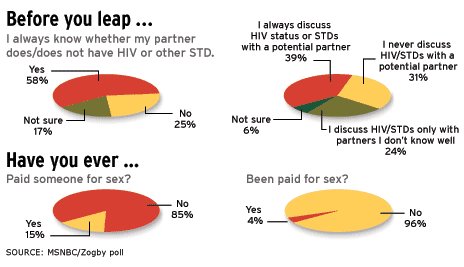
"Have you had an AIDS test?"

Have you ever asked that question? It's not nice to ask, because it can kill the moment, and spoil the fun. But then, so can AIDS.

Men tend to think they would never catch something from a woman, he says.

Overall, adds Schachter, "it's a failure to come to grips."

Researchers weren't surprised that age, education and income influence sexual behavior.

While almost half of those with less than a high school degree never discuss STDs with a new partner, this group also was nine times more likely than college graduates to have paid someone for sex.

"The older you are and the more money you make, the less likely you are to engage in risky sexual behavior," says Fritz Wentzel, a spokesperson for Zogby.


'Sex is alive' in America
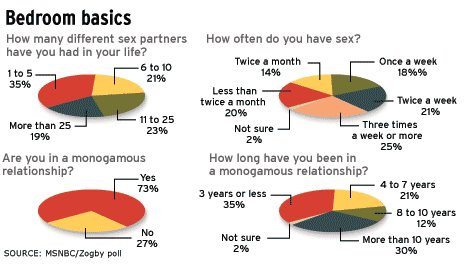
Most people who took the survey reported being in long-term monogamous relationships. But far from the stereotype that monogamy means the end of bedroom bliss, sex is a big part of their lives. Over 60 percent reported having sex within the last day or week.

Almost two out of every three couples are having sex at least once a week and a quarter report having sex more than three times a week, the survey found.

"Sex is alive and well in America," says Wentzel. "There are a substantial number of people who are having lots of sex."

In the survey, nearly 25 percent of men and and 13 percent of women reported having more than 25 partners in their lifetimes. Women were slightly more likely than men to have between six and 10 partners.

On the lower end, 34 percent of men and 38 percent of women say they've had one to five partners.

In comparison, according to the National Center for Health Statistics, a division of the Centers for Disease Control and Prevention, men ages 30 to 44 have had a median of six to eight sexual partners in their lifetimes; women have had about four.


"Alcohol and unprotected sex seem to spiral together," says Wentzel. "Unless you use your head when making these decisions, the more trouble you're going to get into."

Iraqi Sniper


Last night I downloaded a disturbing video clip (with audio) showing an Iraqi sniper picking off US soldiers. This means he had a long range scope fitted to a video camera in some way.
The sniper is a professional.
He positions himself from a great distance, based on the quality of the video, and foreground objects like leaves and pedetrians moving in front of the target. There are 10-20 clips (I didn't remember to count) in the 16 minute video showing US troops standing in front of Humvees or eating in the turret of an armoured car, or talking to a comrade before you hear the rifle engage. It's obviously a very powerful weapon because in every case the victim is blown off his feet. Even after taking his shot, in many cases the camera remains fixed on the activity afterwards.
Usually people start running, army vehicles immediately move away (when the soldier in the turret has been shot and collapses inside the vehicle), and soldiers on the ground scramble for weapons and attempt to get the injured soldier to safety. The video is not clear enough for it to be particularly gruesome. You can't see blood or clear facial expressions. But it is clear enough to see how dangerous it is to be a US soldier walking around in Iraq.
None of the video is in English, and there is no English text. You simply see Arab script and hear some kind've chanting soundtrack throughout. After each sniper attack, the video shows a picture of President Bush with a background of coffins draped in US flags. Obviously it is a propoganda message, possibly even a recruiting device.

I wouldn't advise other people to watch the video because what you're seeing is real people getting killed. That should not become part of our daily entertainment. As such I don't feel it's appropriate to post any images to explain or illustrate the text above.

The only useful thing this video communicates is the unmitigated reality and absolutely lethal nature of war. The text below seems flowery in comparison to the footage. War is real, and blood is red. An individual's living or dying in war is purely a matter of chance. As such we ought never to place ourselves, our lives, in such a game of chance and luck.

Attack on Insurgents Tests Iraqi Soldiers By ROBERT H. REID, Associated Press Writer
2 hours, 2 minutes ago


BAGHDAD, Iraq - About 3,500 U.S. and Iraqi troops backed by jets launched a major attack Saturday against an insurgent-held town near the Syrian border, seeking to dislodge al-Qaida and its allies and seal off a main route for foreign fighters entering the country.


U.S. officials describe the town of Husaybah as the key to controlling the volatile Euphrates River valley of western Iraq and dislodging al-Qaida in Iraq, led by Jordanian terror mastermind Abu Musab al-Zarqawi.

The U.S.-led operation includes about 1,000 Iraqi soldiers, and the offensive will serve as a major test of their capability to battle the insurgents — seen as essential to enabling Washington to draw down its 157,000-strong military presence.

Thunderous explosions shook Husaybah early Saturday as U.S. Marines and Iraqi scouts, recruited from pro-government tribes from the area, fought their way into western neighborhoods of the town, 200 miles northwest of Baghdad, residents said.

As fighting continued throughout the day, U.S. jets launched at least nine airstrikes, according to a U.S. Marine statement. The U.S. command said there were no reports of casualties among American or Iraqi forces.

However, the military said Saturday that three more U.S. troops had been killed elsewhere in Iraq.

One soldier was killed Friday by small-arms fire south of Baghdad, and another died the same day when the vehicle in his patrol was hit by a mine near Habaniyah, 50 miles west of the capital. The third soldier was killed Saturday in a traffic accident in southern Iraq.

Unrest Reaches Paris; 13 Cars Torched


By ELAINE GANLEY, Associated Press Writer 1 hour, 21 minutes ago

PARIS - The urban unrest that triggered scores of arson attacks on vehicles, nursery schools and other targets from the Mediterranean to the German border reached Paris overnight, with police saying early Sunday that 13 cars were burned in the French capital.

By 1 a.m., at least 607 vehicles — including those in Paris — were burned during the 10th night of violence, said Patrick Hamon, spokesman for the national police. The overall figures were expected to climb by daybreak, he added.

The violence — originally concentrated in neighborhoods northeast of Paris with large immigrant populations — has spread across France, extending west to the rolling fields of Normandy and south to resort cities on the Mediterranean. Attacks were reported in Cannes and Nice.

In the Normandy town of Evreux, arsonists burned at least 50 vehicles, part of a shopping center, a post office and two schools, Hamon said.

Five police officers and three firefighters were injured battling the blazes, he said.

The unrest is forcing France to confront long-simmering anger in its suburbs, where many Africans and their French-born children live on society's margins, struggling with unemployment, poor housing, racial discrimination, crime and a lack of opportunity.

Police deployed a helicopter and tactical teams to chase down youths speeding from one attack to another in cars and on motorbikes. Some 2,300 police were brought into the Paris region to bolster security, France-Info said. More than 250 people were arrested.

The violence erupted Oct. 27 following the accidental electrocution of two teenagers who hid in a power substation, apparently believing police were chasing them.

The anger spread to the Internet, with blogs mourning the youths.

Along with messages of condolence and appeals for calm were insults targeting police, threats of more violence and warnings that the unrest will feed support for France's anti-immigration extreme right.

"Civil war is declared. There will no doubt be deaths. Unfortunately, we have to prepare," said a posting signed "Rania."

"We are going to destroy everything. Rest in peace, guys," wrote "Saint Denis."


Implications Of Climate Change


In the Amazon river region, one of the worst droughts ever recorded is damaging the world's largest rainforest, with wildfires breaking out, fresh drinking water becoming scarce and polluted and the death of millions of fish as the streams dry up.

"For human health, malaria is clearly danger number one, killing 3,000 African children every day," he told IPS. "This is a dramatic increase from the 1950s and '60s, when we thought we could control and contain this disease and the numbers were really dipping."

Malaria is spreading increasingly in highland areas in Africa. Before the 1970s, cold temperatures became freezing at high altitudes and thus limited mosquito populations to lower areas. Today, increased warmth has caused mountain glaciers to shrink in the tropics, permitting some mosquitoes to migrate higher in the mountains.

For 1999, the report estimates that in sub-Saharan Africa, the total cost of malaria can be valued at between 5.8 17.4 percent of Gross National Product. Malaria has also been shown to decrease economic growth in some countries by 1.3 percent per year.

In addition, West Nile virus, Lyme disease and asthma are also on the rise. "Carbon dioxide is affecting the plants, spores and fungi. (It has) an impact on public health that we had not even thought of several years ago," says Epstein. "In the U.S. alone, asthma prevalence has quadrupled since 1980, which costs the American taxpayer up to 18 billion dollars a year."

Korea develops hydrogen container for fuel-cell cars

A new type of hydrogen storage container received approval from the U.S. Department of Transportation in September and is now commercially available, the Ministry of Science and Technology said yesterday.
The new container was developed after a two-year joint effort between a local research institute and a company which specializes in producing composite high-pressurized containers.

The Korea Institute of Machinery and Materials and Innocom Co. said that they succeeded in commercializing a composite high-pressurized hydrogen storage container - the world's second following the United States.

The hydrogen storage container, normally used in portable air breathers and natural gas vehicles, has received plenty of global attention since its use has expanded to hydrogen fuel-cell cars for use as the hydrogen fuel tank.

"A composite type of container has advantages compared with the steel container in terms of weight and safety," said Dr. Park Ji-sang of KIMM who participated in the development project.

"This container, surrounded by carbon epoxy composites, will not burst, unlike a steel one. Hydrogen will leak out of the vessel before bursting."

Up to now, the technology for producing composite high-pressurized containers was exclusively used for aerospace and military-industrial purposes in the United States.

The U.S. Department of Transportation's approval certifies the trustworthiness of the newly developed container, the Ministry of Science and Technology said.

KIMM and Innocom Co. said their composite high-pressurized containers for hydrogen fuel-cell cars will hit the local market next year.

The government envisions mass producing pollution-free hydrogen fuel-cell cars from 2010.

(siyoungh@heraldm.com)


By Hwang Si-young

Saturday in Seoul

This morning I spent about an hour coughing...painful, chest scrubbing barks...tiny red dots were spraying out with everything else. I took a Tylenol which went to work about half an hour later, and knocked me out for most of the day.

After 5pm I went into Seoul with Corneli. On the bus we caught up on the latest gossip, and had quite a good laugh at all the antics going on amongst the expats here.
We started at Yongsan (it was open on a Saturday night until past 8pm). We quickly found what I was looking for; a gift for my girlfriend. I think it's a cool gift and I'm sure she's going to be thrilled with it. (Corneli bought her something else earlier in the day).
Yongsan station looks awesome. They've upgraded it magnificently, and brought the electronics market much closer to the station. It's a sensible development, and quite stylish too...its a vast improvement on the previous setup...although when you've seen one square glass space filled with cameras, you've seen them all, and there are hundreds of the same sort of shops. Of course Yongsan is more than just cameras and MP3 players.
I've been advised by my Korean friends that it is still cheaper to buy things at Yongsan than at duty free airports (in Incheon or Hong Kong). I wonder if that's true. Anyone know for sure? I can certainly believe it though.

Although the Tylenol had me feeling quite unsteady on my feet, Corneli and I went from there to a bookshop in Itaewon (CLOSED) and then grabbed an excellent dinner in La Tavola (http://www.seoulstyle.com/itae_latavola.htm)...an Italian restuarant just below Hollywood. I said I didn't want to eat at Gecko's or Outback, I wanted to try something different. Well we walked around quite a bit, found some too expensive restaurants, and other restaurants were closed, and one wasn't a restaurant at all. La Tavola was perfect for what we wanted tonight. After ordering we were served a portion of warm bread and a vinegar/oil dip; a nice touch.
Our food was just bursting with flavor; I had a salmon pasta, and Corneli had a delicious chicken and vegetable meal. We exchanged bites, and both meals were exquisite. The wine was alright, any heavier and I would have been in trouble. La Tovola is a little expensive; my bill came to W29 000. If you're after a comfortable and enjoyable dining experience, La Tovola has a lovely atmosphere, good service, excellent food. For a special occasion it's well worth it.

Sohnjoo and Minjung joined us at La Tavola, and Jo arrived just after they did. We had a good chat and then went on to The Bangalo, which is right beside 3 Alley Pub. On the way there we were luck to spot a second hand book store called Abby's Book Store (I think). I got about W18 000 for the ten books or so that I wanted to get rid of. I might go back and sell them my Harry Potter book. She said she'd give me W6 000 for it (one third it's resale price).
The Bangalow was cosy. I took off my shoes and socks and dug my feet into the soft sand, finding it surprisingly warm. I think there is a kind of underfloor heating in the sandpit area...and the waittress helped me choose a cocktail. Jo and Corneli were fussing over Jo's engagement ring, a real eye-catching gold and diamond sparkler. Jo said it's worth about R2000.
I see.
Corneli was trying it on to see how it looked...
Interesting...
Jo recognised a girl from her Salsa class, who was part of a big birthday party right beside us.

We went our separate ways shortly after 11pm, and Corneli and I managed to catch the last 0015 bus to Gwanghamun. On the bus I saw that Seoul Station's refurbishments are finished too. It's looking just as slick as Yongsan...the sort of station you'd expect when you get on and get off Korea's high speed KTX.

We had to change busses at Gwanghumun again, and we met a Kiwi guy called Jim, who has been in Korea for 5 years, and is a qualified lawyer. We had an interesting chat about rugby and life in Korea. He said he might be leaving Korea soon as well. I was feeling pretty tired so after I'd seen the 5th or more bus number 1000 zoom by us, I finally said, "I'm going to catch the next 1000 bus."

Which is what we did. The evening worked out very well, and it was a nice way to share time with Corneli, who has been a close friend for as long as I've been in Korea

When I got home I called my girlfriend. She says the OFM Classic (a bicycle race) is tomorrow. She is also excited to hear that we've been buying presents for her. She said she bought me a blue toothbrush and a hairclipper (quite a while ago). Looking forward to giving those a test drive.
But more than than that I'm looking forward to...well, I'll leave it to your imagination...

Saturday, November 05, 2005

Alert


Preamble
One of the themes of this blog is the theme of 'Awakening'. Serious things are happening in the world, and do you know about them; do you even care? What is important to you?

Some events, like riots in Paris and riots in Argentina may seem to be irrelevant to you. It's actually all relevant, because the world is a complex system, and we're part of that system. We're effected by the economics of it, the climate, the prevailing philosophies about lifestyle, government, how we engage other countries etc.

One of the philosophies of our time, is that the average person is seen as a 'consumer'. Someone who consumes (rather than produces something meaningful). You and I are locusts. That's our job.
We're actually enlightened beings, or ought to be. If we were awake we would not be sleepwalking into a series of real horrors, a nightmare we will unfortunately find whether we're asleep or finally awakened to the reality of our lives. I'm sorry that it doesn't sound better. But you can't spin it any other way.

Example
I have been following H5N1 for months, and I can tell you (based on news reports)it's not only spreading, but accelerating. I would not be suprised if this winter, the virus finds a way through to an efficient re-combination (with a human flu), which would launch the pandemic at the end of 2005, or early next year, and this process would last for several months.

I personally was worried about this much earlier on, predicting that the human flu season (when it gets cold in the Northern Hemisphere) would make animals and people both more vulnerable to disease. That, in addition to the movements of birds (also based on seasonal weather changes) seems to be the engine behind the spread of these infections, and will continue to be for some time.

What we know so far is H5N1 was in Korea in 2003. It's now the end of 2005, and it has been picked up from Japan to Britain, and almost everywhere in between. Over the next few weeks that spread will be north to south, instead of east to west.
It's hard to say where the worst outbreaks are likely. I would guess that China faces a serious risk to its population, as does India and Russia.
Once it reaches Africa it will be able through large areas without detection, simply because Africa has less infrastrucutre than any other continent, and its people are the most vulnerable disease because they are already malnourished, suffering from AIDS and impoverished.

Richard Branson has ordered 10 000 vaccines, and Bush is spending $7 billion to protect Americans. These are not the kind of actions from individuals who expect Avian Flu to be a long or even medium term event. I believe that sensible people are seeing the signs, and the signs indicate the Pandemic is already here. It's starting. I am not trying to frighten you, by telling you this. The last thing we need is a worldwide panic. But people out to begin to mkae preparations now, and get where they ought to go as soon as they can make those arrangements. Airlines will be the first system to shutdown, so we need to be aware of that.

Actually ponder this for a moment. Think about it as a very real likelihood in the coming days and weeks. Then make a decision. Remember, not making a decision, is also a decision. It's a decision, your personal decision, to wait and see.
If that's what you decide to do, I hope you're right. And good luck. My decision is not to wait and see.


Indonesia: Two new human bird flu cases
Number of human deaths in country climbs to five

Saturday, November 5, 2005; Posted: 1:26 a.m. EST (06:26 GMT)

JAKARTA, Indonesia (CNN) -- A woman who died last month in Indonesia was suffering from the deadly H5N1 strain of avian influenza, health officials said Saturday, and an 8-year-old relative has tested positive for the disease.

Indonesian officials received confirmation of the positive test results from the World Health Organization lab in Hong Kong, said Health ministry official Hariadi Wibisono.

The woman died October 28, and samples were sent for testing afterward, Wibisono said.

Children who had come in contact with the woman were taken to a hospital with flu-like symptoms, and the child has tested positive for the strain, but is in stable condition, Wibisono said.

The latest reports bring the number of human bird flu cases in Indonesia to nine since July. Five of those have been fatal.

The disease has spread rapidly among birds, first in Southeast Asia and more recently in Europe.

Japanese health officials said Friday signs of bird flu were found among a flock of 300,000 chickens, but tests had not yet determined whether the strain is the deadly H5N1.

A day earlier, China reported 8,940 chickens in the country's northeast died of the fatal strain, prompting authorities to destroy another 369,900 birds. It marked the country's fourth H5N1 outbreak in just three weeks. (Full story)

The H5N1 strain has infected more than 120 people and has proven fatal in half those cases.

Earlier this week, United Nations Secretary-General Kofi Annan called on the international community to make immediate preparations for a possible pandemic of bird flu.

While it is not yet clear if the H5N1 strain will ever gain the ability to infect large numbers of people, Annan said world leaders cannot ignore the threat it poses. (Full story)

On Friday, Vietnam also confirmed more bird flu outbreaks among poultry in three villages, according to The Associated Press.

Earlier, the World Bank highlighted the potentially huge human and economic costs from any bird flu pandemic, while the Asian Development Bank (ADB) said such an outbreak could push the world economy into recession, Reuters reported.

The ADB said a year-long shock from bird flu in humans would cost Asian economies as much as $283 billion and would reduce the region's gross domestic product by 6.5 percentage points, hitting Hong Kong and Singapore the most.

CNN's Kathy Quiano contributed to this report.

How To Stop Bush


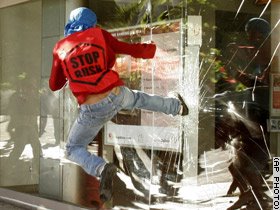
'Stop Bush', yes but this guy's going about it the wrong way. If civil society becomes violent, government forces will simply crush them (police/military).
The way to do it is through mass protests, mass communications, lobbying policitians and senators, forming groups and forums who share similar goals (and not necessarily the same political philosophies)and civil disobedience (strikes). Violence simply takes us all to the same base level...we all become animals.
 Posted by Picasa

Rioting Spreads Beyond Paris Suburbs

Rioting Spreads Beyond Paris Suburbs As Unrest Enters Second Week,
U.S. Cites Danger to Tourists


By JAMEY KEATEN Associated Press Writer

AUBERVILLIERS, France Nov 5, 2005 — Marauding youths set fire to cars, warehouses and a nursery school and pelted rescuers with rocks early Saturday, as the worst rioting in a decade spread from Paris to other French cities. The U.S. warned Americans against taking trains to the airport via strife-torn areas.

A savage assault on a bus passenger highlighted the dangers of travel in Paris' impoverished outlying neighborhoods, where the violence has entered its second week.

Attackers doused the woman, in her 50s and on crutches, with an inflammable liquid and set her afire as she tried to get off a bus in the suburb of Sevran Wednesday, judicial officials said. The bus had been forced to stop because of burning objects in its path. She was rescued by the driver and hospitalized with severe burns.

Justice Minister Pascal Clement deplored the incident, saying it caused him "great emotion."

Rioters burned more than 500 vehicles Friday as the unrest grew beyond the French capital for the first time. Unrest returned to the streets in the evening and early Saturday, the ninth night in a row.

Police said troublemakers fired bullets into a vandalized bus and burned 85 more cars in Paris and Suresnes, just to the west. In Meaux, east of Paris, officials said youths stoned rescuers aiding someone who had fallen ill.

Meanwhile, warehouses in Suresnes and Aubervilliers, on the northern edge of Paris, were set ablaze. Officials said other fires raged outside the capital in Lille, Toulouse, and Rouen, while an incendiary device was tossed at the wall outside a synagogue in Pierrefitte, northwest of Paris.

Some 30 mayors from the Seine-Saint-Denis region where the unrest started Oct. 27 met Friday to make a joint call for calm. Claude Pernes, mayor of Rosny-sous-Bois, denounced a "veritable guerrilla situation, urban insurrection" that has taken hold.

A national police spokesman, Patrick Hamon, said there appeared to be no coordination among gangs in different areas. But he said youths in individual neighborhoods were communicating by cell phone text messages or e-mails arranging meetings and warning each other about police operations.

Tired of globalisation


 Posted by Picasa
Globalisation sounds like a good idea. It would be if co-operation was the motive behind it; an altruistic type of co-operative system. But it's far from that. Globalisation has some elements of co-operation, of course. Most of these are legal arrangements, and economic arrangements (such as common curriencies and trade systems). In reality, it's really just an aberration. And although the world is racing towards globalisation, it is racing towards a concept that has no future.
It's like a couple pouring their money and investments into a holiday home in a foreign country. For a while it's good. The holiday home earns rental income for a while, and provides a place for further investment. So they decorate, and furnish and travel to their faraway home. It creates local demand. But further down the road, the costs to use the house, the costs to get to the home, the costs of one's own home, make it an unsustainable arrangement. After that it becomes difficult to dispose of the investment, because everyone else is trying to do the same thing, and local resources are minimal.
What are these future costs? They're the costs associated with Peak Oil. Peak Oil will undo globalisation, and reverse the efficiencies we see in the world into proportionate inefficiency. The globalised world is less a system of co-operation, than a competitive, profit-seeking system addicted to oil, and very dependent on long range sustaining systems (Wal-Mart's supply chains from China, Zimbabwe consuming grain grown in Kansas).
When these systems disintegrate, local vacuums are exposed, and these leave large numbers of the global population vulnerable to food and other shortages. This is the worst risk associated with globalisation - dependence on the importation of food. But there are others: globalisation provides thoroughfares for terrorism and disease, and the transmission of instability to each and every thing connected to this system.

It's nevertheless easy to be a proponent of globalisation. Globalisation sounds good. No borders, no boundaries. Free trade. But the reality is quite different. It's only free for big corporations and multinationals. The trick is to try to engender co-operation instead of competition. But in a free market, given the profit motive, this is not easily achieved. Ordinary citizens experience the so-called freedoms of globalisation through common currency, for example in Europe. Travel is also easier in some cases.
The ideals of this concept aren't bad, but pursuing globalisation ignores the severe problems it causes.
- worsening divide between rich and poor (not only individuals, but countries, especially Third World countries)
- outsourcing of jobs (example: auditing jobs and basic call centre services outsourced to India, and Bangladesh)
- outsourcing of local production (example: McDonald's and Starbucks replacing local restaurants and coffee shops on a global scale)
- increased vulnerability to outside instabilities (including increased vulnerability and connectivity to war. Globalisation leads to the building and then destruction of Empires. The Roman Empire, British Empire and German's attempts at an Empire are all examples of failed attempts at globalisation).
- unsustainable

In any event, many activites in the world are based around the concept. Much of today's growth and economic activity is fuelled around the globalisation trend.
In Asia, the demand to learn English is incredible, simply because the demand for business and trade on a global scale (especially with English speaking countries) is incredible. Unfortunately, due to future fuel costs, this trend (that's all globalisation is, a trend) is not likely to continue for much longer.

We'll see more and more problems associated with globalisation, and we'll read more articles like this one below, saying why we should continue on our road to nowhere.
What we ought to do is encourage and support local comptencies, including the local production of food.

Nov 3rd 2005
But trade liberalisation and other forms of openness are needed more than ever

FREDERIC BASTIAT, who was that rarest of creatures, a French free-market economist, wrote to this newspaper in 1846 to express a noble and romantic hope: “May all the nations soon throw down the barriers which separate them.” Those words were echoed 125 years later by the call of John Lennon, who was not an economist but a rather successful global capitalist, to “imagine there's no countries”. As he said in his 1971 song, it isn't hard to do. But despite the spectacular rise in living standards that has occurred as barriers between nations have fallen, and despite the resulting escape from poverty by hundreds of millions of people in those places that have joined the world economy, it is still hard to convince publics and politicians of the merits of openness. Now, once again, a queue is forming to denounce openness—ie, globalisation. It is putting at risk the next big advance in trade liberalisation and the next big reduction in poverty in the developing countries.

In Washington, DC, home of a fabled “consensus” about poor countries' economic policies, a bill before Congress devised by one of New York's senators, Charles Schumer, threatens a 27.5% tariff on imports from China if that country does not revalue its currency by an equivalent amount. In Mr Schumer's view, presumably, far too many Chinese peasants are escaping poverty. On November 4th George Bush will escape the febrile atmosphere along Pennsylvania Avenue by visiting Argentina to attend the 34-country Summit of the Americas. There he will be greeted by a rally against “imperialism”, by which is meant him personally, the Iraq war and the Free Trade Area of the Americas which he espouses. Among the hoped-for 50,000 demonstrators will be Diego Maradona, who as a footballer became rich through the game's global market and as a cocaine-addict was dependent on barrier-busting international trade; and naturally his fellow-summiteer, Hugo Chávez, who is using trade in high-priced oil to finance his “21st-century socialism” in Venezuela.

Advertisement Click here to find out more!

All, perhaps, the normal fun of a Latin American visit. Last week's Latinobarómetro opinion poll revealed that whatever the protesters may say, a clear majority in all the region's countries favour a market economy rather than a closed, state-directed one—even in Venezuela (see article). This is, however, a difficult moment for the market economy and for relations between rich countries and poorer ones, for the Doha round of trade-liberalisation talks under the World Trade Organisation are in trouble. When it began in 2001, the round was billed as a big effort to boost growth in poor countries, and the lowering of barriers to food trade was placed at its centre. In the past few weeks, however, a fairly bold American proposal for reducing its farm protection has been greeted by a much weaker response from the European Union and none at all from Japan. And ministers from Bastiat's own country, France, have vied with one another to denounce all talk of further reform to the EU's common agricultural policy. Europe must, they say, remain an “agricultural power” even at the expense of the taxpayer and the poor, and, according to President Jacques Chirac, must fight back “liberalism”. Whatever happened to Liberté, Egalité, Fraternité?

The world will find out, to some extent, next month when ministers from the 148 countries in the WTO meet in Hong Kong. The last time they gathered for such a crucial meeting was in September 2003 in Cancún, and the result was a shambles. There was a bitter row between rich countries and poor ones, and the meeting broke up in acrimony. At that stage, however, there was still plenty of time to repair the damage. For in effect the deadline for the Doha round comes in June 2007, when the trade-negotiating authority granted by Congress to President Bush expires. But, although that leaves more than a year and a half after Hong Kong, the complexity of a negotiation involving 148 countries and scores of highly technical issues means that the deal really needs to be done during 2006, with the political framework for it set early on—which essentially means in Hong Kong.
The case for selfish generosity

Trade-liberalisation rounds are arcane affairs about which free-traders are often thought to cry wolf. The previous talks, known as the Uruguay round, went through lots of brinkmanship and delays before they were completed. The result was still disappointing in many ways, especially to developing countries, and yet since the round's completion in 1993 the world economy has grown lustily and the biggest developing countries, China, India and Brazil, have all burst on to the global trading scene. Would the world really be hurt if the EU merely refuses to expose its farmers to more competition?

The likeliest outcome both from the Hong Kong meeting and the eventual Doha agreement is a compromise—as always. The European position is feeble but not risible, for it has offered an overall average cut in its farm tariffs of 39%, up from 25% only a month ago, though with rather a lot of loopholes that could severely limit the benefits. France, and other European farm protectionists, may prove more flexible than they currently imply: this is hardly the first time they have promised to man the barricades shortly before striking a deal. Yet though some sort of fudge in Hong Kong must be likely, with the Americans lowering their ambition and the Europeans raising theirs a little, such an outcome would still represent both a missed opportunity and a risk.

The missed opportunity is that Doha has offered the first proper chance to involve developing countries in trade negotiations—they now make up two-thirds of the WTO members—but also thereby to use a full exchange of agricultural, industrial and service liberalisations to make a big advance in free trade that could benefit a wide range of countries. Some of that progress may still be made, even in a fudged deal: Brazil, for example, stands to benefit hugely from freer trade in agriculture (see article), so it should be willing to promote other concessions in return. India is reluctant to cut its own farm tariffs but has a big interest in liberalising trade in services, wanting more freedom in everything from finance to health care to entertainment. But if the rich world could gird itself to be more ambitious on agriculture the gains would be even greater: help for the poorest countries, making the rich look generous; better access to the biggest and richest developing countries for western companies; and a rise in global income in a decade's time of $300 billion a year (says the World Bank), which would thus help everyone.

The risk is that failure to agree on a new wave of openness during a period (the past two years) in which the world economy has been growing at its fastest for three decades, with more countries sharing in that growth than ever before, will set a sour political note for what may well be tougher times ahead. A turn away from trade liberalisation just ahead of an American recession, say, or a Chinese economic slowdown, could open up a chance not just for a slowdown in progress but for a rollback. Currently, for example, the Schumer bill to put a penal tariff on Chinese goods looks unlikely to pass. If American unemployment were rising and world trade talks had turned acrimonious, that might change. So might the political wind in many developing countries.

If so, that would be a tragedy for the whole world. Although the case for reducing poverty by sending more aid to the poorest countries has some merit, the experience of China, South Korea, Chile and India shows that the much better and more powerful way to deal with poverty is to use the solution that worked in the past in America, western Europe and Japan: open, trading economies, exploiting the full infrastructure of capitalism (including financial services—see our survey on microfinance) amid a rule of law provided by government. In other words, globalisation. To paraphrase Samuel Johnson, anyone who is tired of that is tired of life.

Friday, November 04, 2005

1 472


I'm starting to wonder how Harry is ever going to get Slughorn to confide his dark secret to him.
Was tough to go to school today. Still felt very weak, body aching, and unable to really speak without both croaking and squeaking.

School was quite ordinary. Didn't get a heartwarming sense of 'where were you teacher', except from a couple of students. I asked the kids who taught in my place yesterday and they said, without exception, the director. I asked 'what he taught' and they said he read them a religious story, in Korean. Now he can speak a bit of English, and the parents he cares so much about, are paying for their kids to learn English....couldn't help chuckling at that information. I brought it up later at our meeting, where I accused him of scamming the parents, taking their money and not doing what the school's supposed to be doing: get the kids to learn English (see below).

The meeting this evening was a real triumph. Curiously, last night I happened to download Tony Robbins (Lessons in Mastery) and found myself listening to it this morning, dreary eyed, in the bus.
I only listened to a piece, but I think it gave me a boost for the whole day. It was about identity, and that control over one's own self, what goes on inside us, is the power we have over ourselves and our world. What goes on beyond that is far less important.
I also read my diary, from 2002, and realised to what extent I'd come to Korea with a really positive attitude, and lots of enthusiasm, and just how, over a period of time, I had to deal with a lot of weirdos and assholes, both koreans and foreigners. Mostly in the hagwons. I really think these jobs attract a strange, insecure, and not entirely rational, subset of society. And hey, I'm the first to admit, I'm part of this group whether I like it or not. I don't like it, of course, which is why very soon I'll no longer be identifiable as part of it.

It was good to play the director at his own game, and wear him out, even though I was tired, I was sick and I was unhappy. I feel a much clearer sense of purpose, a much more certain sense of what I'm doing, than I felt on Thursday, when I started feeling a sense of appreciation for having a job in the first place. I think that was an attempt to stay in a comfort zone. I think being ill, it's easier to feel like that's the best thing.

I still feel feverish and icky, but felt pretty happy after work. Must have showed on my face 'cos more than one Korean girl caught my eye and some smiled at me, one girl even said, "Hello."
I called Corneli from Sandpresso and she came over (from having a shower) to hear my story - I'd called her just before my meeting.
Then she ran off for chicken at Allalie, and I bumped into Andrea and Liz. We had a long conversation that took us all the way in and out of the Nike store. We made plans to maybe go bowling on Sunday.

So I'm in a good place, mentally. I've defended myself in these situations before, and won. I got scammed out of money at Farmovs and after a meeting they paid me out in full. I took a company that fired me to the Labor Board in South Africa and got a R5 000 payout (a lawyer later said I could have got R10 000). And so on and so forth. But it's also true, that I've not always won, and it's important to pick your fights. I picked this one, and came out on top, and it's a feather in my cap after six months here. People teach you how to treat them, and you teach them how to treat you. It seems I have learnt something here after all.

I'm a Lawyer, not a Teacher


(Click on the title above to link to an audio clip)

Today my bozo boss called me into the regular Friday-night-before-payday meeting. I knew he was going to try to shuck me out of my salary. If you're working in Korea (or anywhere in the Far East), here's a good example of how to deal with a boss who is an asshole. And you don't even have to be a lawyer...

Actually, you know I started my university education with a law degree, and after I changed to a Commercial Degree I still studied Commercial Law. Law of course is not just knowing about what's fair and reasonable, it's being able to argue convincingly (whether what you're arguing is completely rational or not). Of course the best arguments are reasonable and rational. Anything that is self-evident needs no defense.

Back to reality. Here's the context. My pay day is the middle of next week, and I have come back to work after taking a day off sick. Although I worked today I am still suffering from a high fever, headaches, body ache and general malaise.
So my esteemed colleague graciously invites me into his office. I deferred, by calling a friend first...who had invited me to dinner. This wasn't contrived, but of course, him asking me to join him in a meeting, and me first making a call, shows that his power is not to be taken for granted, I'm showing that it's being called into question.

So the next thing I'm in his office and as I'm about to sit down, he says, "Close the door."
He starts off by pulling a face and seeming extremely upset, disappointed and annoyed. He tells me many, many parents are complaining about me, are unhappy about me. This is obviously embarassing, discomforting and disturbing. I care about the job I'm doing, I care that I'm proving my students with a meaningful experience. So I am hurt and stung by this.
I ask him about these upset parents, and he tells me they came to see him yesterday when I was sick. He said they wanted to talk to me, but I wasn't there. This sounds a little dodgy...but I say, "You know, I'd like to speak to the parents."
He's like, "No no no, they are very angry. VERY angry with you."
So I say, okay, well then let me understand what I did wrong and I can talk to them and apologise. He blinks at me.
I explain: "Yes, I can say, what did I do, okay, okay, right, I'm sorry..."
He shakes his hands at me and says, "No,no,no...They don't understand English..."
Now I'm onto him. I suggest his fiance translate for us, and I impress upon him that I want to meet them...


By now it's clear what he's doing, because he's done it before. He's manufacturing complaints, a mixture of likely and ludicrous material, and then once he's showed me what a bad teacher I am, he says, "So, this is what I'm paying you this month." But I can already see a white sheet of paper with numbers on it, and I can already see the punchline. Why Jim, you're such a funny guy.

Some background: In my very first week he cut about W7 000 from my salary, saying he forgot to add a decimal to the amount taxed on my salary. He called me at home to ask if that was okay. Subsequently, we've had a handful of meetings, all on friday nights when I'm about to go home, always featuring complaints and then featuring the money related punchline. He tried to get W100 000 for my Japan ticket (and I negotiated W50 000 back).
He'd also asked me to slice W200 000 off my salary because by then I was working an hour less a day than when I started, and I immediately accepted that, although the contract says the working time and salary can't be changed. But that particular meeting seemed reasonable so I accepted that.

Today he wanted to slice double that - W400 000 (or about R2 000) from my salary. His rationale was based on, as far as I could tell, the fact that I didn't work yesterday, and then his list of grievances.
I told him I was sick for one day (equivalent to about W100 000 pay - or R500), not 4 days. And I came to work today, even though I was sick, to help him. I said, "I'm here, helping you."
Then he complained about the parents again.
Frankly, I am not at all sure the parents he's talking about are real. I think he's hallucinating, or he's been watching too many movies. I wonder if he's ever watched A Few Good Men?

Me/Lieutenant Kaffee:
What kind of school are you running here? Disneyland? Answer the question.
Direcor/Jessep: You want answers?
Me/Lieutenant Kaffee: I think I'm entitled to them.
Direcor/Jessep: You want answers?!
Me/Lieutenant Kaffee: I want the truth.
Direcor/Jessep: You can't handle the truth.
Son, here in Korea we have to teach children about icecream, and candy, and how to have fun. This job is an important responsibility, and can only be done with God and gum. Who's gonna do it? You? You, Montesori? I have a greater responsibility than you can possibly fathom. You weep for your Won, and you curse the bad English books. You have that luxury. You have the luxury of not knowing what I know -- that children learning nothing, while tragic, probably saved lives; and my existence, while grotesque and incomprehensible to you, helps children have fun.

You don't want the truth because deep down in places you don't talk about at parties, you want me in this hagwon -- you need me in this hagwon.

We use words like "eat," "games," "fun." We use these words as the backbone of a life spent defending something. You use them as a punch line.

I have neither the time nor the inclination to explain myself to a man who rises and sleeps under the blanket of the very freedom that I provide and then questions the manner in which I provide it.
I would rather that you just said "thank you" for the little I pay you, and went on your way. Otherwise, I suggest you pick up an English book and stand the post. Either way, I don't give a DAMN what you think you're entitled to!
Me/Lieutenant Kaffee: Are you trying to cheat me out of money?
Director/Jessep: I am doing what any other --
Me/Lieutenant Kaffee: -- Are you cheating me?!"
Director/Jessep: You're god damn right I am!!!


I told him if the parents saw what these kids are allowed to do in class,things I try to discourage (but things he permits), they would be very unhappy. They would be unhappy to pay for sending their kids to his school, if they're allowed to eat food and slurp icecreams, be rambunctious, and obnoxious for the duration of lessons, to come in 20 minutes late for classes, etc. They are supposed to learn English, learn something. I said I am trying to teach English, I am trying to apply high standards, but the kids understand from him an entirely different set of standards. If they misbehave and I send them to him, he says, "It's okay, don't do it again."
He happened to step into a class as a kid said to me, "Teacher, you're crazy." That's fine of course, I have a sense of humor. He doesn't though. He makes his list of grievances and wants to cry about them every Friday before my pay day. Silly puppet.

Can YOU handle the truth, because you're about to get a monthful.

So here's what you do (here's what I did):
I wrote down on a piece of paper his amount, and put a cross next to it. And I said, "This is not acceptable."
Then underneath that I wrote something else, and said, this is acceptable.
We argued for about 40 minutes. During that time he complained of having no time, and having a headache. I said, "I have a headache. I am sick. I came to work today to help you." He obviously bargained on me being tired, and worn out, and that I've give in to his demands on a Friday night just so I could go home. He kept saying, "Just go home and think about it." I kept saying, "No, let's come to an agreement now."


So I took the issue to another level. Not everyone can be this hardball, because not everyone is willing to risk losing their home, and their job, in a faraway country. It's a kind've scary thing to undertake.
But you know, I am willing to risk this, and I made this clear. I said, "I've asked for this amount X. You're offering me Y. If you pay me Y, I am going to be very angry. I will want to leave this school very soon. You can start looking for a new teacher today, this weekend."
He was like, "No, no,no..." He assured me he hadn't called any agents etc.
I said, "But I want to help you. Even though I want to help you, I'm unhappy here, so once you pay me, I want to leave. You need to find a new teacher as soon as possible."
And then I stressed the point that him paying me the amount I asked for would make me more predisposed to staying until he found another teacher.
He picked up a Korean/English dictionary and pointed to the translation: impatient, irritated.
I didn't follow him there; was he saying I am impatient, or that he was. It was pretty obvious how we both felt. So not sure why he was pointing it out.

We agreed that even if a new teacher came next week, that would be fine with me and he could accept that. But he asked me not to tell the students that I'd be leaving soon. In this way, he pissed all over his own contract, where he required two months notice from me, and a month's notice from himself.

Finally he asked me to be 'kind and lovely', and then said, "Okay I'll pay X."

This crook tried to con me out of W400 000 (W300 000 if one accepts the sick day, but he gets paid whether I am at school that day or not), and I had to 'negotiate' my way just to get back to the original salary I should be paid anyway.

This was nevertheless an important victory.
1. It proves beyond doubt that this guy is a major asshole.
2. He nullified his own contract through his verbal admission that no notice was required, either from me or him (and I'd already given him my notice).
3. It's important to stand up for yourself at hagwon's, or be walked all over.
4. The strategy is: a number of 'issues' are raised against you. The point of this becomes clear, he'll justify these grievances by taking your money/giving you extra hours or extra work.
5. The idea is wear you down, especially after work on a Friday night. Don't let them.

Harry and his cohorts are Growing Up